


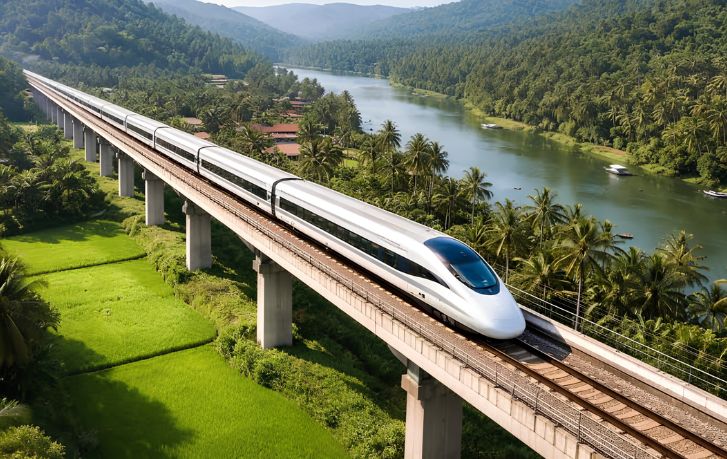
India’s 508-Kilometer Bullet Train Line Shifts Full Completion From 2022 to 2029
India’s first bullet train line presents a sharp schedule tension: the 508-kilometer Mumbai-Ahmedabad corridor was originally due for completion in 2022, but full completion is now targeted for 2029. The first passenger section, linking Surat and Vapi in Gujarat, is expected to open by December 2027.
That seven-year movement is consequential for prospective passengers, but Masafumi Shukuri, chairman of the International High-Speed Rail Association, disputes the idea that it can be treated as a simple delay. He points to the project’s scale, land-acquisition hurdles and disruption from the Covid-19 pandemic. His association has monitored the Indian project since 2014.
Shukuri, who also heads the Japan Transport and Tourism Research Institute, argued that even Japan would struggle to construct a comparable 500-kilometer high-speed railway within 10 years. That is his assessment, not an independently established construction benchmark. It nevertheless highlights why a 508-kilometer railway cannot be evaluated solely by counting years between its original and revised targets.
A corridor is more than its civil works
High-speed rail delivery requires bridges, tunnels, stations and track, but completing those structures does not by itself produce an operating railway. Trains, electrical supply, signaling, communications, maintenance systems, trained personnel and operating procedures must function as one system. Each interface has to be tested under the conditions expected in passenger service.
This systems-integration requirement is especially important because the rolling-stock plan has changed. Initial services are expected to use the B28, an Indian train being built by BEML in Bengaluru, while Japan’s E10 Shinkansen is not expected before 2034. The B28 is designed for 280 kilometers per hour and is expected to operate at up to 250 kilometers per hour on the corridor.
Those figures describe design and operating intentions, not proof that the train has completed the testing required for passenger service. Separate reporting indicates that extensive track testing is planned before deployment. Manufacturing progress on major subsystems is an important step, but vehicle readiness ultimately depends on validation of the complete train in its intended infrastructure and operating environment.
Shukuri said Indian rolling stock poses no inherent problem, while stressing the need for thorough testing and personnel training. He also raised a more specific long-term integration issue: in an interview about the corridor’s train and signaling plans, he said that safe operation involving two different rolling-stock and signaling systems would have to be demonstrated. Discussions over the eventual arrangement remain ongoing.
The first opening will be a limited but important test
The planned Surat-Vapi opening would not represent completion of the entire Mumbai-Ahmedabad system. It would instead place a priority section into service while construction and integration continue elsewhere. That phased approach can begin delivering operational experience earlier, but it also makes the distinction between opening one segment and completing the full corridor essential.
The priority section will test more than whether a train can move at speed. Stable passenger operations require trained crews, effective maintenance, reliable power and signaling, station procedures and demonstrated performance across the complete operating system. Shukuri’s defense of the construction schedule does not remove those requirements; it reinforces the point that high-speed rail is a coordinated safety system rather than a collection of independently finished components.
The 2027 and 2029 dates therefore remain targets rather than guaranteed opening dates. Their credibility will depend on construction progress, testing results, staff preparation and successful integration of the B28 with the corridor’s infrastructure. The later arrival anticipated for Japan’s E10 adds another future decision: whether and how the corridor will transition between train and signaling arrangements without compromising reliability or safety.
For passengers, the practical sequence is now clearer even if the final outcome is not assured: a Surat-Vapi service is expected first, using an Indian-built train, while the complete 508-kilometer route is targeted for 2029. The project’s next meaningful milestone will be proving that the initial train, infrastructure and operating organization work together safely before the first passengers board.
| More aerospace and engineering stories, right in your MSN feed. Follow AMI on MSN |
By Thomas Caldwell — AMI’s senior editor for mechanical and mobility engineering, covering vehicle electronics, systems integration, electrification, chassis systems, propulsion, and safety policy.



