


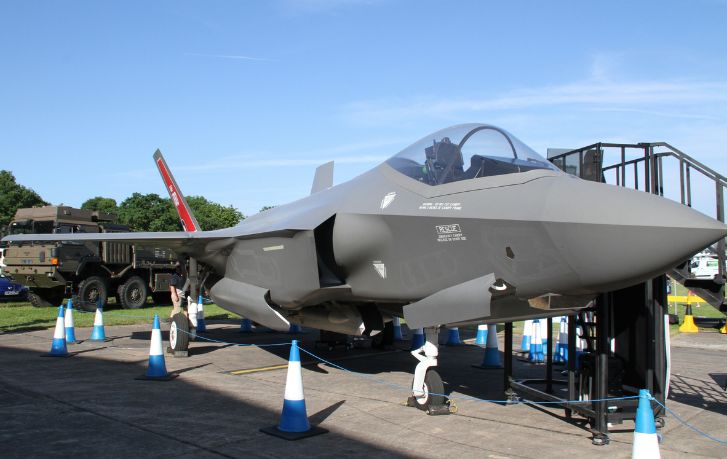
Missed UPS Email Let F-35 Canopy and Weapons-Bay Door Reach China
A UPS employee reportedly missed an email barring an F-35 parts shipment from transiting through Hong Kong. The mistake allowed a cockpit canopy and a weapons-bay door coated in radar-absorbing material to reach China, according to Bloomberg’s account of the incident.

The freight forwarder DSV A/S had emailed routing instructions stating that the components could not pass through certain countries under the U.S. International Traffic in Arms Regulations, commonly called ITAR. Those rules control the movement of defense articles and are intended in part to prevent sensitive U.S. military technology from reaching adversaries. A person briefed on the incident told Bloomberg that the UPS employee missed that warning.
The shipment was traveling from Australia to the United States for repair or disposal when it was diverted through Hong Kong months ago, according to The Associated Press. The precise shipment origin, intended U.S. destination and reason for the diversion have not been publicly established.
A commercial handoff defeated the routing restriction
The reported sequence is notable because the restriction itself was communicated. DSV sent a warning identifying prohibited transit locations, but that instruction did not prevent the carrier from routing the package through Hong Kong. In practical terms, a control protecting military components appears to have depended on a commercial-freight message being noticed and acted upon at the correct handoff.
That does not by itself establish a program-wide breakdown. It does show the difference between writing an export-control requirement and reliably enforcing it across a shipment involving freight forwarders, carriers and international transfer points. A routing instruction can be legally clear yet operationally ineffective if it is not embedded in booking systems, shipment holds or other processes that stop an incompatible route before departure.
The parts were not described as serviceable aircraft components. The F-35 Joint Program Office called them “unserviceable F-35 Lightning II components.” That status matters for maintenance and inventory purposes, but it did not eliminate the applicable handling restrictions identified in DSV’s email.
There is also a public disagreement over how to characterize the shipment’s sensitivity. Australian Defense Minister Richard Marles confirmed that the components reached Hong Kong but said his understanding was that they were not sensitive equipment or parts. Separately, the reported cargo included a canopy and a weapons-bay door with radar-absorbing material. The available accounts do not provide a formal technical assessment reconciling those descriptions, and they do not establish what, if anything, Chinese authorities learned from the components.
The investigation now has two jobs
The Pentagon and F-35 Joint Program Office are investigating the incident. The program office said it was working with U.S. authorities and industry partners to retrieve the components, determine what happened and install safeguards against a recurrence. Congressional staff on national-security committees have also received briefings, with State Department and Pentagon officials beginning those discussions in June, according to Politico.
Retrieval addresses the immediate shipment. Preventing another diversion requires a separate examination of how export restrictions move through the logistics chain. Investigators will need to determine whether the missed email was the only failed control or merely the last visible one, without assuming an answer before the shipment records and carrier procedures are reviewed.
Several basic accountability questions remain open. Officials have not publicly disclosed how long the components were in China, who possessed them, whether they have been recovered or what procedural changes have already been made. UPS, DSV and U.S. authorities have not provided a complete public reconstruction of the shipment’s route.
The next consequential milestone is therefore not simply confirmation that an email was missed. It is whether the investigation produces a documented route, a clear disposition for both F-35 components and a freight-control process capable of blocking restricted transit even when one employee overlooks a warning.
| More aerospace and engineering stories, right in your MSN feed. Follow AMI on MSN |
By David Whitaker — Associate editor for AMI’s aerospace and drone systems desk, translating flight systems, aircraft programs, spaceflight, and UAV developments into accessible technical stories.




