


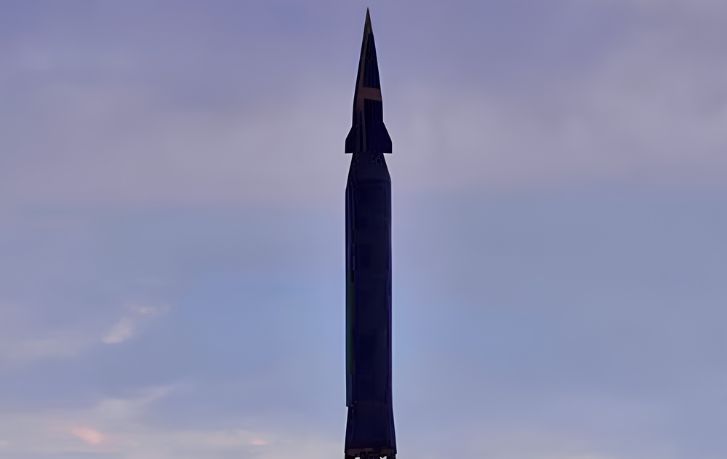
South Korea’s First Hypersonic Glide Test Hits Target, but Tracking Gap Remains
South Korea’s new hypersonic glide vehicle may be fast enough to compress an adversary’s response time, but speed cannot help it strike a missile launcher that has not been found. That is the central tension following the country’s first reported flight test of a domestically developed hypersonic weapon: the vehicle reached its offshore target, while the surveillance network needed to support such a system remains incomplete.
During the October 8 test, a booster reportedly carried the vehicle to its planned separation altitude. The glider then descended, changed course horizontally and vertically at low altitude, and struck the designated target. Reports said the flight verified guidance and control functions as well as ultra-high-temperature thermal protection. The government did not disclose the exact test location or detailed performance figures.
A meaningful flight result, not an operational declaration
Those test objectives matter because a boost-glide vehicle must survive and remain controllable across several demanding phases. It first rides a rocket booster to altitude, separates cleanly and then uses aerodynamic lift to maneuver through the atmosphere at hypersonic speed. Guidance must continue working as the vehicle’s attitude, velocity and surrounding airflow change.
Thermal protection is equally fundamental. Air compressed around a hypersonic vehicle produces severe aerodynamic heating, with particularly demanding conditions around leading edges and other high-load surfaces. Heat-resistant materials and structures must protect the airframe and internal equipment without adding so much mass that they compromise the vehicle’s range or maneuverability.
A target strike therefore represents more than a brief demonstration of raw speed. It indicates that the booster, separation sequence, flight controls, guidance and thermal-protection package worked together during this particular test profile. The reported vertical and horizontal maneuvers also suggest that engineers exercised the vehicle beyond a simple ballistic arc.
It does not, however, establish that South Korea has an operational weapon. The disclosed information provides no speed, range, accuracy, production plan, deployment date or schedule for another test. There is also no public indication of how the system performs across different trajectories or environmental conditions. Repeated flights would normally be needed to characterize reliability and confirm that hardware can be produced consistently rather than demonstrated once.
The larger system starts before launch
South Korea could eventually place the weapon within its broader “Three-Axis System,” the defense framework combining conventional counterstrike capabilities, air and missile defense, and retaliatory forces. A maneuvering hypersonic vehicle could expand the conventional options available to South Korean and allied planners, particularly where rapid response and penetration of defended airspace are priorities.
Yet the weapon is only the final part of a much longer chain. A credible time-sensitive strike capability also requires sensors to detect a potential threat, systems to identify and track it, communications networks to distribute that information, commanders to make a decision, and a launch platform ready to respond. Delay or uncertainty at any earlier stage erodes the advantage purchased by a faster vehicle.
That constraint is substantial on the Korean Peninsula. North Korea is estimated to operate 15 to 20 undeclared ballistic-missile bases protected by underground facilities, berms and reinforced structures. It also fields mobile launchers and solid-fuel missiles. Solid-fuel systems can remain at extended readiness because they do not require fueling immediately before launch, reducing the visible preparation period available to surveillance systems.
South Korea, meanwhile, has lacked a fully sovereign, persistent space-based intelligence, surveillance and reconnaissance architecture and continues to depend significantly on data supplied by the United States and Japan. Allied information sharing can provide important coverage, but dependence on multiple national sensor and command networks introduces institutional and technical demands that weapon speed alone cannot remove.
Faster weapons can also narrow decisions
The deterrence value is further complicated by escalation risk. North Korea’s 2022 nuclear-forces law provides for automatic retaliation if its central leadership is incapacitated. In that environment, systems designed to shorten strike timelines can coexist with pressure to make decisions more quickly during a crisis. The result may be a stronger conventional deterrent, but also less room to interpret ambiguous warning data or correct a mistaken assessment.
South Korea’s first domestic hypersonic glide flight is consequently a real engineering milestone: the reported target hit brought separation, maneuvering, guidance and heat protection together in flight. Its practical military value will depend on less visible work across testing, manufacturing, surveillance and command systems. Until deployment plans and follow-on trials are disclosed, the offshore impact confirms a promising vehicle not a complete counterstrike capability.
| More aerospace and engineering stories, right in your MSN feed. Follow AMI on MSN |
By David Whitaker — Associate editor for AMI’s aerospace and drone systems desk, translating flight systems, aircraft programs, spaceflight, and UAV developments into accessible technical stories.



