


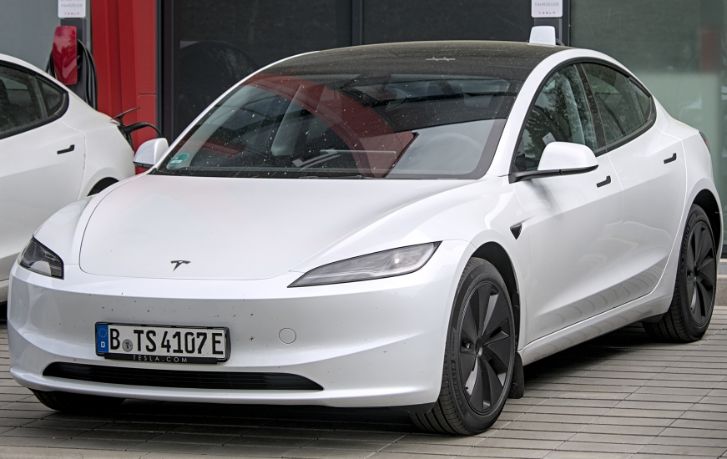
Tesla Model 3 Hits 250,000 Miles With Original Battery and Motors
At 250,000 miles, a former-taxi 2021 Tesla Model 3 Long Range reportedly still has its original traction battery and both electric motors. The heavily used car also retains an estimated or measured 84% of its original battery capacity, according to a case study conducted by Richard Symons, who operates a large used-Tesla showroom in the United Kingdom.

That is a notable result for a vehicle driven roughly 150 miles per day and accumulated in less than five years. It is not, however, a controlled fleet result or proof that other Model 3s will age the same way. Battery chemistry, charging behavior, climate, driving style and production variation can all affect the durability of an individual electric vehicle.
What remained original
The battery pack and electric motors are the most consequential original components because replacing either can materially change the economics of keeping a high-mileage electric car. The reported 84% capacity retention suggests a 16% loss from the battery’s original capacity, although that figure was not independently certified and the test method was not specified.
For context, Tesla’s current battery and drive-unit warranty terms list coverage of eight years or 120,000 miles for premium all-wheel-drive Model 3 variants, with at least 70% battery-capacity retention during the warranty period. The former taxi has traveled more than twice that mileage threshold while reportedly remaining well above the capacity floor. Warranty terms can vary by vehicle configuration and purchase date, so this comparison is a benchmark rather than a warranty determination for this particular car.
The car was said to deliver approximately 284 miles on a full charge under favorable summer conditions. That figure should not be treated as a fixed all-season range: temperature, speed, terrain, cabin heating and wheel or tire configuration can change the distance available from the same stored energy.
Reported performance also remained strong. The Model 3 accelerated from zero to 60 mph in 3.8 seconds. During an 11-minute Supercharger session, its state of charge increased by 30 percentage points and the display added 85 miles of indicated range. Those results show that the car remained usable for rapid charging and high power demand, but neither a single charging session nor one acceleration run provides a complete battery-health assessment.
One premature failure, plus ordinary wear
The only component identified as failing prematurely was the exterior speaker mounted in the front bumper, which was replaced. The other reported work involved wear items: six sets of tires, several sets of wiper blades and various bushings. The rear shock absorbers were upgraded to improve comfort, although the original units were reportedly still serviceable.
Six tire sets across 250,000 miles work out to substantial but unsurprising consumable use for a vehicle covering taxi-level distances. Tire life depends on compound, alignment, rotation, road conditions and acceleration habits, so that count cannot establish what another owner should expect.
More unusual is the claim that the original brake rotors, pads, brake fluid and coolant remain in the car. Regenerative braking can reduce friction-brake use by slowing the vehicle through its motors and returning energy to the battery. Low pad wear does not eliminate inspection requirements, however. Tesla’s Model 3 service guidance calls for a brake-fluid health check every four years and recommends periodic caliper cleaning and lubrication where winter road salt is used. Fluid condition and component age are different questions from whether replacement has yet proved necessary.
Efficiency needs operating context
During Symons’ ownership, the Model 3 reportedly averaged 4.15 miles per kilowatt-hour. That is a potentially useful efficiency figure, but the associated average speed was not disclosed. Without speed, route profile, weather, temperature and charging-loss information, it cannot support a broad comparison with other vehicles. Symons also reported no squeaks or rattles, which is an owner observation rather than a standardized body-integrity measurement.
Broader operating data reinforces why one high-mileage car should be treated as an example, not a forecast. A Geotab analysis covering more than 22,700 electric vehicles found average battery degradation of 2.3% per year, while also identifying meaningful variation with vehicle type, climate, charging power and usage. High daily energy throughput was associated with faster average degradation, and frequent high-power direct-current charging produced a larger penalty than predominantly lower-power charging.
This Model 3 therefore answers one important question narrowly: an intensively used electric car can pass 250,000 miles without necessarily replacing its battery or motors. The next question requires many more vehicles with documented charging histories, climates, repairs and standardized battery tests. Until those data exist, the original powertrain is the compelling result; the limits of a one-car case are equally important.
| More aerospace and engineering stories, right in your MSN feed. Follow AMI on MSN |
By Thomas Caldwell — AMI’s senior editor for mechanical and mobility engineering, covering vehicle electronics, systems integration, electrification, chassis systems, propulsion, and safety policy.




