Webb Traces Record Radio Burst to Galaxy 11 Billion Light-Years Away
Eleven billion light-years separate Earth from the small galaxy now identified as the source of the most distant known fast radio burst. South Africa’s MeerKAT radio telescope detected the millisecond flash, designated FRB 20240304B, while the James Webb Space Telescope identified and measured its host galaxy. The distance more than doubles the previous record for a detected fast radio burst.

The signal began traveling when the universe was approximately 3 billion years old. That makes it more than a distance record: It extends localized fast radio burst research into a substantially earlier period of cosmic history. The findings were published Oct. 8 in Science.
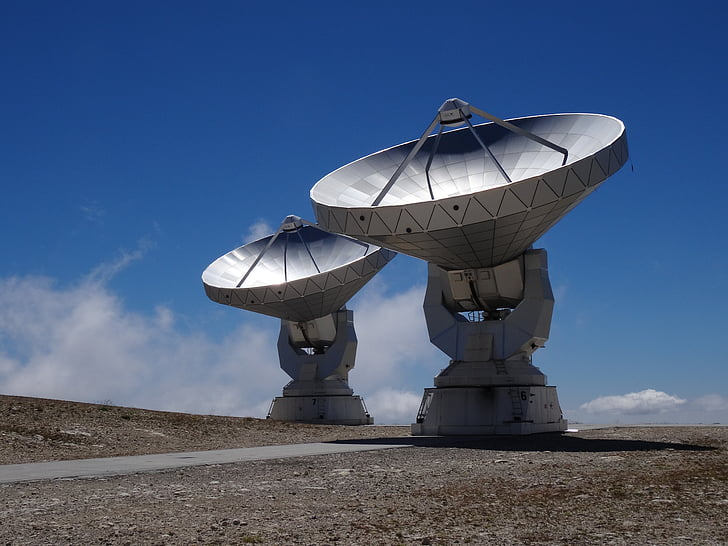
The division of work between the observatories is important. Webb did not detect the radio burst itself. The MeerTRAP team found it with MeerKAT on March 4, 2024, and the radio array localized its position while indicating that the burst was extremely distant. Establishing a reliable distance, however, required identifying the galaxy at that position and measuring its redshift.
Large ground-based telescopes could not see a galaxy there. Webb’s Near-Infrared Camera detected a faint host at the burst location, and its Near-Infrared Spectrograph measured a redshift of 2.148. Because cosmic expansion stretches light toward longer wavelengths, Webb’s infrared sensitivity was central to characterizing a galaxy this remote.
A millisecond signal carrying billions of years of information
Fast radio bursts are brief flashes that typically last only milliseconds and often appear just once. During that short interval, they can emit many times more energy than the sun radiates in a year. Their physical source remains unresolved, but their usefulness does not depend entirely on settling that question.
As a burst crosses galaxies and the thin ionized material between them, lower-frequency radio waves are delayed more than higher-frequency waves. Measuring that effect lets astronomers examine matter that is otherwise difficult to observe directly. In this case, the burst probes ionized gas across roughly 80% of cosmic history.
The team also identified imprints from two intervening structures: a previously unknown galaxy cluster about 3.5 billion light-years from Earth and the nearby Virgo Cluster, about 54 million light-years away. One distant flash therefore supplied information not only about its source but also about material encountered during its journey.
That is the larger value of pushing the distance boundary. A growing set of localized bursts with independently measured host distances could help researchers map how diffuse matter is distributed across the cosmic web. The new result moves that method much deeper into the universe than the previous record allowed.
An unexpectedly small host complicates the origin question
Webb found that the host was not a typical fast radio burst galaxy. It is a small, metal-poor dwarf undergoing intense star formation and is about 1,000 times less massive than researchers expected. The galaxy existed during “cosmic noon,” when star formation across the universe was near its peak, and the team estimated that most of its stars may have formed within only about 30 million years.
That young environment is consistent with one leading proposal for fast radio bursts: a magnetar, or highly magnetic neutron star, formed after a massive star collapses. Such an object could arise relatively quickly in an active star-forming region. By contrast, a binary neutron-star merger generally requires a much longer period for the two objects to spiral together.
The host therefore weighs against a long-delay merger explanation for this particular event and supports a young-object route. It does not confirm that a magnetar produced FRB 20240304B. Fast radio burst origins remain uncertain, and other magnetar formation pathways have also been proposed.
The observation demonstrates a practical pairing for future work: wide-field radio facilities can find and localize fleeting signals, while Webb can identify faint galaxies and measure their distances after ground-based optical observations reach their limits. Researchers estimate MeerKAT may be able to detect and localize several bursts per year beyond a redshift of 1, with newer radio facilities potentially increasing that rate.
More powerful bursts could, in principle, be detected from still earlier periods. For now, one millisecond radio flash has already crossed about 11 billion light-years, exposed matter along the route and led Webb to a host galaxy far smaller than astronomers expected without yet revealing exactly what produced it.
| More aerospace and engineering stories, right in your MSN feed. Follow AMI on MSN |
By David Whitaker — Associate editor for AMI’s aerospace and drone systems desk, translating flight systems, aircraft programs, spaceflight, and UAV developments into accessible technical stories.