


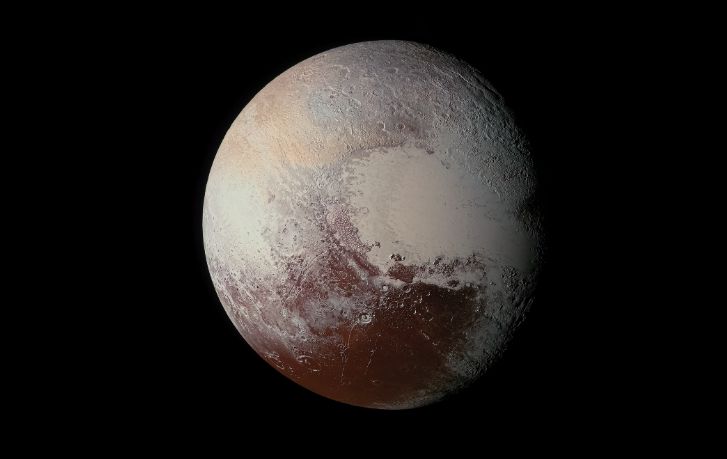
NASA’s New Horizons Images of Pluto and Arrokoth May Remain Clearest for Decades
New Horizons spent only hours gathering its best observations of Pluto, yet those close-ups may define the dwarf planet for decades. NASA identifies no planned return mission capable of replacing them, or the spacecraft’s later views of Arrokoth, with comparable close-range imagery. The constraint is not camera development. It is the time, energy and mission architecture required to put another spacecraft that deep into the outer solar system.

The NASA mission remains active, but its close encounters are behind it. New Horizons flew past Pluto on July 14, 2015, after a journey of more than nine years. It then passed Arrokoth on Jan. 1, 2019, making that Kuiper Belt object the most distant target explored up close. As of 2025, the spacecraft was focused on collecting heliophysics data rather than approaching another major imaging target.
A brief encounter transformed Pluto
Before New Horizons arrived, even the Hubble Space Telescope could offer only a coarse view of Pluto. During its flyby, New Horizons recorded mountains, broad ice plains, glaciers, moons and layers in the dwarf planet’s atmosphere. NASA’s comparison of changing Pluto observations shows that a New Horizons image taken roughly 77,000 kilometers from the surface resolved structures smaller than a mile across.
The sharpest observations came from a tightly sequenced, high-speed pass rather than an orbit. New Horizons approached to about 12,500 kilometers above Pluto, collecting data as the geometry changed rapidly. There was no opportunity to stop, circle back or repeat a missed observation. Cameras, spectrometers and radio-science equipment had to execute a preloaded plan while the spacecraft moved through the system.
That architecture made Pluto reachable within a practical mission duration, but it imposed a hard operational tradeoff. An orbiter could examine changing terrain and atmospheric conditions over time. A flyby instead concentrates its best observations into a narrow window, purchasing speed and reach at the cost of repeated close-range coverage.
Jupiter, hibernation and a low-power spacecraft
New Horizons launched in 2006 and used a Jupiter gravity assist in 2007. The encounter increased its velocity and shortened the trip to Pluto by about three years. For much of the cruise, controllers placed the spacecraft in hibernation, switching off nonessential systems to preserve component life while onboard computers monitored its health.
The vehicle also had to operate with a modest power supply far beyond the useful range of conventional solar arrays. Its radioisotope generator provided about 250 watts at launch and was expected to produce roughly 200 watts by the Pluto encounter. The science payload therefore relied on lightweight, low-power instruments, and the spacecraft itself had to turn to aim instruments that lacked independent scanning platforms.
Those constraints shaped what New Horizons could collect, but distance governed how quickly the observations reached Earth. At Pluto, radio signals took approximately 4.5 hours to travel one way. The downlink managed only about 1 to 2 kilobits per second, comparable to transmitting a modern photograph through an extremely narrow data pipe.
The Pluto encounter produced about 6.25 gigabytes of data. Returning the complete set took more than 15 months and was finished in October 2016. That delay was not a sign of a failed communications system; it was the expected result of sending data billions of miles with limited onboard power and a low-rate link.
Arrokoth extended the mission’s reach
After Pluto, New Horizons continued deeper into the Kuiper Belt and approached within about 3,500 kilometers of Arrokoth. Close-range observations showed an object about 35 kilometers long with two connected lobes. The larger lobe was notably flattened rather than spherical, giving researchers a form unlike the simple round body that distant observations might suggest.
New Horizons demonstrated that a single compact spacecraft could explore two previously unseen worlds up close. It also showed why replacing such observations is difficult. Another mission would need a suitable launch trajectory, years of reliable cruise operations, power that remains useful far from the Sun, precise autonomous encounter sequencing and communications capable of returning valuable data over an immense distance.
Future telescopes may improve distant observations, and a later spacecraft could ultimately surpass New Horizons. But without an identified follow-up mission, there is no near-term route to another close pass. The spacecraft that spent nine years reaching Pluto may therefore leave its brief encounters as the defining close-up record of both Pluto and Arrokoth for decades.
| More aerospace and engineering stories, right in your MSN feed. Follow AMI on MSN |
By David Whitaker — Associate editor for AMI’s aerospace and drone systems desk, translating flight systems, aircraft programs, spaceflight, and UAV developments into accessible technical stories.




