


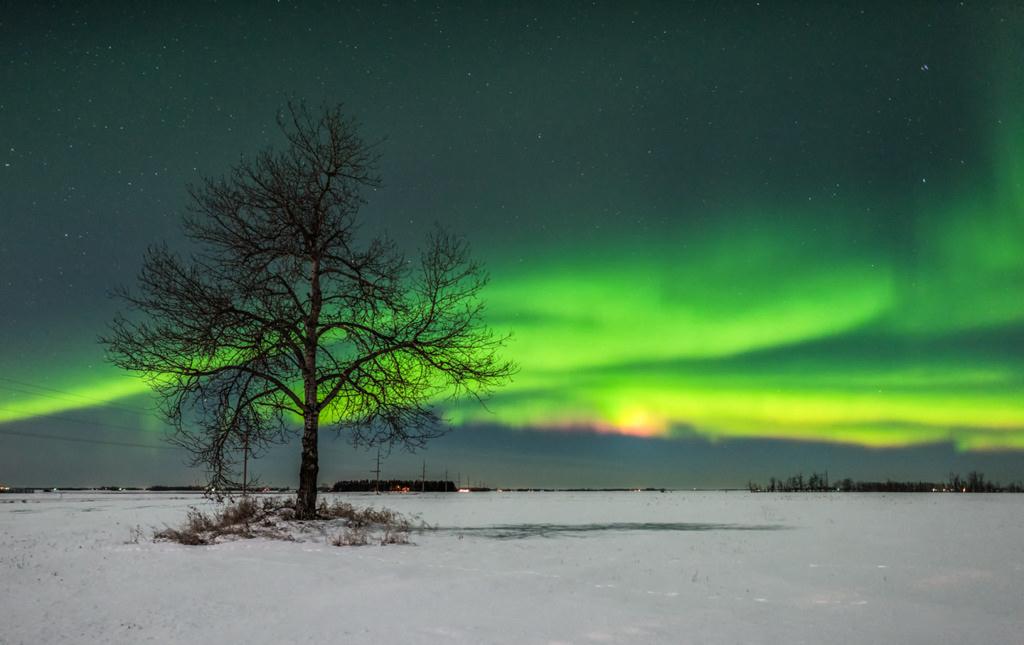
NOAA’s Live Aurora Reading Looks Back Three Hours, Not Ahead
As skywatchers track Monday night’s possible aurora across parts of 10 states, NOAA’s preliminary planetary Kp reading comes with an important timing limitation. Although the number is updated every minute, it estimates geomagnetic activity measured during the previous three hours using eight ground-based magnetometers around the world. It is an observed, retrospective reading not a forecast or a direct measurement of what is visible overhead at that moment.

That reading should not be confused with NOAA’s forecast of Kp five for Monday night, October 12, which is behind the multistate viewing opportunity. The forecast points to what geomagnetic activity may reach; the preliminary Kp value shows what instruments estimated over an already elapsed period. Neither one confirms that an aurora is currently visible from a particular yard, park or roadside because darkness, latitude, clouds, light pollution and the display’s actual position still matter locally.
The distinction becomes easy to miss because the preliminary index looks unusually current. A display that refreshes once a minute naturally resembles a live gauge, but its underlying measurement window remains three hours long. Readers can inspect the preliminary NOAA planetary Kp presentation, which identifies the reading as an estimate of the preceding three-hour period.
Why a fresh number can still describe the past
Kp condenses magnetic disturbances recorded at multiple ground stations into a planetary-scale index ranging from zero to nine. The preliminary NOAA product continuously revises its estimate as measurements arrive, but a faster refresh rate does not create a shorter observation period. In practical terms, the latest value may become more refined every minute while still characterizing the same broader block of past activity.
That makes the index useful for establishing whether planetary geomagnetic activity has developed, but less useful as a yes or no answer to the immediate question: “Can I see the aurora here now?” A rising observed value can confirm that stronger activity occurred during the covered interval. It cannot, by itself, establish clear skies, sufficient darkness or a favorable local viewing boundary at the instant someone checks it.
The Kp-five forecast has a different job. It describes an expected level of planetary geomagnetic activity and supports the possibility that the auroral viewing boundary could extend into the northern United States. NOAA mapped possible visibility in northern Washington and Idaho, most of Montana, essentially all of North Dakota, much of Minnesota, northern Wisconsin, Michigan’s Upper Peninsula and the far north of South Dakota and Wyoming. Most of Alaska received a high likelihood, bringing the potential footprint to parts of 10 states.
Even within that footprint, the map is not a guarantee. Someone near the southern edge faces a narrower margin than an observer farther north, and city lighting or an obstructed northern horizon can erase an otherwise viable opportunity. Cloud cover can settle the matter regardless of geomagnetic conditions. NOAA’s GOES imagery viewer provides informational satellite imagery, including products for nighttime clouds and fog, although NOAA notes that the viewer is not an operational forecasting service.
Kp five without a Monday-night storm forecast
Monday night’s outlook also carries an apparent contradiction: NOAA forecast Kp five, yet it did not call for a geomagnetic storm that night. Its three-day outlook indicated that mild G1 geomagnetic activity could occur early Tuesday instead. Kp and storm forecasts are related measures of geomagnetic conditions, but a possible aurora-viewing opportunity should not be interpreted as proof that a storm is strengthening on the same timetable.
Earth had reached strong G3 geomagnetic-storm conditions Saturday night, and stronger storms can brighten auroras and move visibility farther south. That earlier episode supplies context, not confirmation that Monday’s conditions will repeat it. The relevant Monday-night question remains whether the forecast activity develops where and when expected and whether local observing conditions cooperate.
For anyone inside the forecast area, the practical approach is to treat each information source according to its function. The Kp-five forecast defines the opportunity. The preliminary Kp reading indicates what was measured over the prior three hours. A dark site, an open northern view and local cloud conditions determine whether that opportunity becomes an actual sighting, generally with the best chance in the hours around midnight. The minute by minute refresh can help track the event, but its most important timestamp is the three-hour window behind it.
| More aerospace and engineering stories, right in your MSN feed. Follow AMI on MSN |
By David Whitaker — Associate editor for AMI’s aerospace and drone systems desk, translating flight systems, aircraft programs, spaceflight, and UAV developments into accessible technical stories.



