


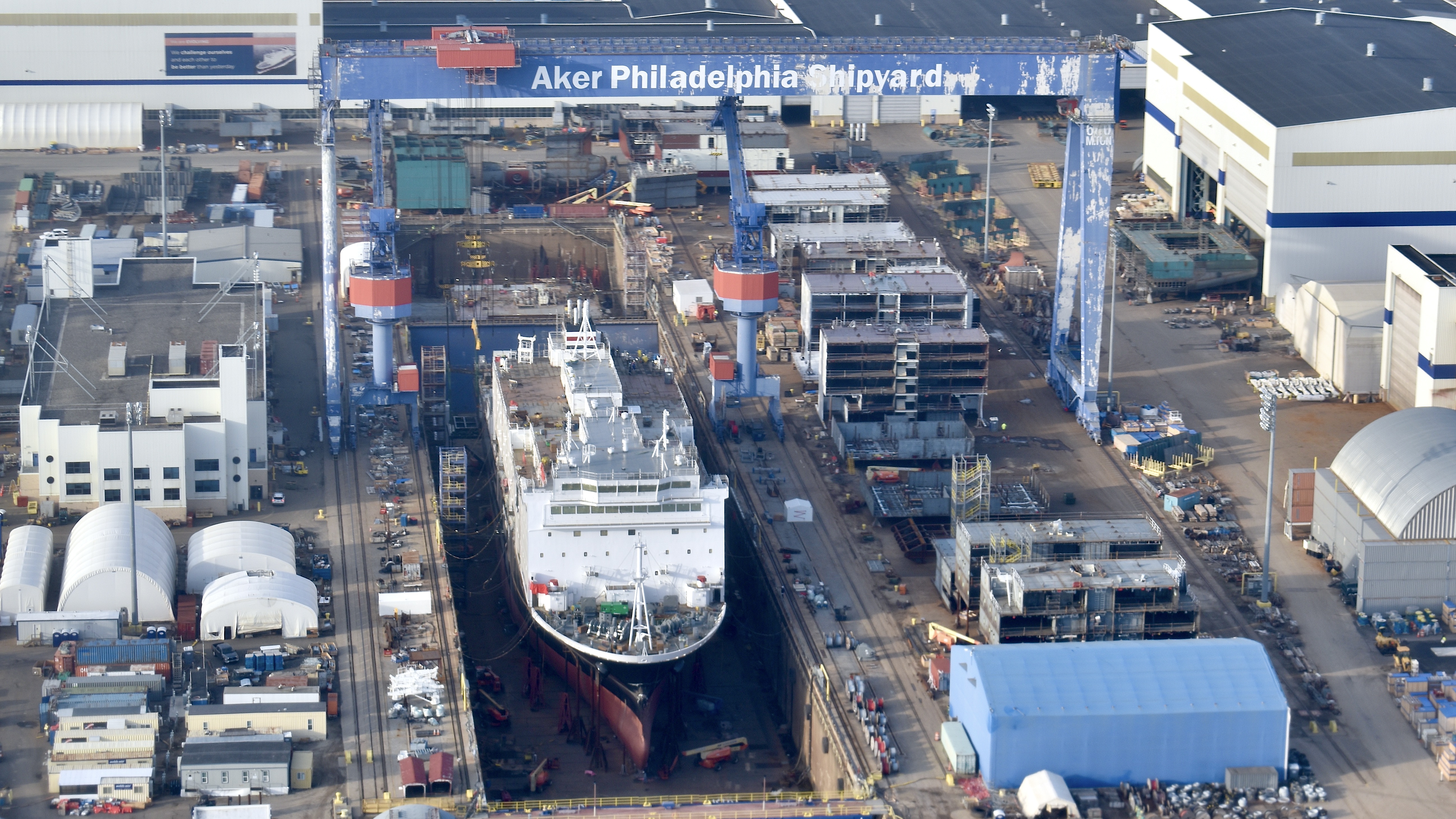
Hanwha Targets 20 Ships a Year Despite Philadelphia Yard Constraints
Hanwha’s $5 billion plan for Philadelphia Shipyard carries a striking production goal: increase output from two commercial ships a year to 20. But a tenfold increase cannot come from hiring alone. The historic yard still needs enough physical space, trained labor, competitively priced production and firm orders to keep that much capacity occupied.

Space is the most visible constraint, and Hanwha has begun addressing it. The company agreed to lease another 47 acres at the Philadelphia Navy Yard, supplementing its existing 110-acre facility. The added properties provide room for shipbuilding facilities, waterfront access and supporting infrastructure, but taking control of land is not the same as creating an operating production line.
Shipyards are tightly coupled industrial systems. Fabrication areas, assembly positions, docks, cranes, storage, transport routes and waterfront access must support a repeatable flow of large modules. Increasing annual deliveries by a factor of 10 therefore requires more than proportionally adding people. Hanwha must remove bottlenecks across the yard so one constrained stage does not leave workers or expensive facilities waiting elsewhere.
More workers do not automatically mean more ships
Philadelphia Shipyard has doubled its workforce to about 2,500 over the past two years. That is a substantial expansion, but shipbuilding depends on experienced welders, pipe fitters, painters and other specialized trades. New employees require training and must become productive within coordinated teams before their numbers translate into faster vessel completion.
The proposed investment is intended to add docks, cranes and shipbuilding facilities while supporting thousands of additional jobs. Even then, the 20-ship figure remains a target rather than demonstrated capacity. The key measure will be sustained throughput: whether the expanded yard can move multiple vessels through different production stages at the same time without creating new schedule or labor conflicts.
That distinction matters because heavy manufacturing capacity is not defined simply by a site’s maximum theoretical output. It depends on how consistently the facility can repeat the work, maintain quality and deliver ships on contract schedules. A yard configured to complete two vessels annually would need a markedly different production rhythm to deliver 20.
The order book must grow with the yard
Hanwha also needs enough customers to justify building and maintaining the expanded system. Beyond a vessel order associated with owner Hanwha Shipping, the identified commercial backlog includes three containerships for Hawaii-based Matson. Those ships are priced at $330 million each.
That price is roughly twice the cited cost of a mega vessel built in South Korea or China. It is a sharp illustration of the cost challenge, although it should not be treated as a universal comparison across every vessel class, specification or contract. Ship prices vary with design, equipment, size and regulatory requirements.
Philadelphia’s commercial ships operate in domestic U.S. service under the Jones Act, which requires covered vessels to be built, crewed, flagged and insured in the United States. Those rules preserve a domestic market for American yards, but they also place construction inside a higher-cost labor and supply environment. Maritime adviser Basil Karatzas summarized the underlying problem: “It’s hard to justify a high valuation multiple for a U.S. shipbuilder like Philly from a foreign buyer, based on pure economics.”
The yard’s history underscores how large the transition is. The Philadelphia site dates to the Revolutionary War and once built vessels for the U.S. Navy, but military shipbuilding there ended in the 1990s. Its present business centers on commercial and government vessels, including the last of five training ships for the U.S. Maritime Administration and the three Matson containerships.
Hanwha’s expansion could materially increase U.S. commercial shipbuilding capacity and strengthen the supporting maritime workforce. Yet capacity only becomes durable when facilities, skilled labor, suppliers and customers arrive in step. The new acreage addresses one obstacle; it does not settle the production economics or fill the future order book.
The decisive milestone will not be the investment announcement or even completion of new facilities. It will be whether Philadelphia Shipyard can secure enough competitively priced work to keep an expanded yard moving steadily toward 20 deliveries a year.
| More aerospace and engineering stories, right in your MSN feed. Follow AMI on MSN |
By David Whitaker — Associate editor for AMI’s aerospace and drone systems desk, translating flight systems, aircraft programs, spaceflight, and UAV developments into accessible technical stories.




