


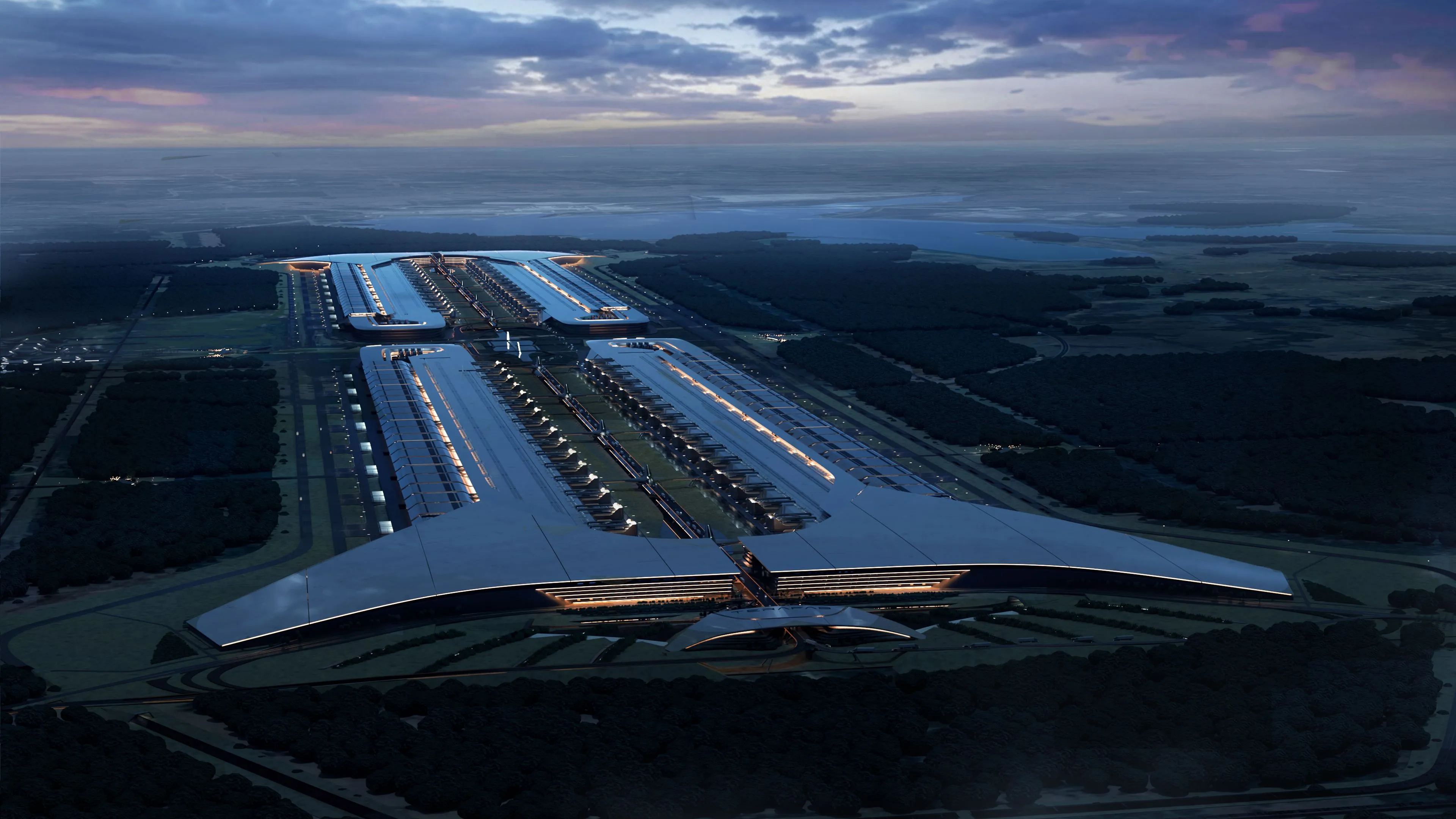
Terafab Filings Map Conditional $119 Billion Expansion Through 2036
Terafab could become a four-phase semiconductor complex built over a decade, but the largest number attached to it remains conditional. Public filings reviewed by Engineering News-Record outline four independently operable manufacturing phases from 2026 through 2036, with total eligible investment reaching roughly $119 billion if every phase proceeds. Only the approximately $16.8 billion first phase is currently confirmed; the applicants would decide separately whether to build each subsequent phase.
The filings also answer some practical infrastructure questions surrounding the proposed Grimes County, Texas, campus. They identify onsite power generation, water treatment and recycling, industrial wastewater treatment and other utility systems. A separate road-use agreement assigns six county roads to construction traffic and makes the company responsible for maintaining those routes during construction and repairing construction-related damage.
That distinction between a confirmed opening phase and a possible full buildout is central to understanding Terafab’s scale. The $119 billion figure is not a single committed construction budget. It is the rounded cumulative value of four proposed investment stages, three of which depend on future decisions after earlier facilities are completed.
Four factories that can stand on their own
The first phase is projected for construction from 2026 through 2028, with commercial operations expected to begin in 2028. Its eligible investment is divided across two school districts: approximately $10.37 billion within Anderson-Shiro Consolidated Independent School District and $6.43 billion within Iola Independent School District, producing the combined $16.8 billion figure.
Phase 2 is projected for 2029 through 2031 and carries about $38.6 billion in eligible investment. Phase 3, scheduled in the filings for 2032 through 2034, adds another $38.6 billion. Phase 4 is projected for 2035 through 2036 and totals approximately $25.3 billion. Together, the listed amounts come to about $119.3 billion, commonly expressed as up to $119 billion.
Each phase is described as independently capable of manufacturing semiconductors. That architecture matters because it allows Terafab to begin production without waiting for the entire decade-long concept to be completed. It also limits the immediate financial and construction commitment: after finishing a phase, the applicant would decide whether additional capacity is justified.
This modular approach does not make the individual stages simple. The eligible-property schedules encompass fabrication buildings, cleanrooms, supporting sub-fab spaces, a central utility plant, substations, cooling equipment, transformers and backup generation. Water-treatment, recycling and industrial wastewater systems are also included, along with compressed-gas and chemical-distribution infrastructure.
Utilities are part of the manufacturing system
Under the executed county tax-abatement agreement, the facilities are expected to use electricity from onsite power plants rather than relying on the grid. The plans contemplate gas turbines and utility-scale battery storage. They also call for surface water from Gibbons Creek Reservoir instead of groundwater, with onsite treatment, wastewater processing and water reuse.
Those provisions clarify the intended sources and treatment paths for two essential fab inputs: electricity and water. They do not, by themselves, demonstrate completed systems or operating performance. Detailed engineering, construction, commissioning and regulatory work would still have to turn the proposed utility architecture into dependable manufacturing support.
The road agreement similarly converts a broad local concern into a defined responsibility. Six county roads are designated for construction use, and the company must maintain them during the work and repair damage attributed to construction traffic. With development potentially extending through 2036, that obligation could remain relevant well beyond the first factory opening.
Tesla and SpaceX retain operating control
The buildout plan carries an additional operational tension. Elon Musk said on October 7 that Tesla and SpaceX intend to build and run Terafab themselves. He limited Taiwan Semiconductor Manufacturing Company’s possible participation to subleasing part of the site, leaving the precise nature of any involvement unresolved.
Intel’s reported role remains separate. Intel joined the program in April and is expected to contribute its 14A manufacturing process while participating in technology development, design, construction and packaging work. Intel Chief Executive Lip-Bu Tan has said the company would continue working on Terafab despite discussions involving TSMC.
Tesla and SpaceX would therefore retain control of a factory intended to supply chips for autonomous-driving systems, Cybercab vehicles, Optimus robots, artificial intelligence and SpaceX computing infrastructure. Neither company has previously operated a full-scale semiconductor fab. TSMC Chairman C.C. Wei has said a new fab can require two to three years to construct and another one to two years to reach full production, illustrating why buildings and process technology are only part of the challenge.
The immediate program is the $16.8 billion first phase scheduled to start operations in 2028. Whether Terafab becomes a $119 billion complex will depend on three later decisions and on whether the first independently operable factory can convert its extensive utility, construction and process plans into stable chip production.
| More aerospace and engineering stories, right in your MSN feed. Follow AMI on MSN |
By Thomas Caldwell — AMI’s senior editor for mechanical and mobility engineering, covering vehicle electronics, systems integration, electrification, chassis systems, propulsion, and safety policy.



