


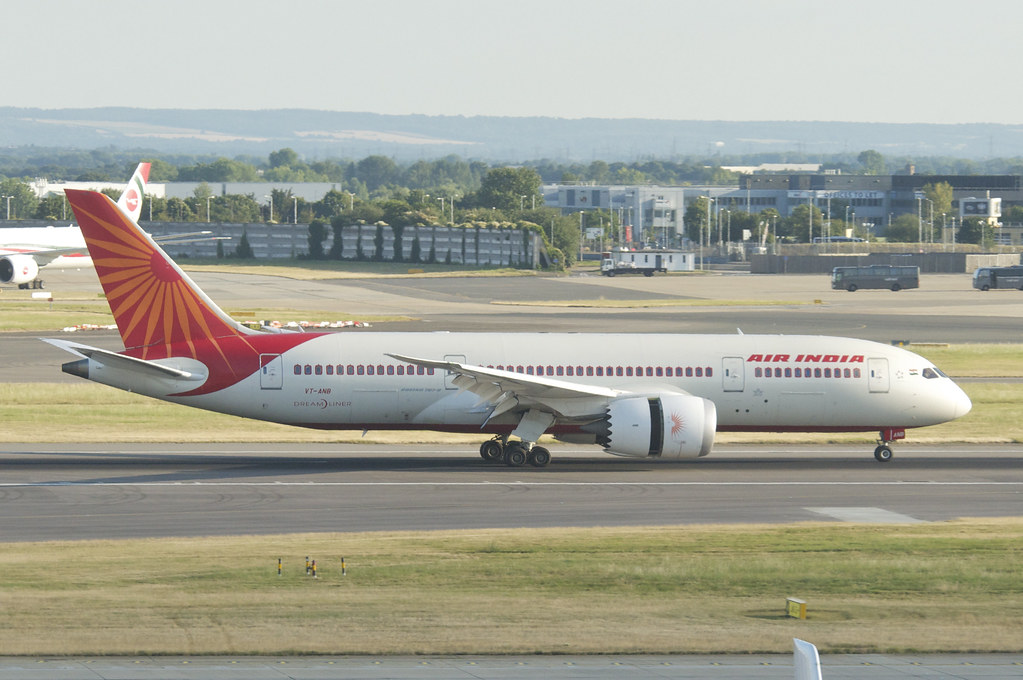
Air India Pilots Deny Selecting Hijack Code, Then Resume Flight After Checks
Air traffic control received a hijack-code signal from Air India Flight AI2030, but its pilots reportedly told investigators that they had not selected an emergency transponder code. After a diversion to Jaipur and approximately four hours of security checks, the Boeing 787-9 and the same crew were cleared to continue to Delhi. That clearance resolved the immediate operational response, not the unanswered question of what generated the signal.

The Frankfurt-to-Delhi flight diverted on October 14 after code 7500 was detected while the aircraft was passing through the Mumbai Flight Information Region. The aircraft landed safely at Jaipur International Airport at 9:35 a.m. and was moved to an isolation bay, according to reporting on the diversion and investigation. Its passengers were taken off and subjected to security checks before continuing on the same aircraft.
Personnel from the Directorate General of Civil Aviation, Anti-Terrorism Squad, Central Industrial Security Force and local police participated in the response. Investigators questioned the pilots and examined the aircraft. Air India confirmed that the relevant security agencies completed their required checks and cleared both the aircraft and crew. The flight subsequently reached Indira Gandhi International Airport, with all passengers and crew reported safe.
A code communicates urgency, not a complete account
An aircraft transponder helps air traffic control identify and track the aircraft. Crews ordinarily operate with an assigned four-digit code, while several internationally recognized codes communicate emergency conditions. Code 7500 indicates unlawful interference, including hijacking; 7600 indicates a communications failure; and 7700 identifies a general emergency.
This gives code 7500 an intentionally narrow and serious meaning. It can communicate a security problem when a crew might not be able to explain the situation openly by radio. International procedures also provide for controllers to seek confirmation of a 7500 selection, while accounting for the possibility that a crew facing unlawful interference may not answer.
What appears on a surveillance display, however, is an emergency-status indication rather than a description of events inside the cockpit. The received code does not by itself establish who selected it, whether it was deliberately selected, or whether the displayed status originated in crew action, equipment behavior, transmission or processing. None of those possible explanations has been established for AI2030.
The pilots’ denial also requires careful attribution. Their reported account comes from unnamed sources within the investigative teams, not from a published investigative finding or a direct public statement by the pilots. Air traffic control’s reception of the alert and the crew account therefore remain facts of different types that investigators must reconcile through recordings and other available information.
Why the crew’s clearance has a limited meaning
Allowing the same pilots and aircraft to complete the journey is operationally significant. It indicates that the security agencies found no immediate condition during the Jaipur checks that prevented the crew or aircraft from continuing. It also limited the disruption to roughly four hours rather than requiring a replacement aircraft or flight crew.
Clearance is not, however, equivalent to determining the alert’s origin. Security personnel can decide that a flight may safely continue after examining the aircraft, passengers and crew while a technical and procedural investigation remains open. Those decisions answer different questions: one concerns whether an immediate threat remains; the other concerns why a specific electronic indication reached air traffic control.
A separate 2026 incident involving a Corendon Airlines Boeing 737-800 illustrates why the distinction matters without explaining the Air India event. German police said that aircraft inadvertently transmitted code 7500, while the airline attributed the alert to a brief radio-communication malfunction. That case had an identified explanation from authorities and the operator. No comparable cause has been established for AI2030, so it cannot be used to infer either a malfunction or accidental selection here.
The DGCA investigation must now account for both sides of the discrepancy: air traffic control received a signal reserved for unlawful interference, while the pilots reportedly deny selecting any emergency code. Until that reconciliation is published, the diversion and four-hour security response are confirmed consequences, but the initiating cause remains unassigned.
| More aerospace and engineering stories, right in your MSN feed. Follow AMI on MSN |
By Thomas Caldwell — AMI’s senior editor for mechanical and mobility engineering, covering vehicle electronics, systems integration, electrification, chassis systems, propulsion, and safety policy.



