


All 78 Schiphol Passport Gates Restored After 90-Minute Queues
All 78 automated passport gates at Amsterdam Airport Schiphol were operating again by 2:30 p.m. local time on Sunday, October 18, after an information-technology failure disabled the entire fleet. The outage, which began at 6 a.m., forced travelers through staffed checkpoints and produced passport-control waits of up to 90 minutes during the Dutch autumn school holiday rush.

The afternoon restoration update ended more than eight hours of disruption to automated border processing. Before service returned, Schiphol reported average passport-control queues of about one hour. KLM said some departures were running approximately 30 minutes late as the airline tried, where possible, to avoid leaving passengers behind.
One failure removed 78 automated processing points
The scale of the disruption illustrates the capacity difference between a large automated fleet and its staffed fallback. The Royal Netherlands Marechaussee opened all available passport counters and streamlined checks, but manual processing could not absorb passenger demand without long lines.
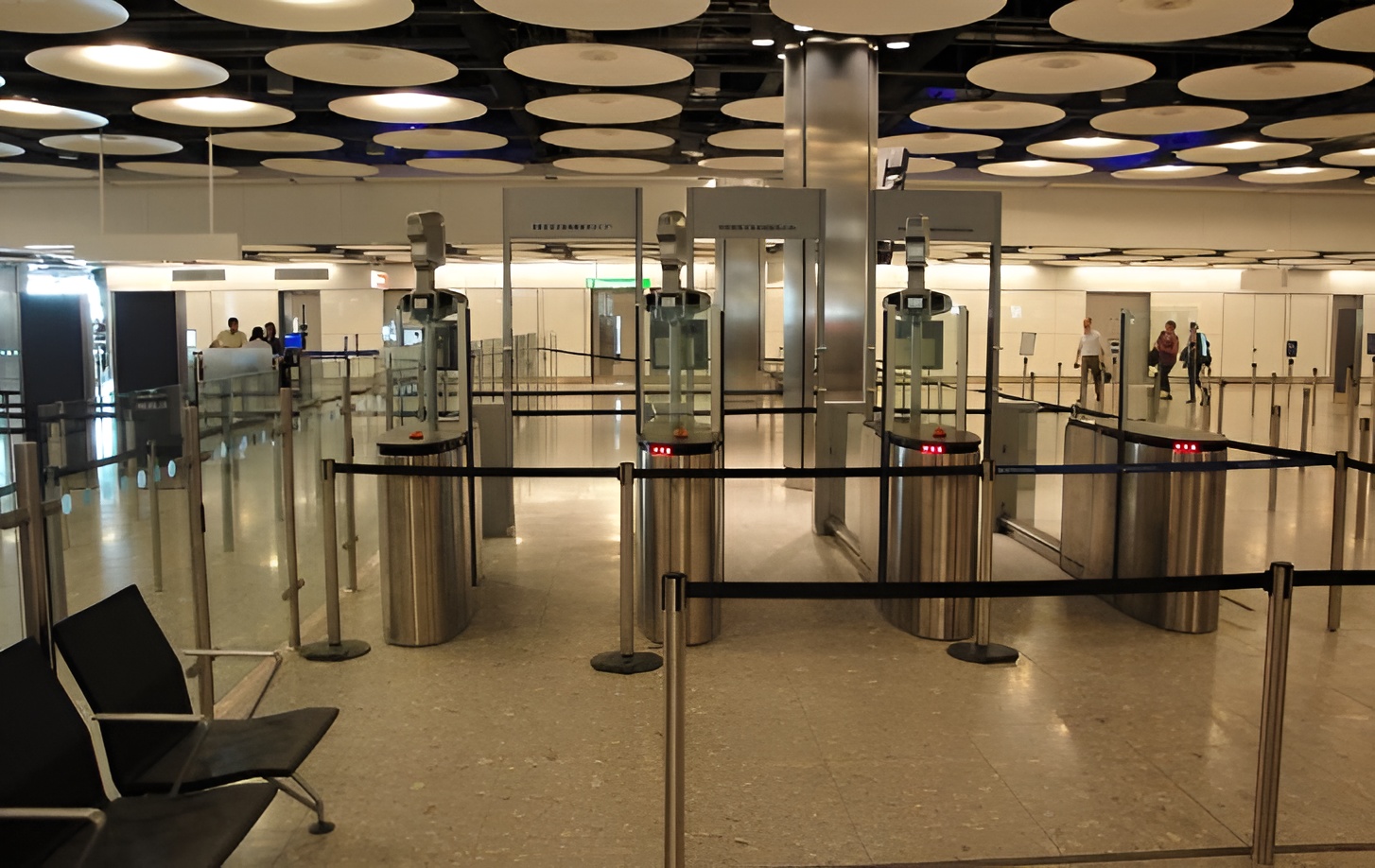
Schiphol’s self-service passport gates scan a biometric passport and use facial recognition to check the traveler’s identity. An automated check can take only seconds when the passenger, passport and gate meet the eligibility requirements. Manual inspection shifts that work to an officer and a finite number of staffed booths, reducing the number of travelers who can be processed simultaneously.
The staffed counters therefore preserved the essential border-control function but not the normal throughput. That is the central systems consequence of the outage: the airport did not lose passport control, but it abruptly lost the parallel processing capacity supplied by 78 machines. Keeping every available counter open limited the disruption without reproducing the capacity of the automated system.
The queues came after check-in and security
The failure affected passengers crossing the external border of the Schengen Area, including travelers arriving from or departing for the United Kingdom, United States and other non-Schengen destinations. Connecting passengers also encountered the queues when their itineraries required a Schengen border crossing. Travelers flying entirely within the Schengen Area normally do not pass through passport control at Schiphol.
For departing passengers, this created a particularly difficult timing problem because passport control is separate from airline check-in and airport security screening. A traveler could complete both earlier processes and still encounter an hour-long border queue before reaching the gate. Airlines could delay some departures, but holding aircraft also consumes gate capacity and can carry disruption into later flights and connections.
As of 11:30 a.m., KLM had not reported proactively canceling flights because of the outage, although it warned that continued delays could create an airport-capacity problem. The available figures did not establish an airport-wide cancellation total. The confirmed operational effects were the passport queues, delays of roughly 30 minutes on some departures and missed travel connections reported after the event.
The cause remains under investigation
The Marechaussee described the problem as an information-technology failure and continued investigating its cause after restoring the gates. Officials said they had no reason to suspect a cyberattack.
The failed passport gates are also distinct from the European Union’s Entry/Exit System registration kiosks. Officials did not identify those kiosks or the wider Entry/Exit System as the source of the outage. Depending on a traveler’s nationality, age and direction of travel, an Entry/Exit System kiosk may collect registration information before the traveler proceeds either to an automated gate or a staffed desk.
Restoring all 78 gates recovered Schiphol’s automated border-processing capacity, but it could not reverse the consequences for passengers whose flights or onward connections had already departed. The remaining engineering and operational question is what common dependency allowed every gate to become unavailable at once and whether the investigation leads to a fallback that preserves more throughput during the next fleet-wide failure.
| More aerospace and engineering stories, right in your MSN feed. Follow AMI on MSN |
By Thomas Caldwell — AMI’s senior editor for mechanical and mobility engineering, covering vehicle electronics, systems integration, electrification, chassis systems, propulsion, and safety policy.




