


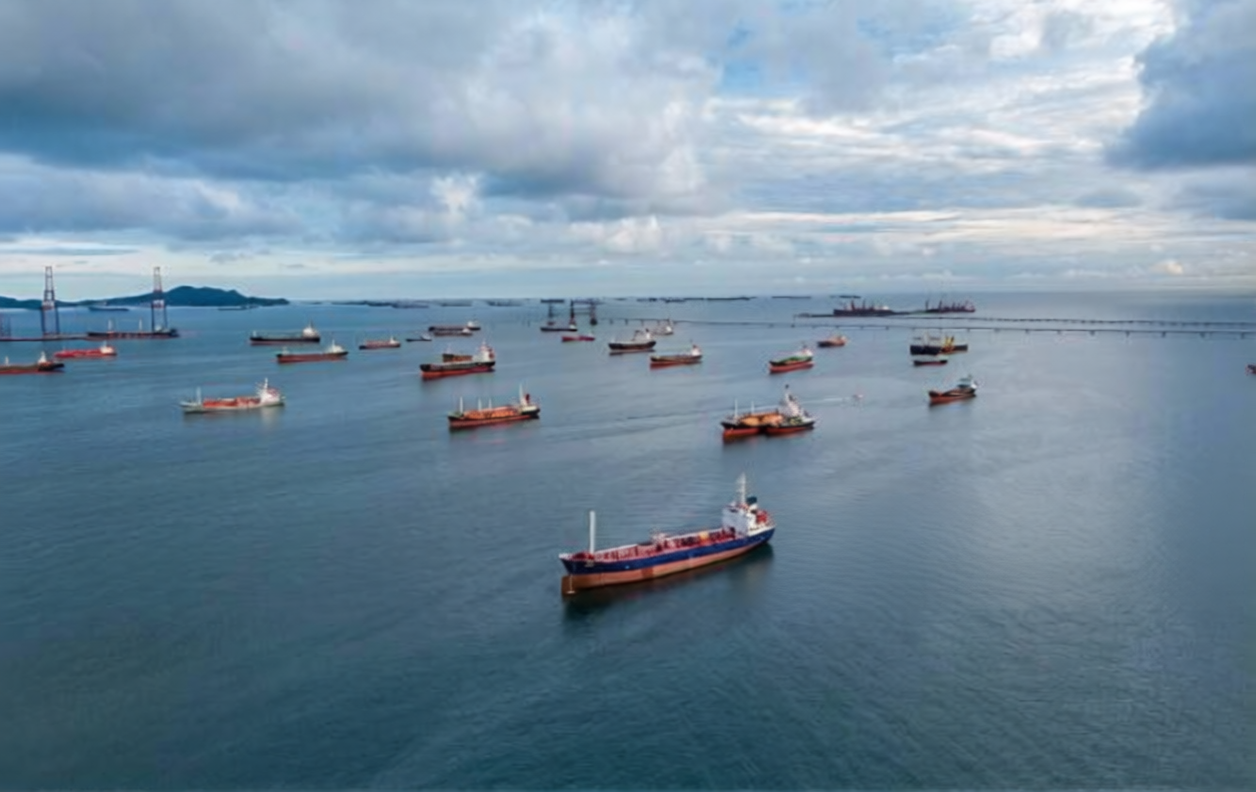
Hormuz Oil Recovery Falters as Tanker Costs Reach $1.4 Million Daily
Gulf oil exports recovered sharply in September, only for daily traffic through the Strait of Hormuz to fall again while the cost of chartering a large tanker reached as much as $1.4 million per day. The reversal shows that a network of tanker shuttles, offshore cargo transfers and pipeline bypasses can restore substantial volume, but not the predictability or cost structure of normal shipping.

Gulf crude exports increased by 4.4 million barrels per day in September to 13.9 million, exceeding 75% of prewar levels, according to the International Energy Agency’s October Oil Market Report. Flows through Hormuz rose by 3.7 million barrels per day to 10.9 million, while bypass exports increased by 970,000 barrels per day to 5.6 million.
That monthly recovery was followed by a much weaker daily reading. Tracked oil shipments through Hormuz fell to 2.9 million barrels per day on October 11, down from a September peak of 15.5 million. Daily tracking estimates can swing as cargoes move in clusters, and datasets do not always measure the same combination of passages, loading events and cargo volumes. The figure therefore does not establish a new monthly export rate, but it does expose the network’s volatility.
More handoffs restored volume but consumed tanker capacity
The recovery depended partly on tankers making short passages through Hormuz and transferring crude to other vessels in the Gulf of Oman for the longer trip to customers. Splitting one voyage between multiple ships reduces the exposure of an individual long-haul carrier, but it introduces another scheduling and handling interface. Both vessels, transfer equipment, suitable weather and receiving capacity must be available at the same time.
Those handoffs also reduce the effective productivity of the tanker fleet. Two ships may be committed to moving cargo that would ordinarily remain aboard one vessel, while transfer and waiting time keep hulls unavailable for other work. Reuters reported that shippers moving Saudi crude were using more vessels than before, contributing to tighter tanker availability. Freight rates consequently account for more than 40% of the value of U.S. crude at the cited price, compared with an average of 7% in 2025.
The extreme rates are visible even outside the strait. A Gulf of Oman fixture for a very large crude carrier was reported at $1.162 million per day, while another confirmed fixture reached $1.015 million. Comparable deals had recently ranged from $719,000 to $864,000 per day. A separate cited rate for a large tanker crossing the Hormuz system reached $1.4 million per day.
Bypass pipelines offer another route, but their nominal pumping capacity is only one part of the export chain. Oil must reach storage, move through operating terminals and be matched with available ships. The IEA estimates that Saudi and Emirati bypass routes offset more than 500 million barrels, equivalent to 2.8 million barrels per day, of Hormuz losses between the conflict’s start and August. Port and terminal constraints still limit how much additional pipeline flow can become seaborne exports.
Crews remain the system’s least replaceable element
The shipping recovery also rests on people accepting severe operating risk. The U.S. Navy-led Joint Maritime Information Center continued to classify the threat to merchant shipping in Hormuz as severe in mid-October. International Maritime Organization figures cited in maritime reporting counted 24 seafarer deaths since the conflict began, while commercial movements remained well below prewar traffic levels.
Higher compensation can attract crews and tanker capacity, but it cannot create an unlimited labor pool or normalize repeated exposure to attacks. When crews, owners or insurers withdraw, nominal export capacity at pipelines and terminals cannot compensate for the missing ships and personnel.
Crude recovery has not restored diesel supply
The September crude rebound also concealed a deeper product shortage. Middle Eastern refined-product exports reached 1.9 million barrels per day, versus 4.7 million before the conflict. Liquefied petroleum gas shipments were 670,000 barrels per day, compared with 1.5 million previously.
Crude at sea cannot immediately replace diesel positioned near farms, trucking fleets and industrial users. Refineries need the appropriate crude grades, available processing capacity and profitable operating margins. Record freight and delivered crude costs have weakened margins in Europe and Asia, potentially limiting the rate at which additional crude becomes usable fuel.
Global observed oil inventories ended September 509 million barrels below their end-February level. The IEA expects recovering refinery output to begin rebuilding supplies, but says the accumulated deficit could keep diesel markets tight well into 2027. September demonstrated that the Hormuz transport system can recover millions of barrels per day; the October traffic plunge, severe crew risk and $1.4 million daily tanker cost show how much redundancy that recovery is consuming.
| More aerospace and engineering stories, right in your MSN feed. Follow AMI on MSN |
By Thomas Caldwell — AMI’s senior editor for mechanical and mobility engineering, covering vehicle electronics, systems integration, electrification, chassis systems, propulsion, and safety policy.



