


Tesla Seeks $250,000 Roadster Deposits, but Federal Regulators Say It’s No Aircraft
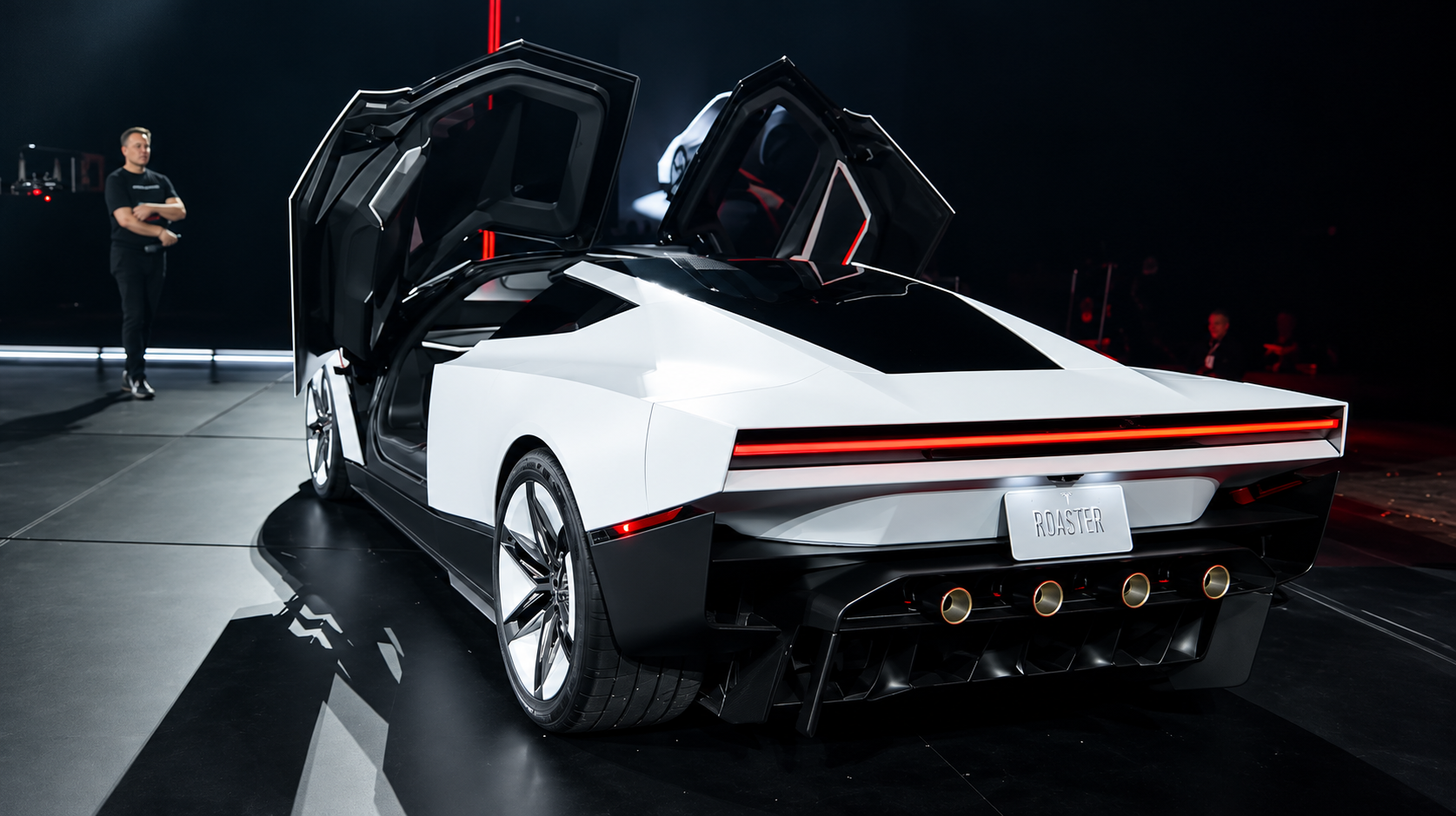
Tesla has demonstrated a Roadster prototype making brief thruster-powered jumps and is seeking reservation payments as high as $250,000. Yet the Federal Aviation Administration says the vehicle is not an aircraft, while Tesla says the version designed to leave the ground is not approved for public roads.
That leaves the redesigned Roadster in an unusual gap between a dramatic prototype demonstration and a commercially usable vehicle. Tesla has not announced final prices, established sustained-flight capability or shown that the thruster-equipped car is ready for production. The company now targets production in 2028, eight years after the launch date originally proposed when the second-generation Roadster was unveiled in 2017.
What Tesla demonstrated
At SpaceX’s test facility in McGregor, Texas, the prototype traveled along a curved ramp, became airborne, rolled 180 degrees with bursts of compressed air and landed on its wheels. It also used its thrusters to jump over a lineup of Tesla vehicles. Elon Musk said the demonstration car operated autonomously for safety, with a mannequin occupying the vehicle.
Those maneuvers showed that the system could produce enough impulse to alter the car’s motion during short periods off the ground. They did not demonstrate sustained flight, and Tesla has not disclosed how long or how far the Rocket configuration can remain airborne. The event involved a prototype rather than a production-ready vehicle.
Tesla engineering vice president Lars Moravy said the cold-gas system uses about 600 liters of rechargeable compressed air. Unlike a combustion rocket, a cold-gas thruster releases stored pressurized gas to generate force. Packaging that air supply, its pressure hardware and multiple thrusters inside a sports car adds another system alongside the battery, motors, suspension, brakes and occupant-protection structure.
The company now describes three configurations. Performance is a road-oriented two-seater with active aerodynamics and a fan-driven suction system. Thrust adds rear-mounted cold-gas thrusters, with Tesla claiming acceleration to 60 mph in less than one second. The invitation-only Rocket is a single-seat version with 10 thrusters arranged around the car for brief aerial maneuvers. Tesla also claims a top speed above 230 mph.
Airborne does not automatically mean FAA-certified
The FAA told CBS News and Politico that the Roadster does not meet its definition of an aircraft and therefore would not require FAA airworthiness certification. Federal regulations generally define an aircraft as a device used or intended for flight in the air, as shown in 14 CFR Section 1.1, but the agency’s current position places this vehicle outside its aircraft-certification pathway.
That does not create an automatic route to road legality. Tesla’s own website says the Rocket version is not approved for public-road use. The Transportation Department said the National Highway Traffic Safety Administration will continue monitoring the situation.
For road vehicles, NHTSA generally does not conduct pre-sale approval comparable to FAA aircraft certification. The American system instead relies on manufacturers to certify that their vehicles satisfy applicable federal motor-vehicle safety standards. NHTSA explains in its official interpretation of the self-certification system that manufacturers assume responsibility for compliance, while the agency can test vehicles, investigate potential defects and pursue recalls.
A novel design does not avoid those road-safety obligations merely because regulators do not preapprove it. A production version would still need an applicable compliance basis covering the complete vehicle. Tesla has not disclosed such a path for the Rocket model, which it currently excludes from public-road use.
The reservation commitment precedes final specifications
Tesla is requesting $50,000 to reserve the Performance version and $250,000 for Thrust. Final prices have not been announced, and the company has not explained what will happen to deposits placed on the Roadster introduced in 2017.
The product itself has also changed. The 2017 proposal promised four seats and 620 miles of range. The redesigned Roadster seats no more than two and carries a current range promise above 300 miles. Those changes may reflect a substantially different packaging and performance balance, but Tesla has not provided production specifications that would allow a complete comparison.
The engineering demonstration therefore sits well ahead of the milestones that matter to buyers: finalized design, validated specifications, regulatory compliance and production. Until those arrive, a $250,000 reservation secures a place for a delayed thruster-assisted prototype whose most unusual version is currently neither FAA-certified as an aircraft nor approved by Tesla for public roads.
| More aerospace and engineering stories, right in your MSN feed. Follow AMI on MSN |
By Thomas Caldwell — AMI’s senior editor for mechanical and mobility engineering, covering vehicle electronics, systems integration, electrification, chassis systems, propulsion, and safety policy.



