


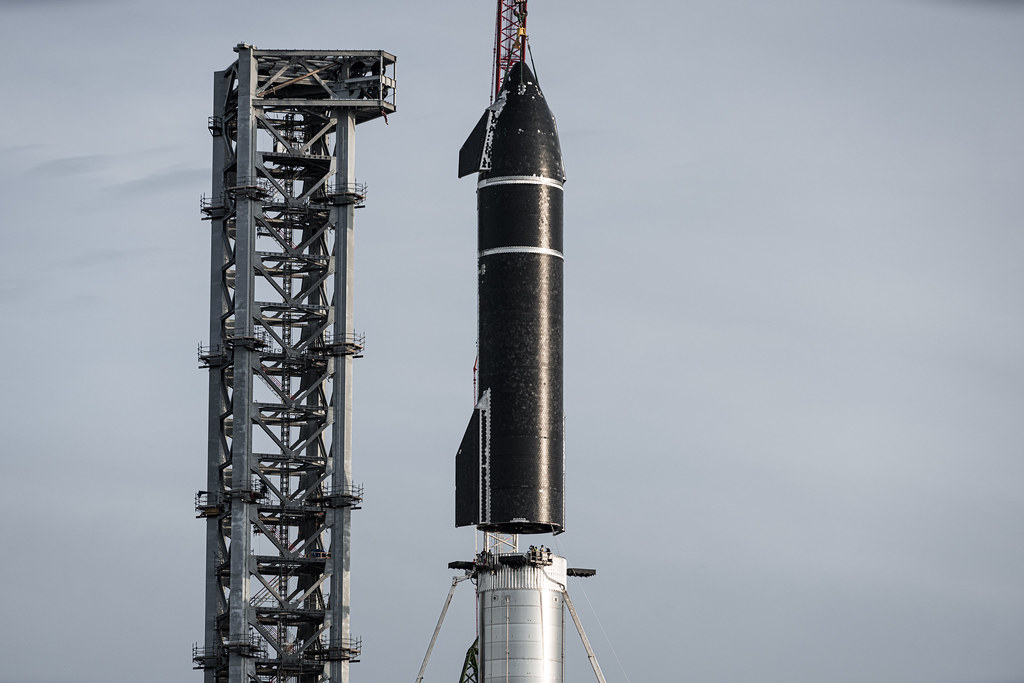
SpaceX Modifies Starship for 10-Hour Test After Booster Relight Failure
SpaceX is preparing Starship for a roughly 10-hour orbital test, but the mission begins with an unresolved problem from a much shorter phase of the previous flight: restarting the Super Heavy booster’s engines for landing. After only 10 of 13 Raptor engines relit in July, the booster struck the water hard and exploded. SpaceX has now changed engine hardware and relight software before Flight 14.

The company completed a full wet dress rehearsal earlier in the week, loading the vehicle and running through countdown procedures without igniting its engines. As of September 28, the launch was planned for Monday, pending regulatory approval. SpaceX must obtain the required authorization because the Federal Aviation Administration licenses commercial launch and reentry operations after reviewing public-safety, payload, insurance and environmental requirements.
A successful rehearsal establishes that the vehicle, ground equipment and launch team can complete a coordinated countdown under loaded conditions. It does not exercise the propulsion, orbital, thermal-protection or landing systems that define the flight itself. Flight 14 is intended to address all of those areas in one mission.
Engine relights drive the booster changes
SpaceX said the upcoming Super Heavy incorporates hardware modifications to improve filtering for its engines, along with software changes designed to increase relight reliability. The work follows July’s Flight 13, when Starship successfully deployed 20 operational satellites but the booster’s planned landing burn began with three engines unavailable.
Landing an enormous reusable booster requires more than surviving ascent. Engines must shut down, coast through the return profile and restart when commanded after experiencing vibration, changing propellant conditions and the broader loads of flight. For Flight 14, the measurable result will be whether the modified system supports a controlled Gulf of Mexico splashdown rather than another hard impact.
The ocean target keeps this flight focused on vehicle behavior rather than a return to the launch site. It can provide data on relight performance and terminal control without making tower recovery part of the test. That is an intermediate step toward repeatable operations, not the end state of full booster reuse.
Six orbits expand the upper stage test
The planned Starship profile calls for six trips around Earth at an altitude of 171 miles, extending the mission to approximately 10 hours. During that period, the upper stage is intended to deploy 26 Starlink V3 satellites before reentering and attempting a Pacific Ocean splashdown west of Chile.
That combination raises the test beyond a short ascent and reentry demonstration. SpaceX must manage the spacecraft through extended orbital operations, execute a real payload deployment and then bring Starship back through atmospheric heating under control. Each objective remains planned rather than demonstrated by the completed rehearsal.
The mission also introduces an upgraded heat shield. Two tiles recovered from the previous flight are scheduled to fly again, an experiment SpaceX describes as the “first tile reuse for Starship.” Reusing two components is a limited test, but it directly addresses the inspection and refurbishment burden that can determine whether a nominally reusable vehicle becomes practical to operate repeatedly.
Thermal protection is especially consequential for Starship because reentry performance connects orbital delivery with vehicle recovery. A spacecraft that can place satellites in orbit but requires extensive heat-shield replacement between missions would face a different operating model from one capable of rapid inspection and refight.
A larger payload promise still depends on recovery
SpaceX is developing Starship as the eventual successor to Falcon 9. The larger vehicle could theoretically deliver about 10 times as many satellites per launch, making the planned batch of 26 Starlink V3 spacecraft an early demonstration of the payload role it is meant to assume. The same vehicle family is also relevant to NASA’s planned Artemis 3 lunar mission.
Those ambitions put Flight 14’s individual objectives in context without making one test decisive. Satellite deployment would show useful work in orbit. A controlled Starship splashdown would test the upgraded thermal protection and reentry profile. A controlled Super Heavy splashdown would indicate whether the filtering and software changes corrected the previous landing-relight shortfall.
The most demanding result is the combination: approximately 10 hours in orbit, 26 satellites released, atmospheric reentry and two controlled ocean returns. SpaceX has completed the countdown rehearsal and installed the changes. Flight 14 must still show whether those preparations hold together from ignition through the final splashdowns.
| More aerospace and engineering stories, right in your MSN feed. Follow AMI on MSN |
By David Whitaker — Associate editor for AMI’s aerospace and drone systems desk, translating flight systems, aircraft programs, spaceflight, and UAV developments into accessible technical stories.



