


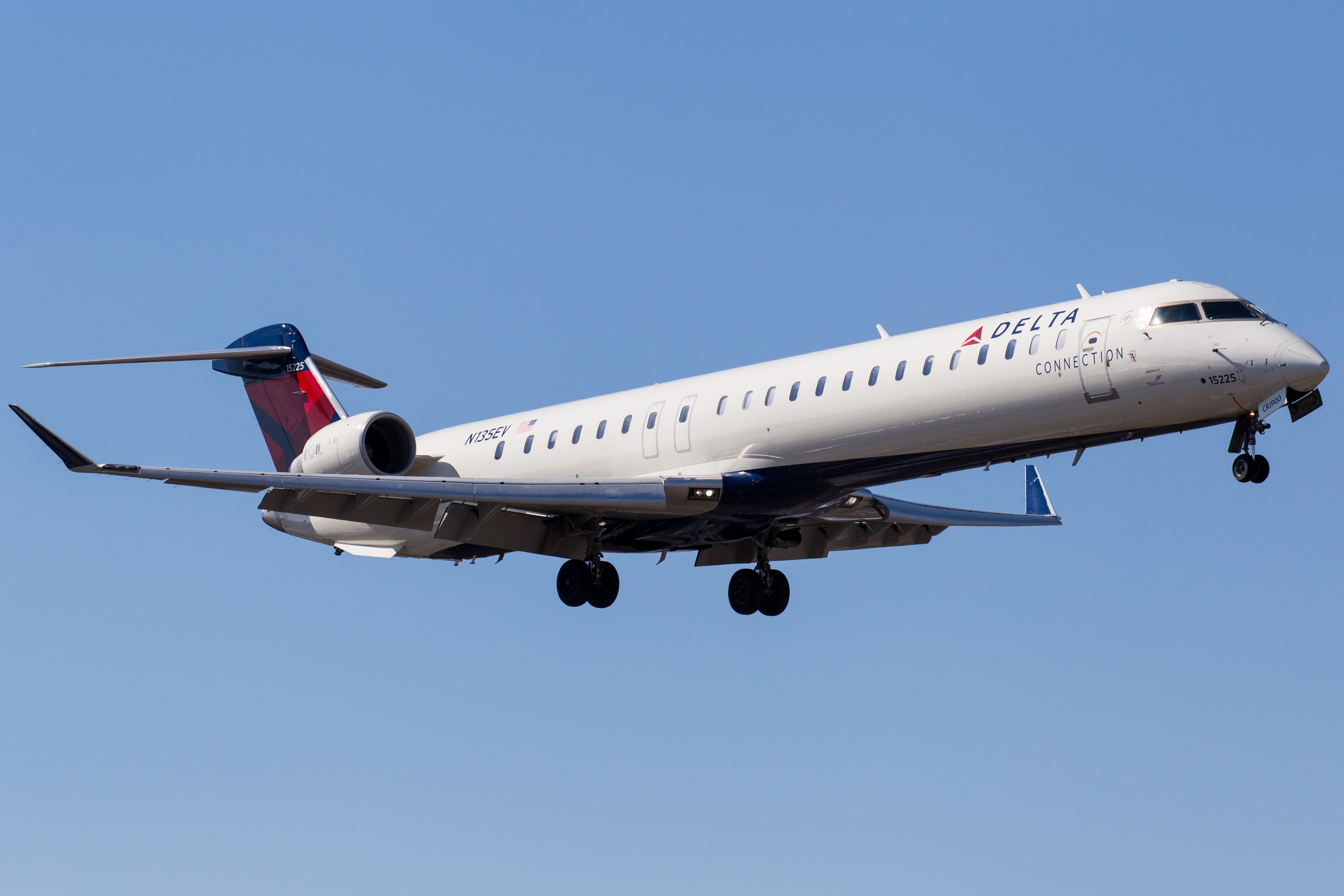
Delta Connection Jet Pulls Up at 100 Feet as Unauthorized Takeoff Crosses Path
A Delta Connection regional jet descended to about 100 feet above a LaGuardia Airport runway before its pilots pulled up as a private jet accelerated along an intersecting runway without takeoff clearance. The go-around ended the convergence of the two aircraft, which flight-tracking data indicates came within roughly 1,000 feet of each other.

The October 7 incident unfolded at about 3:55 p.m. local time. Delta flight DL5415, operated by Endeavor Air with a Bombardier CRJ900, was arriving from Omaha and approaching Runway 22. At the same time, a NetJets Embraer Phenom 300 operating for ExecJet as EJA398 began its takeoff roll on Runway 13.
The two runways intersect, so an aircraft landing on Runway 22 and another departing on Runway 13 can occupy crossing paths at runway level. Tracking data cited for the encounter put the CRJ900 at approximately 128 knots before it pulled up and the Phenom at about 90 knots. The reported altitudes, speeds and 1,000-foot proximity are tracking estimates rather than a final FAA reconstruction.
The go-around provided the immediate escape
Instead of continuing toward touchdown and the runway intersection, the Delta crew transitioned the CRJ900 from descent into a climb. A go-around is a standard maneuver available whenever a landing cannot be completed safely, but initiating it at roughly 100 feet means the aircraft was already near the end of its approach.
In this case, climbing away was the action that prevented the arrival from continuing along its landing path while the private jet was taking off across it. The maneuver supplied vertical separation and removed the Delta aircraft from the runway-level conflict before touchdown.
The clearance dispute began before the Phenom moved. Air traffic control recordings indicate that its crew believed it had been cleared to depart. The pilot stated an understanding of “cleared for takeoff, Runway 13.” Afterward, the controller told the crew, “I believe you were never cleared for takeoff, sir. You were cleared to line up and wait.” The pilot responded that “we got cleared for takeoff.”
Those instructions authorize different actions. “Line up and wait” permits an aircraft to enter the runway and take position, but it does not authorize the takeoff roll. FAA operating guidance requires a clearance before an aircraft takes off and calls for pilots to seek clarification when an instruction is not understood.
The FAA said the private jet “departed on an intersecting runway without air traffic control authorization” and is investigating. The agency had not publicly assigned a runway-incursion severity category when the incident details emerged.
Why the formal classification remains open
The FAA’s incursion scale runs from Category D, covering an event without immediate safety consequences, to Category A, a serious incident in which a collision was narrowly avoided. A Category B event involves reduced separation and significant collision potential that may require a time-critical corrective response. The FAA has not placed this event in any of those categories, and the reported closest distance alone is insufficient to do so.
The agency now assesses runway risk more broadly through its Surface Safety Metric, which became its primary runway-environment measure in October 2019. Its Surface Safety Risk Index considers outcomes across aircraft, vehicles and pedestrians, while the Aviation Risk Identification and Assessment system uses surveillance data including position, speed and vertical or lateral separation to identify potential collision risks.
Airport monitoring is another safety layer, but it is not a direct cockpit warning in most installations. Runway conflict systems can fuse radar, multilateration and aircraft-broadcast location data to identify intersecting traffic and alert controllers. Those alerts generally remain in the tower, leaving a controller to communicate instructions to the aircraft and adding human response and radio-transmission time.
The encounter came months after an Air Canada Express CRJ900 collided with an airport fire truck at LaGuardia on March 22, killing both pilots and injuring dozens. The NTSB’s preliminary findings described a different sequence in which the truck was erroneously cleared to cross while the aircraft was on short final. The airport’s detection equipment did not alert controllers before that collision, partly because emergency vehicles lacked transponders.
That earlier accident has prompted work on a separate surface-risk gap. As Aerospace America reported, the FAA accelerated plans to spend $16.5 million equipping 1,900 vehicles at 44 airports with location transponders, while MIT Lincoln Laboratory is developing an in-cab warning system that could alert vehicle drivers directly.
The October event instead centers on what the Phenom crew heard, what the controller transmitted and how the takeoff began without authorization. Investigators must reconstruct that exchange and the aircraft trajectories before assigning severity. The immediate safety result is already clear: with both jets moving toward intersecting runway paths, the CRJ900’s go-around at about 100 feet stopped the convergence from continuing.
| More aerospace and engineering stories, right in your MSN feed. Follow AMI on MSN |
By David Whitaker — Associate editor for AMI’s aerospace and drone systems desk, translating flight systems, aircraft programs, spaceflight, and UAV developments into accessible technical stories.



