


NASA’s Orion Trajectory Change Cut Heat-Shield Char-Loss Spots From 103 to Nine
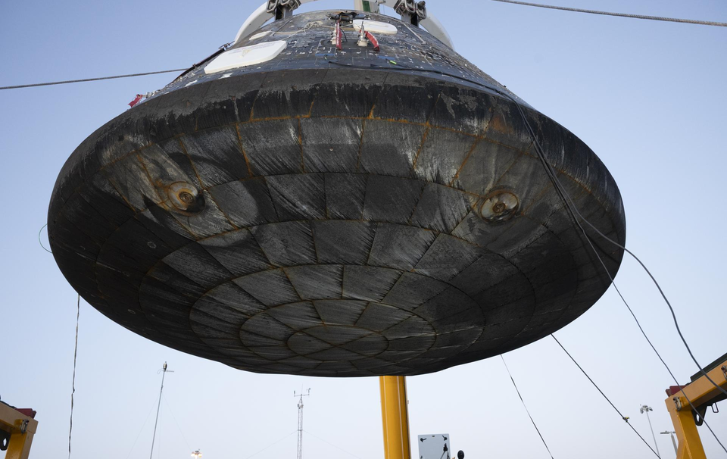
NASA found nine areas of char loss on Orion’s heat shield after the crewed Artemis II mission, down from 103 after the uncrewed Artemis I flight. The agency attributed the tenfold reduction in cracking and char loss to a revised atmospheric-entry trajectory that limited the spacecraft’s time in the temperature range associated with the earlier damage.
The comparison is consequential because Artemis II carried four astronauts around the Moon and marked the first crewed flight of Orion. During the return, the capsule reached 39 times the speed of sound and encountered external temperatures above 4,000 degrees Fahrenheit. Its cabin remained in the mid-70-degree range as the heat shield absorbed and shed the energy of a lunar-return reentry.
A trajectory change instead of a replacement heat shield
Orion flew Artemis II with the same basic heat-shield material used on Artemis I. NASA instead shortened the maximum allowable downrange distance during entry, modifying how the capsule moved through the upper atmosphere. The objective was to spend less time in the thermal conditions linked to the Artemis I char loss while retaining a controlled path to splashdown.
The operational change followed NASA’s investigation into the Artemis I heat shield. Engineers found that gases generated inside the ablative Avcoat material could not vent as expected during portions of the original entry profile. Pressure accumulated inside the material, producing cracks and causing charred sections to break away.
That mechanism made the entry environment a practical control point. Changing the trajectory could reduce exposure to the problematic temperature range without removing and rebuilding the already-installed Artemis II heat shield. NASA’s post-flight assessment found the resulting aerodynamic and aerothermal performance aligned with its preflight analysis and ground-test predictions.
The navigation results also stayed close to plan. Orion crossed its targeted atmospheric entry interface within 192 feet and splashed down 0.59 miles from its predicted landing point off San Diego. Those figures show that restricting the allowable downrange distance did not prevent the spacecraft from delivering a precise return.
Nine locations do not complete the damage assessment
The nine-versus-103 count is the clearest visual measure of improvement, but it is not a complete measure of heat-shield condition. The identified areas varied in size, and engineers are still calculating how much material receded across the shield. Teams are comparing post-flight laser scans with measurements taken before launch to establish that depth change.
NASA is also extracting samples and conducting material tests, assessments and thermal analysis at Marshall Space Flight Center. Those results will provide a more detailed account of how the 186 individual Avcoat blocks responded to the actual entry environment. Until that work is complete, the spot count demonstrates a substantial reduction in observed char loss rather than a final measurement of total material loss or damage severity.
The rest of Orion’s thermal protection system supplied another useful comparison. Its backshell uses 1,300 ceramic tiles to protect areas away from the main ablative heat shield. Visual inspections found the expected performance and no signs of overheating around protected penetrations, including the windows, vents, thrusters and side hatch.
Artemis III adds a manufacturing response
NASA is not relying on trajectory management alone for the next spacecraft. The agency made manufacturing upgrades to the Artemis III heat shield intended to produce more uniform Avcoat blocks with more consistent permeability. Permeability is central to the Artemis I finding because it helps gases formed during ablation escape rather than build pressure beneath the charred surface.
The Artemis III heat shield was attached to its crew module in early July, and the crew and service modules were joined at the end of that month. NASA says the mission is planned for next year in low Earth orbit, where it will test systems and operations for later lunar-landing missions.
Artemis II therefore delivered two different kinds of confidence: four astronauts returned safely through a lunar-entry environment, and the targeted trajectory mitigation produced far fewer visible char-loss locations. The remaining laser-scan and sample analyses will determine how closely that dramatic numerical improvement matches the heat shield’s total material recession.
| More aerospace and engineering stories, right in your MSN feed. Follow AMI on MSN |
By David Whitaker — Associate editor for AMI’s aerospace and drone systems desk, translating flight systems, aircraft programs, spaceflight, and UAV developments into accessible technical stories.



