


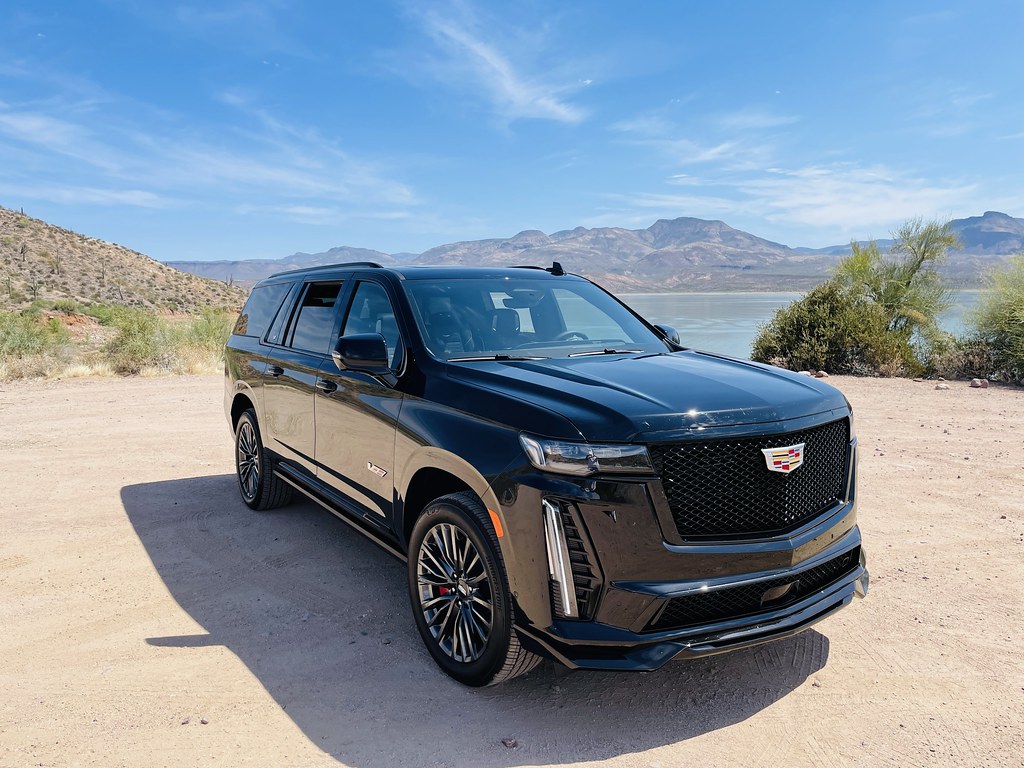
Six Cadillac Escalade IQs Destroyed in 18-Hour Dealership Fire
Six Cadillac Escalade IQ electric SUVs were destroyed in a fire at Frank Kent Cadillac in Fort Worth, Texas, where firefighters spent almost 18 hours containing and extinguishing the blaze. Two other unidentified Cadillac electric vehicles sustained minor damage, but nearby vehicles were moved to safety and no injuries were reported.

The fire began late Friday afternoon and already involved multiple electric vehicles when the Fort Worth Fire Department arrived. Investigators believe it started in one vehicle, likely an Escalade IQ, but the cause remains under investigation. No battery defect or even the battery itself has been identified as the ignition source.
Containment continued through the night
Crews covered the burning vehicles with specialized fire blankets intended to limit the spread. That containment work created enough separation for firefighters to move additional electric vehicles out of the surrounding area. Crews then remained at the dealership overnight, rotating personnel every two hours until the response concluded nearly 18 hours after it began.
The duration illustrates the operational burden that can accompany a group of burning electric vehicles. Suppressing visible flames is only one part of the response when a high-voltage battery may be involved. A damaged lithium-ion pack can retain heat internally, propagate a failure between cells or modules, release flammable gases and reignite after the exterior fire appears to have subsided.
A recent full-scale laboratory study induced thermal runaway in a 66-kilowatt-hour electric SUV battery and recorded renewed battery combustion late in the test. The researchers found that conventional vehicle materials including the cabin, plastics, tires and wiring accounted for much of the overall heat release, while the battery produced a longer and more complex fire progression. The test vehicle burned for about 108 minutes, compared with cited durations of 42 to 60 minutes for combustion-engine vehicles in other experiments.
That controlled test does not describe what happened in Fort Worth, where investigators have not identified thermal runaway. It does help explain why responders may continue cooling, isolating and monitoring electric vehicles long after the most visible phase of a fire. Six large electric SUVs burning close together also present a different containment problem from one isolated vehicle.
A large battery, but no established battery cause
The Escalade IQ is Cadillac’s full-size electric flagship. Introduced for the 2025 model year, it carries a 24-module battery with 205 kilowatt-hours of usable capacity and an estimated 465 miles of range. That is more than three times the battery capacity of the SUV used in the laboratory test, although capacity alone cannot establish how a real fire began or developed.
The 2026 Escalade IQ starts at $127,405, according to Edmunds’ model and recall listing. Seeing six examples of a six-figure luxury electric SUV destroyed at a dealership will understandably raise questions among owners and shoppers about whether their own vehicles are safe. The present investigation cannot yet answer that broader question, and a single dealership incident does not establish a safety rate for the model or for electric vehicles generally.
Fire-safety guidance developed by Australia’s National Transport Research Organisation offers another useful boundary: fewer than half of documented electric-vehicle fires in the research it reviewed originated in the battery system. Other ignition sources included familiar vehicle components such as wiring, tires and cabin materials. When a traction battery does become involved, however, delayed ignition, reignition, intense heat and gas release can complicate the response. The organization’s electric-vehicle fire guidance emphasizes warning recognition, evacuation and accurate information for emergency services.
The earlier recall remains a separate issue
The unresolved cause is especially important because General Motors recalled certain 2026 Escalade IQ and long-wheelbase Escalade IQL models in July. An improperly secured component inside the high-voltage battery could move and damage the battery, increasing fire risk. The remedy was replacement of the affected battery, and the recall covered 11 vehicles across several GM electric models.
No connection between that condition and the Fort Worth fire has been established. The affected model years of the six destroyed SUVs have not been identified, and there had been no previously reported Escalade IQ fires. The dealership blaze gives electric-vehicle skeptics a stark example of the containment challenge, while supporters can correctly point to the unknown ignition source. The next useful finding is narrower and more concrete: whether investigators locate the origin outside the battery, inside the pack or in another vehicle system entirely.
| More aerospace and engineering stories, right in your MSN feed. Follow AMI on MSN |
By Robert McKinney — Editor-in-Chief for AMI’s automotive and mobility coverage, with a mechanical engineering background and a decade reporting on powertrain systems, EV innovation, and global vehicle manufacturing.


