


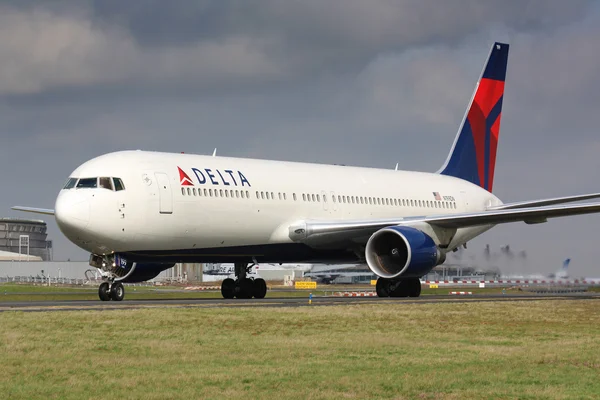
Delta Delays Atlanta-Riyadh Launch Until March After Airport Closure, 2,000 Cancellations
Delta Air Lines has pushed its first nonstop flight between Atlanta and Riyadh from Oct. 23 to March 2027 after attacks closed the Saudi capital’s main airport and disrupted thousands of flights. The planned service, using an Airbus A350-900, would have been the first nonstop commercial route between the United States and Saudi Arabia operated by a U.S. airline.

Delta confirmed the postponement in an Oct. 12 operational update, saying safety and security would continue to guide its decisions. The move turns what had been a landmark network expansion into a delay of more than four months, illustrating how rapidly an airport shutdown and an official air-safety warning can reshape an international route launch.
Airport closure becomes a network-scale disruption
King Khalid International Airport remained closed on Monday after authorities extended the suspension of operations to allow safety and operational-readiness work at its facilities. More than 2,000 flights to or from the airport had been canceled since the previous Thursday, according to FlightAware. The airport is Saudi Arabia’s second busiest after Jeddah, so its closure affected far more than Delta’s future service.
Airlines across Europe, Asia and the Middle East suspended Riyadh flights, with some cancellations extending through the week or later in October. The disruption also spread beyond flights terminating in Riyadh: operators had to assess whether they could safely use Saudi airspace, whether alternative routings were practical and whether schedules could still be supported reliably.
The airport shutdown followed attacks claimed by Yemen’s Iran-backed Houthis. Officials said a projectile struck a passenger terminal on Saturday, killing at least 12 people and injuring more than 300. Those details provide the immediate context for the closure, but Delta’s operational problem was broader: the destination airport was unavailable, other carriers were suspending service and the risk assessment for flying in the area had materially changed.
FAA warning widened the operating concern
On Sunday, the Federal Aviation Administration advised U.S. airlines and pilots to “exercise caution” when flying in or around Saudi Arabia. The warning cited safety-of-flight risks associated with ongoing military activity and navigation-system interference and was scheduled to remain effective until Dec. 10.
The FAA said potential threats could affect aircraft at all altitudes, including during overflight, arrival and departure. That scope is important for airline planning because avoiding one airport does not necessarily resolve a concern that also applies to cruise routes and surrounding airspace. A carrier must consider the complete operation, including dispatch planning, crew support, diversion options and the stability of the schedule over subsequent days.
Delta CEO Ed Bastian had indicated before the postponement that the route remained under review. “Safety is going to make the call,” he said Thursday. The airline later said it was coordinating with government and aviation partners, including Saudia and Riyadh Air, as conditions evolved.
A route launch requires more than an available aircraft
Launching a long-haul service involves a coordinated system of aircraft scheduling, trained crews, airport services, passenger connections and recovery plans. The A350-900 assigned to the route can be moved elsewhere, but repeatedly adjusting an uncertain start date would create knock-on effects across those linked resources. Moving the debut to March provides a wider planning interval than a short rolling delay.
For affected customers, Delta said flexible options include rebooking and a refund for the unflown portion of a trip. Its travel waiver directs passengers to review their itineraries through the airline’s app or website. U.S. Department of Transportation rules also provide refund rights for canceled or significantly changed flights when a traveler rejects the alternatives offered.
Delta continues to describe Saudi Arabia as an important long-term market and says it remains committed to serving the country. The March 2027 target preserves that plan, but the launch now depends on more than reopening the terminal: the airline will need operating conditions, airspace assessments and partner support to remain stable enough to sustain a new intercontinental schedule.
| More aerospace and engineering stories, right in your MSN feed. Follow AMI on MSN |
By Thomas Caldwell — AMI’s senior editor for mechanical and mobility engineering, covering vehicle electronics, systems integration, electrification, chassis systems, propulsion, and safety policy.



