


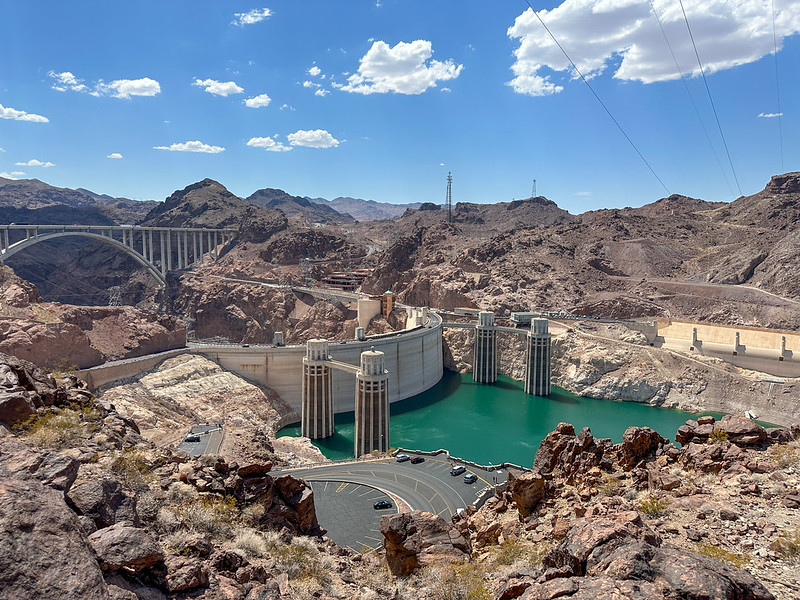
Hoover Dam Shutdown Would Cut 4% of Las Vegas Power, Not Water
Hoover Dam sits only about 30 miles from Las Vegas, but the city is far less dependent on the landmark than that proximity suggests. If the dam stopped generating electricity, the Las Vegas Valley would lose roughly 4 percent of its power supply, while its Lake Mead water supply would continue operating.
The more consequential electrical loss would be flexibility. Hoover’s turbines can increase output within minutes, giving grid operators a fast-response resource when demand rises or other generation falls. That capability is especially useful after sunset, when solar production declines but air-conditioning demand can remain high.
Las Vegas does not receive most of Hoover’s power
NV Energy serves the Las Vegas Valley and produces about 55 percent of its electricity from natural gas and 27 percent from solar. Hydroelectricity accounts for around 4 percent, equivalent to approximately 1.4 billion kilowatt-hours annually. Geothermal power contributes another 8 percent, helping bring the area’s renewable share to roughly 40 percent.
The Bureau of Reclamation’s list of Hoover Dam power recipients does not include Las Vegas as a city. Boulder City is the only Nevada city named on that list. Hoover’s electricity is distributed through a network of long-standing federal contracts: California receives approximately 56 to 58 percent, Nevada about 23 to 25 percent and Arizona 19 percent. Roughly 15 percent of the dam’s output goes to Los Angeles.
Nevada’s allocation is about 355 megawatts delivered into the Nevada Power system, so Hoover still contributes to the broader supply serving Southern Nevada. But its relatively small energy share means an outage would call for replacement generation or purchased power rather than automatically producing a citywide blackout.
The grid would lose a rapid balancing resource
Hoover operates at a capacity factor of about 18 percent, meaning it produces much less than its maximum theoretical annual output. That figure reflects its role as a peaking plant rather than a machine intended to run continuously at full output. Operators can conserve water when demand is lower and raise generation when the grid needs it most.
This distinction between energy quantity and operating capability becomes more important as solar expands. Natural-gas plants and other dispatchable resources can also balance the system, but losing Hoover would remove one source able to respond rapidly during the evening transition. Replacement electricity bought on the open market could also cost more than federal hydropower, which is sold at cost under established contracts.
Large Las Vegas customers would face that change within a diversified regional system. Smaller Nevada customers with greater dependence on the dam would be more exposed. Lincoln County Power District received all its electricity from Hoover until about 2005 and still obtains roughly 70 percent from it. Boulder City, with a population of around 15,000, also remains closely connected to the dam’s power allocation.
Water reaches Las Vegas through a separate system
Las Vegas obtains about 90 percent of its water from Lake Mead, but the Southern Nevada Water Authority draws it through dedicated intakes rather than Hoover’s turbines. The Third Straw intake is at an elevation of 860 feet, and the Low Lake Level Pumping Station runs on grid electricity. Stopping hydroelectric generation therefore would not, by itself, stop water deliveries.
Reservoir elevation still determines how much electricity Hoover can produce. The plant reaches minimum power pool and stops generating at 950 feet, but the nearer operational constraint is higher: most older turbines shut down and capacity drops sharply around 1,035 feet. Lake Mead was near 1,037 feet in the cited conditions, only about two feet above that threshold, although it remained roughly 88 feet above the absolute minimum power pool.
Reclamation estimated about a 10 percent chance of the reservoir crossing 1,035 feet in spring 2027. The agency is spending $52 million on wide-head turbines designed to operate across lower reservoir elevations. That work addresses the immediate machinery constraint, but it cannot preserve all of Hoover’s present output as the available hydraulic head declines.
A generation shutdown would also reduce revenue used for Colorado River infrastructure and environmental-compliance programs, extending the effect beyond utility procurement. Las Vegas could replace a relatively small block of energy and keep pumping water, but the regional system would lose a low-cost generator valued most for how quickly it can respond.
| More aerospace and engineering stories, right in your MSN feed. Follow AMI on MSN |
By Thomas Caldwell — AMI’s senior editor for mechanical and mobility engineering, covering vehicle electronics, systems integration, electrification, chassis systems, propulsion, and safety policy.



