


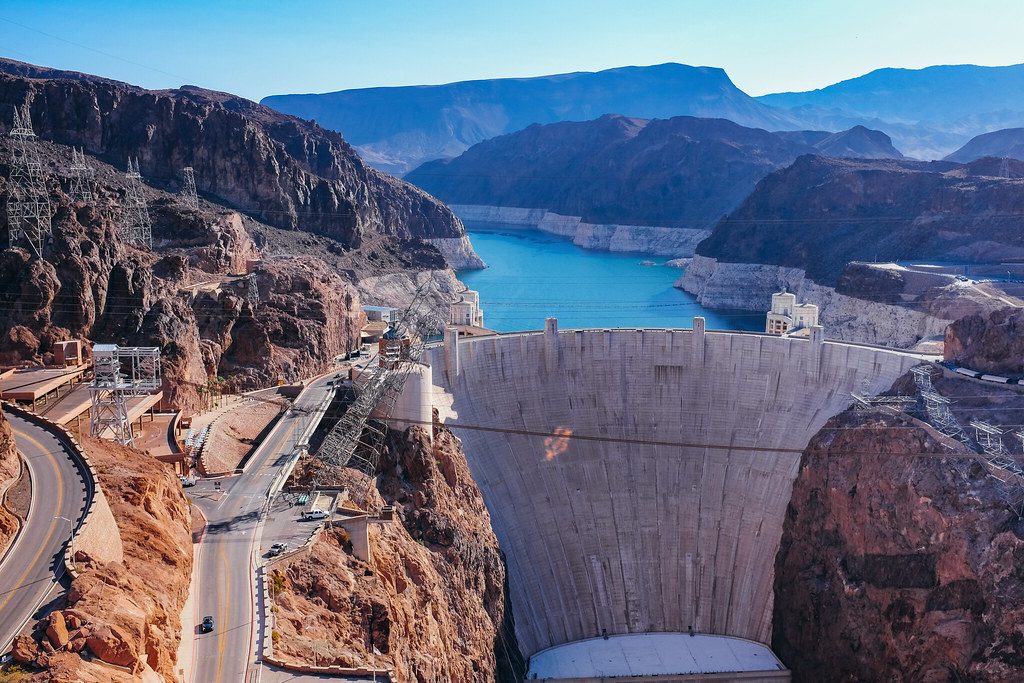
If Hoover Dam Could No Longer Release Water, Lake Mohave Would Drain
Lake Mohave’s ability to keep the lower Colorado River moving depends on water arriving through Hoover Dam. If Lake Mead fell to the point where gravity could no longer carry water through the dam’s outlets, Mohave could temporarily maintain downstream deliveries but only by draining its own stored supply.

This is a worst-case engineering scenario, not an imminent forecast. Lake Mead was near 1,040 feet in 2026, while the stated dead-pool threshold is 895 feet. An October projection placed the reservoir at approximately 1,009.85 feet in July 2028 under the cited operating scenario, nearly 13 feet above the previous month’s projection and still about 115 feet above dead pool. Reclamation attributed the improved outlook partly to new conservation agreements and slightly lower projected water use.
A reservoir designed to regulate upstream releases
Lake Mohave begins immediately below Hoover Dam and extends toward Davis Dam, about 67 miles downstream. It is not an independent water source in the usual sense: almost all the water replenishing it is released from Lake Mead. Davis Dam catches that flow, stores it and regulates its movement farther downriver.
Two elevations define the potential failure progression at Hoover. At approximately 950 feet, Lake Mead would reach minimum power pool, where insufficient hydraulic head would prevent normal hydroelectric generation. Water could still pass through other outlets. At 895 feet the stated elevation at the bottom of Hoover’s intake towers the remaining water could no longer flow through the dam’s outlets by gravity.
Lake Mohave holds about 1.8 million acre-feet behind Davis Dam. Once Hoover releases stopped, operators could continue sending some of that stored water downstream. Every such release, however, would lower Mohave because its principal inflow had disappeared. The depletion rate would depend on release decisions, demand, evaporation and any limited additional inflows, so the available figures do not establish a fixed timeline.
This makes Mohave a hydraulic buffer rather than a durable substitute for Lake Mead. Its storage could delay a disruption, but using the buffer to preserve deliveries would consume it.
The drawdown would move toward Lake Havasu
Water released through Davis Dam flows next toward Lake Havasu, impounded by Parker Dam. Havasu has approximately 646,200 acre-feet of total capacity far less than Mohave and contains major withdrawal points serving Arizona and Southern California.
The Central Arizona Project draws Colorado River water from Lake Havasu for delivery toward Phoenix and Tucson. The Metropolitan Water District’s intake for the Colorado River Aqueduct is about two miles upstream of Parker Dam. According to the Bureau of Reclamation’s Parker Dam profile, that aqueduct runs 242 miles to Lake Mathews near Riverside, California.
Havasu also links water delivery to power production. About half of Parker Dam’s electricity is reserved for the Metropolitan Water District to help pump water along the aqueduct, while the reservoir’s active storage used for hydropower is contractually limited to elevations between 440 and 450 feet. A prolonged loss of replenishment would therefore place water storage, pumping energy and delivery reliability under pressure together.
Davis and Parker dams would lose hydropower capability as usable head and flow declined. Lower Colorado River deliveries, including treaty water for Mexico, would also become increasingly difficult to sustain. Las Vegas has a partial exception because its deep Lake Mead intake can pump below the dead-pool elevation, but that infrastructure would not restore gravity-fed releases through Hoover or refill the downstream reservoirs.
Habitat would shrink with the operating buffer
Drawing down Lake Mohave would affect more than municipal supply and power. The reservoir supports the largest remaining wild population of the endangered razorback sucker, as well as the endangered bonytail chub. Biologists collect tens of thousands of razorback sucker larvae along Mohave’s shoreline each spring and raise them in protected conditions. Major storage loss would reduce the aquatic and shoreline habitat supporting that recovery work while also disrupting recreation.
Current planning is intended to prevent the reservoir chain from approaching these physical limits. A 10-year operating framework allows aggregate Lower Basin deliveries to be reduced by as much as 3 million acre-feet annually if reservoir levels continue declining and the states do not reach an alternative agreement. Nearer-term projections remain well above Hoover’s dead-pool threshold, but they cannot change the system’s underlying geometry: Hoover, Davis and Parker dams operate as connected stages. If the first stage stopped passing water, Lake Mohave’s 1.8 million acre-feet would buy time only by steadily emptying the next reservoir in line.
| More aerospace and engineering stories, right in your MSN feed. Follow AMI on MSN |
By Thomas Caldwell — AMI’s senior editor for mechanical and mobility engineering, covering vehicle electronics, systems integration, electrification, chassis systems, propulsion, and safety policy.



