


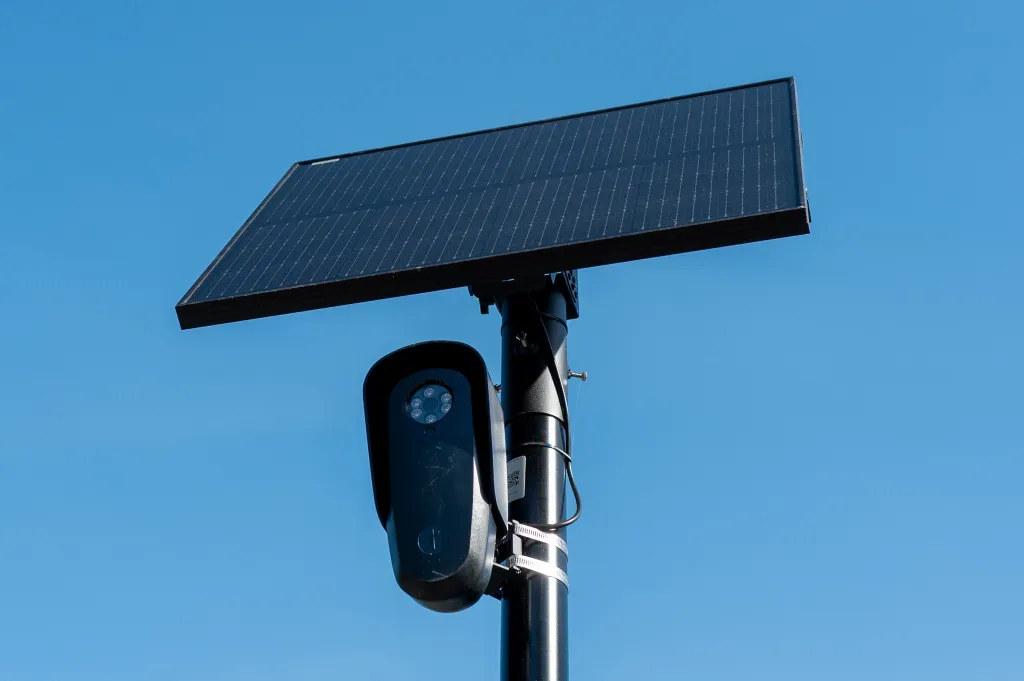
Federal Judge Suppresses Evidence After Flock Search Reconstructed Month of Driving
A federal judge has suppressed evidence obtained after a sheriff’s deputy searched approximately one month of a driver’s Flock camera records, finding that the warrantless database query violated the Fourth Amendment. The search returned more than 50 vehicle sightings across multiple states, turning separate public-road observations into a retrospective account of the vehicle’s travels.
U.S. District Judge Sara E. Hill’s ruling in Oklahoma draws a line between seeing a license plate on a road and retrieving an accumulated location history. As detailed in The Washington Post’s account of the decision, Hill characterized the network as a form of “indiscriminate mass surveillance,” while also acknowledging the “remarkable benefits” automated plate readers can provide law enforcement.
The database, not an individual camera, changed the analysis
A Flock camera does not continuously follow a vehicle. It records a detection when the vehicle passes, including its plate, location and time. Other connected cameras make similar records elsewhere. The system’s more consequential function appears when those detections are retained, shared and made searchable through one interface.
The resulting architecture has three essential layers: distributed roadside sensors, stored detection records and software capable of querying those records. Together they lower the effort required to reconstruct movement across days or jurisdictions. Surveillance that once would have required officers to be stationed at multiple locations can be performed later, after the vehicle or driver becomes a subject of interest.
Automated plate-reader systems also operate in two distinct modes: they can issue real-time alerts when a vehicle matches a hot list, or support post-hoc searches for a vehicle identified after an event. Modern systems may record visible characteristics including make, model, color, direction of travel and vehicle damage, according to a review of the technology and its policy tradeoffs. Those additional fields can make a database useful even when investigators do not begin with a confirmed plate number.
The Policing Project at NYU School of Law similarly describes a roughly 30-day plate search as a location-tracking function. It also notes that systems can support custom hot lists and increasingly sophisticated analysis of relationships between vehicles based on driving patterns. Minnesota requires police to obtain a warrant before using plate-reader data for tracking, offering one legislative model for separating immediate alerts from historical movement searches.
Why separate public sightings can become a protected history
The ruling reflects the logic commonly called mosaic theory: facts that reveal little individually can produce a substantially more detailed picture when aggregated. One detection establishes that a vehicle passed one camera. Dozens can disclose routes, timing, recurring destinations and travel between states.
The Supreme Court did not formally adopt mosaic theory when it decided United States v. Jones, a case involving GPS monitoring of a vehicle; the majority resolved Jones under a property-based trespass analysis. A later decision, Carpenter v. United States, held that obtaining historical cellphone-location records containing 12,898 points over 127 days constituted a Fourth Amendment search. Cornell Law School’s overview of mosaic theory explains how those cases shaped the continuing debate over aggregated location data.
Flock detections are less continuous than cellphone or GPS records, but Hill treated the network’s retrospective reach and low search burden as constitutionally significant. A driver need not be under active surveillance when passing the cameras. Records can be collected first and queried later, permitting officials to choose afterward whose past movements to examine.
The traffic stop and historical search received different rulings
The case arose after Tulsa County sheriff’s deputy Freddie Alaniz saw Melisa Kyle driving a vehicle with California plates and queried the plate in Flock. He later stopped her for following another vehicle too closely and allegedly failing to signal lane changes properly. Hill found an objectively reasonable basis for the traffic stop but ruled that retrieving the historical Flock records was an unconstitutional search.
Because the government did not establish an adequate exception to the exclusionary rule, Hill excluded evidence obtained after the Flock query as derivative of that search. The ruling therefore does not prohibit an officer from reading a visible plate, invalidate every traffic stop involving plate-reader information or impose a nationwide ban on the technology.
It is a federal district court decision in one case, and most courts considering related plate-reader questions have reached the opposite result. Neither the Supreme Court nor the 10th U.S. Circuit Court of Appeals has definitively resolved whether this type of historical search is covered by the Fourth Amendment. Flock was not a party; a company spokesman said the ruling conflicts with the weight of authority, is not controlling precedent and is expected to be appealed.
The next legal boundary will depend not only on what each roadside camera sees, but on retention periods, network reach and how easily software can convert scattered detections into a person’s travel history. In this case, more than 50 sightings over one month were enough for the judge to place the database search on the protected side of that line.
| More aerospace and engineering stories, right in your MSN feed. Follow AMI on MSN |
By Thomas Caldwell — AMI’s senior editor for mechanical and mobility engineering, covering vehicle electronics, systems integration, electrification, chassis systems, propulsion, and safety policy.



