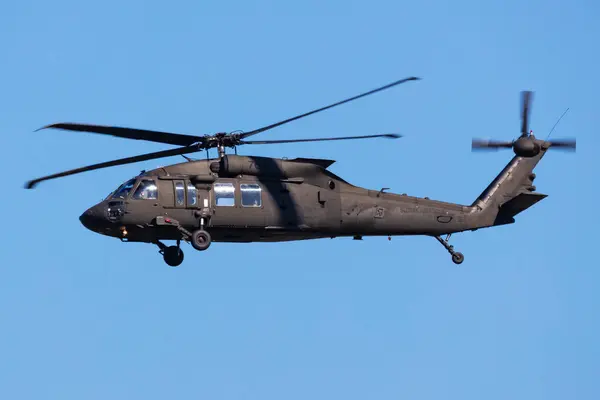
Black Hawk Flew 78 Feet Above Its Reading Before Collision Killed 67
A U.S. Army Black Hawk was actually 278 feet above the Potomac River when its altimeter indicated 200 feet shortly before the helicopter collided with American Airlines Flight 5342. All 67 people aboard the two aircraft died in the Jan. 29, 2025 collision near Ronald Reagan Washington National Airport.
The discrepancy is one part of the Army’s investigation released in October 2026, which identified failures across instruments, communications, training and safety management. The investigators did not designate the altitude error as the sole cause and found no mechanical failure of the Black Hawk. They instead described a layered safety system in which multiple defenses were unavailable, inadequate or ineffective at the same time.
The permitted error exceeded the route’s safety margin
Older Black Hawks used barometric altimeters that could vary by as much as 140 feet while remaining within Army flight limits. The accident helicopter also carried auxiliary fuel tanks, which investigators found could affect altitude readings. A fleet-wide study of how weather and operating conditions influence altimeter accuracy remained incomplete.
The route geometry left little room for such variation. The helicopter route and the approach used by the regional jet provided as little as 75 feet of vertical separation. The accepted altimeter tolerance was therefore substantially larger than the minimum route clearance an imbalance the Army report explicitly identified as inadequate for absorbing the known measurement uncertainty.
An altimeter error alone does not determine an aircraft’s position or cause a collision. Safe separation depends on route design, controller information, crew perception, surveillance and independent traffic-warning systems working together. But when a permitted instrument error can exceed the physical clearance between routes, those other layers must compensate consistently. Here, several did not.
Communications and visual identification added uncertainty
The Army identified two broken radio transmissions as the most significant contributing factor. Investigators also faulted air traffic control for incomplete advisories that omitted useful direction-and-distance information about the approaching jet. The Black Hawk crew likely focused on the wrong aircraft while operating with night-vision goggles against dense urban lighting, making positive identification more difficult.
The helicopter was also not broadcasting key location data because its Automatic Dependent Surveillance-Broadcast Out system was inoperable. Following that finding, the Army inspected approximately 3,600 helicopters for broadcast functionality by July 2025. It also strengthened training and surveillance checks and began pursuing a data-sharing agreement with the Federal Aviation Administration.
Location broadcasting is another protective layer, not a replacement for adequate route clearance, reliable altitude information or complete controller instructions. Its absence reduced the information available to the wider traffic system precisely when visual identification and radio communication were also degraded.
Earlier warnings were not organized into usable safety data
The Army lacked a formal definition and reporting system for near misses. An interagency group covering Washington-area helicopter operations did not systematically discuss airspace violations, close calls or pilot deviations. Without common definitions and structured reporting, repeated hazards are harder to measure, compare and elevate into route or procedural changes.
The National Transportation Safety Board later said the Army’s aviation safety system had failed to consistently detect, interpret and act on signs of latent hazards. Although the NTSB reported significant Army progress on seven of its eight recommendations, that assessment leaves additional work outstanding.
Proposed legislation would extend the response beyond inspections and training. The ROTOR Act outlined by Congress would generally require equipment that receives nearby-aircraft information, narrow the sensitive-government-mission exception for location broadcasting and add federal audits of how that exception is used. It would also establish stronger FAA-military coordination and safety-information sharing.
The Senate passed its ROTOR Act version in December 2025, while a related House measure followed a different path. Negotiators were still working to reconcile the ROTOR and ALERT proposals, so no combined measure had become law.
Operational changes have moved faster than the broader institutional response. The Army issued a service-wide warning about possible altimeter error and improved training near Reagan National, while the FAA restricted reliance on visual separation in busy airspace. Yet important Army findings supplied to families remain redacted, including interview material and specific altimeter information. The report listed no disciplinary action, the wider fleet study was unfinished, and a revised Black Hawk operator manual was not expected until 2027. Until those steps are complete, the 78-foot discrepancy remains a documented warning about an instrument tolerance that was larger than the airspace margin designed to contain it.
| More aerospace and engineering stories, right in your MSN feed. Follow AMI on MSN |
By Thomas Caldwell — AMI’s senior editor for mechanical and mobility engineering, covering vehicle electronics, systems integration, electrification, chassis systems, propulsion, and safety policy.