


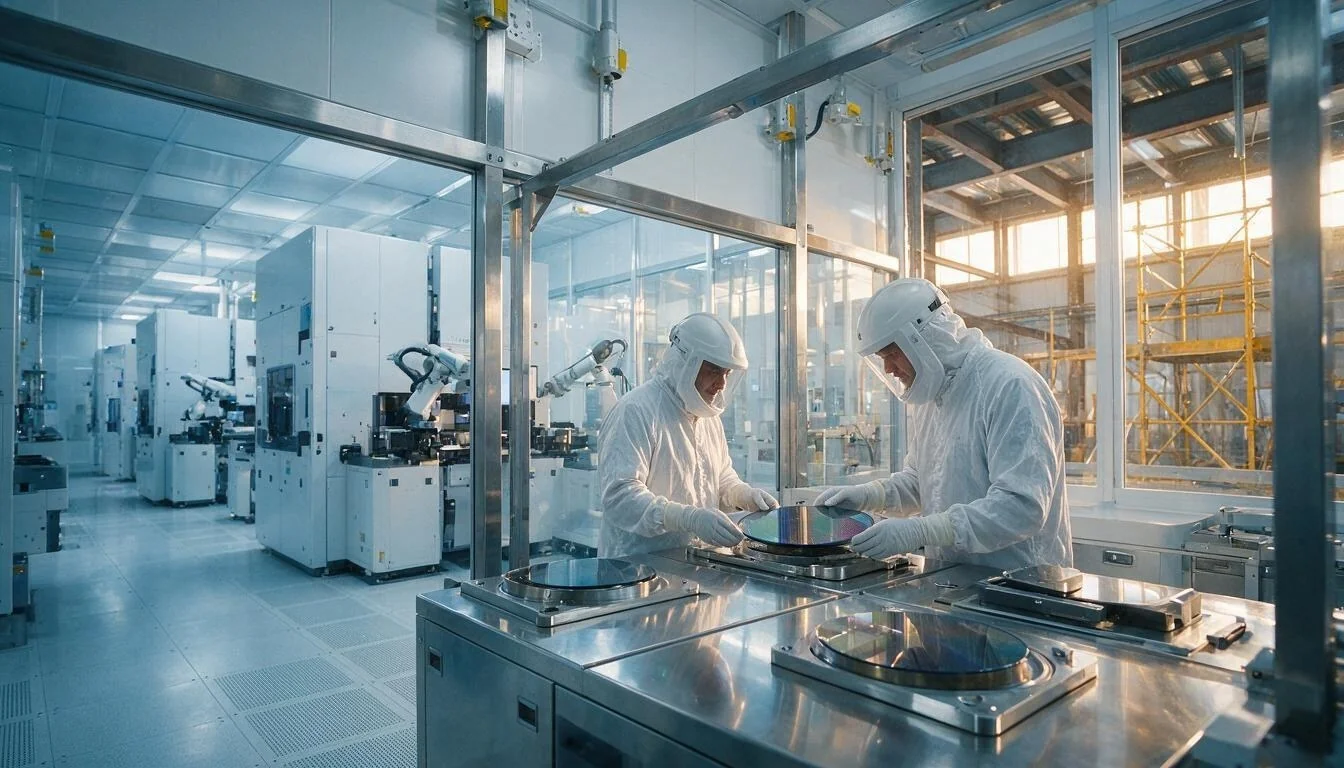
SpaceX and Tesla Target 2028 Terafab Chip Production Despite Schedule Risk
SpaceX and Tesla want their planned Terafab semiconductor complex to reach volume chip production in late 2028, but Elon Musk is warning that the deadline may not hold. During a SpaceX conference call on October 20, Musk described third-quarter production as an internal aspiration and said the fourth quarter was also among the possible outcomes, according to Reuters.

“I put big error bars on this because we don’t know if we will actually achieve this or not,” Musk said. He called the proposed dates “very aggressive.” That caution defines the engineering challenge: Terafab is trying to progress from an initial process-development chip to an operating advanced factory in roughly two years, while construction, production-tool deliveries and manufacturing integration remain substantial constraints.
The proposed Texas complex would combine advanced logic and memory manufacturing with chip packaging and testing. Its intended customers include the computing systems behind SpaceX and Tesla operations, artificial intelligence and robotics. Reuters reported that the project ultimately aims to produce one terawatt a year of computing power, although the companies have not disclosed the venture’s complete structure or expected investment.
The first milestone is working silicon
The earliest stated technical checkpoint is much closer than the volume-production date. Terafab’s Austin research facility is targeting a functional test chip using static random-access memory, or SRAM, circuits around May or June 2027.
That chip would be a process-development vehicle rather than proof that the complete factory is ready for commercial output. SRAM structures are commonly used to refine semiconductor processes because they provide engineers with repeatable circuits for assessing whether manufacturing steps produce functioning silicon. A successful test can reveal that a process works at research scale, but volume manufacturing additionally requires stable yields, production controls, repeatable tool performance and integration with packaging and testing.
The SRAM milestone therefore offers the first practical way to evaluate Terafab’s schedule. Missing it would reduce the time available for process refinement before the planned 2028 ramp. Meeting it would demonstrate progress, but it would leave the largest industrial tasks ahead.
Factory construction and equipment must advance in parallel
Advanced logic factories in the United States can take three years or more to build. Terafab’s schedule implies that facility construction, process engineering, equipment procurement and workforce development will need to overlap rather than proceed as a comfortable sequence.
Production tools are another limiting factor. Leading-edge semiconductor equipment is expensive, technically complex and available from a relatively small group of suppliers. Extreme-ultraviolet lithography machines from ASML are required for the most advanced chips, while the project may also need equipment from Applied Materials and KLA for other manufacturing and process-control stages.
When asked whether Terafab had ordered ASML’s extreme-ultraviolet machines, Musk did not directly confirm an order. He instead thanked ASML and other suppliers for accelerating deliveries in support of the proposed schedule. Until equipment orders, deliveries and installation progress become clearer, the 2028 date remains exposed to a supply chain that Terafab cannot control by construction speed alone.
Tool delivery is not the end of procurement risk. Each machine must be installed, calibrated and connected to the wider production flow. Logic, memory, packaging and testing also have to operate as one manufacturing system. Bringing those functions together could shorten logistics once production stabilizes, but it increases the number of interfaces that must be commissioned before dependable output can begin.
Partners are involved, but their roles remain unclear
Intel said in April that it would join Terafab to help accelerate the project’s goals, although the companies have not explained how that collaboration will work. Musk has also discussed possible cooperation with Taiwan Semiconductor Manufacturing Company. He subsequently said SpaceX and Tesla would build and operate the complex themselves, while suggesting TSMC might sublease part of it.
That operating commitment raises the importance of staffing as well as physical construction. Semiconductor factories require experienced process engineers, equipment specialists and technicians before installed machinery can become reliable production capacity. A 2026 SEMI discussion of regional talent shortages cited a McKinsey analysis finding that the U.S. semiconductor manufacturing workforce was 43% below its 2000 peak, illustrating the competition for experienced personnel as multiple American factories expand.
Terafab’s progress can now be judged against three visible gates: a functional SRAM test chip around May or June 2027, evidence that critical production equipment is arriving and being installed, and a transition to repeatable logic and memory output by late 2028. The first chip would establish a process starting point. The factory, tools and integrated production system will determine whether Musk’s aggressive deadline becomes manufacturing capacity rather than an aspiration.
| More aerospace and engineering stories, right in your MSN feed. Follow AMI on MSN |
By Thomas Caldwell — AMI’s senior editor for mechanical and mobility engineering, covering vehicle electronics, systems integration, electrification, chassis systems, propulsion, and safety policy.



