


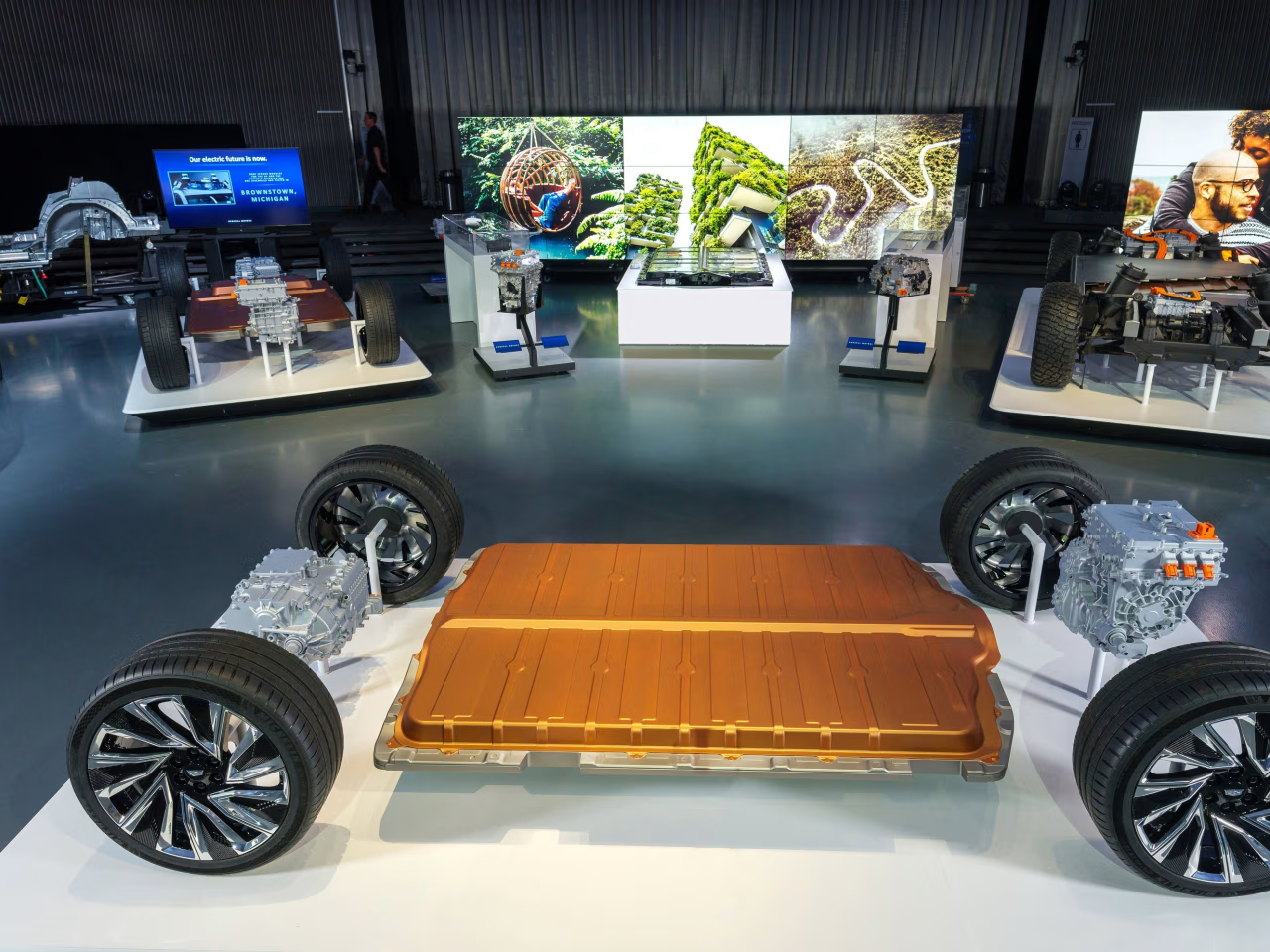
GM Simulated 300,000 EV Battery Designs, but Production Waits Until 2028
General Motors has compressed an extraordinary amount of battery design work into computers, but the cells that matter still have to survive physical testing and mass production. GM says it simulated more than 300,000 designs for its next electric-vehicle battery before building one physical cell, consuming 300 million CPU hours the equivalent of one computer running continuously for roughly 34,000 years. Yet volume production is not planned until 2028.
That gap defines the project. The enormous computing effort allowed GM’s battery team to move from its first pack concept to formal program approval in one month. GM presents simulation-led development as a way to reduce a conventional four-to-five-year vehicle program to about two years. The 34,000-year figure shows the scale of virtual screening, but it does not yet demonstrate that a production-ready battery can complete its full development cycle in half the usual time.
What 300,000 virtual designs can accomplish
Battery development involves choices that interact: cathode composition, electrode design, cell dimensions, thermal behavior, pack packaging and manufacturing requirements. Building every candidate would be too slow and expensive. Simulation lets engineers discard weak combinations early, concentrate laboratory work on more promising candidates and evaluate how changes at the cell level affect the complete vehicle.
This is where the computing scale has practical value. The objective is not to replace physical cells but to reduce how many must be built before engineers find a viable design. GM battery executive Kurt Kelty said the company selected its lithium manganese-rich chemistry with perhaps 60% to 70% of the data available. That reflects a development model based on making an earlier program decision, then using testing and additional data to refine it.
The chemistry, commonly shortened to LMR, is central to GM’s claim. The company says its planned cells can provide 33% more energy density than lithium iron phosphate batteries at comparable cost. Lithium iron phosphate is widely used where affordability and durability take priority over maximum energy storage. If GM’s projection holds in production, a vehicle could obtain more range from a similarly priced battery or use a smaller, lighter pack for the same range.
GM battery engineer Andy Oury said the new cells use roughly 30% to 40% nickel, compared with about 85% in current high-nickel cells. That creates a potential middle position between inexpensive iron-based chemistry and costly high-nickel batteries: more energy than lithium iron phosphate without relying on the same nickel concentration as GM’s existing long-range cells.
Physical cycling remains the decisive test
Lithium-rich manganese cathodes have long presented difficult durability problems. Academic reviews identify irreversible capacity loss, voltage decay and structural changes during repeated cycling as barriers to commercialization. A 2026 review of lithium-rich layered oxides describes voltage decay during long-term cycling as a critical application challenge involving reactions and degradation across multiple physical scales.
GM says it has solved LMR’s short cycle life and voltage-decay problems. Physical validation now has to show that the cells retain useful energy and voltage through repeated charging, different temperatures and the service life expected of an automobile. Simulation can narrow the design space, but durability data must come from manufactured cells whose materials and production variation reflect the eventual factory process.
GM’s $900 million Battery Cell complex in Warren, Michigan, is expected to become fully operational later this year and ramp toward producing a couple thousand cells per day. That capacity should give engineers far more hardware for validation than small laboratory batches can provide. It also creates an intermediate step between a successful prototype and automotive-scale manufacturing.
For volume production, GM and LG Energy Solution plan to modify their Ultium Cells factory in Spring Hill, Tennessee. The joint venture says the plant upgrade is expected to be completed in 2028, when it intends to mass-produce prismatic LMR cells.
A battery claim tied to the whole vehicle
GM projects that its fourth-generation EV platform will travel about 20% farther per kilowatt-hour than its current vehicles. That estimate combines the battery with a vehicle expected to be 15% lighter and 25% more aerodynamic, plus a 20% more compact pack and drive units containing 40% fewer parts. Those are system-level projections, not completed production results, but they show why GM is evaluating the battery alongside propulsion, structure and aerodynamics rather than treating the cell in isolation.
The company is extending the same simulation strategy into software and manufacturing. It says its autonomous-driving software records more than 3 billion simulated miles per day, while its PlantBrAIn factory system has moved battery packs through assembly 30% faster. These examples support GM’s broader argument that virtual development can accelerate engineering, although a battery’s electrochemical aging places different demands on validation than software or factory-flow modeling.
GM also frames the faster process as necessary to compete with China’s battery industry. The test will not be the number of virtual designs alone. It will be whether Warren can produce repeatable cells, whether those cells retain their claimed performance through physical cycling, and whether Spring Hill can turn them into affordable automotive batteries at volume in 2028.
| More aerospace and engineering stories, right in your MSN feed. Follow AMI on MSN |
By Robert McKinney — Editor-in-Chief for AMI’s automotive and mobility coverage, with a mechanical engineering background and a decade reporting on powertrain systems, EV innovation, and global vehicle manufacturing.


