Nikola Tesla’s 1898 Boat Turned Radio Pulses Into Steering Commands
A radio pulse reached Nikola Tesla’s small steel boat, altered the electrical state of a receiver and released an electromechanical sequence. Relays, contacts and a motor then moved the rudder. Another pulse advanced the mechanism again, giving the operator a small but useful command set without any control wire running to the vessel.

Tesla publicly demonstrated the system at Madison Square Garden in 1898, steering the boat from a separate wooden control box when wireless control was unfamiliar to most observers. The demonstration is identified as the first public showing of a radio-controlled vehicle, and Tesla’s US patent 613,809, dated November 8, 1898, described controlling the propulsion, steering and other mechanisms of a moving vessel from a distance.
A receiver that had to reset itself
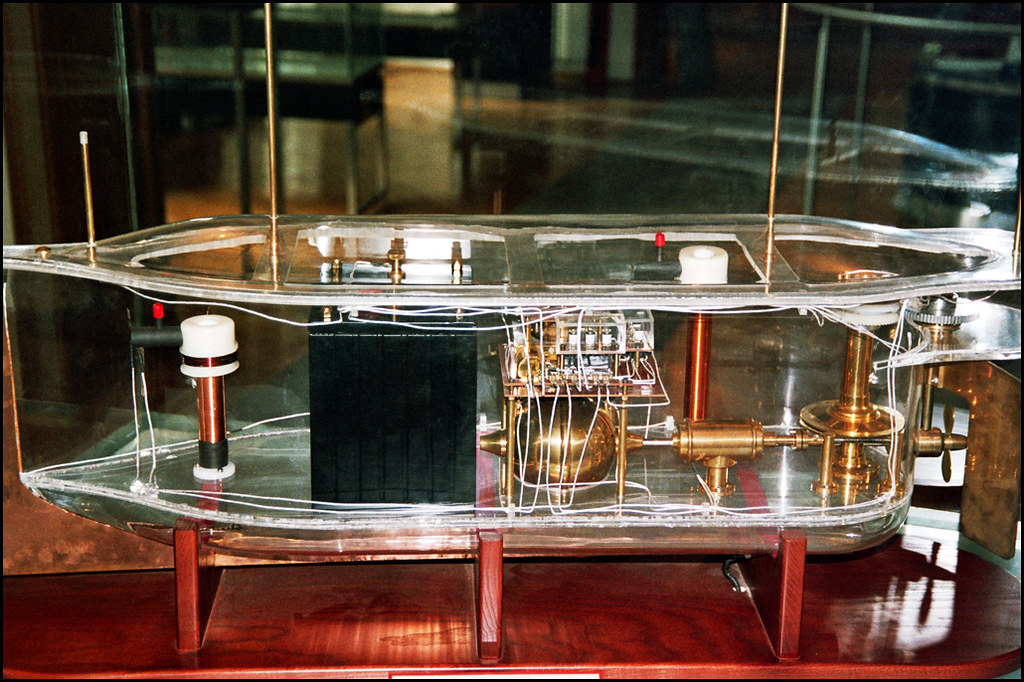
The boat carried the basic physical elements still found in remotely operated machines: a source of propulsion, a steering actuator, a receiver and control logic connecting incoming signals to mechanical actions. Its roughly three- to four-foot hull also carried antennas and lights, making its responses visible to the audience.
The difficult part was reliably detecting a weak radio disturbance and converting it into repeatable movement. Tesla used a sensitive device containing conducting particles. When a radio signal arrived, the material became conductive enough to energize a local relay. The apparatus then mechanically shifted the particles so that the detector returned to its previous, nonconducting condition and could receive another command.
That reset operation was essential. A detector that reacted once but remained conductive would not provide dependable sequential control. Tesla’s design therefore combined sensing and restoration: it detected the radio pulse, triggered the control circuitry and prepared itself for the next pulse.
The relay also released a clockwork-like stepping arrangement. Each received pulse moved a rotating contact mechanism to another position. Depending on that position, electrical circuits could command the steering motor to move the rudder left or right, leave it centered or control propulsion. The operator was not continuously transmitting a proportional steering angle as a modern joystick might. Instead, pulses advanced a mechanical state machine through predetermined contact arrangements.
This approach purchased multiple functions with a relatively simple radio link. The transmitter did not need to encode and send a large stream of digital data. Much of the command interpretation resided aboard the boat in the sequencing of contacts, relays, gears, springs and motors. Its limitation was equally clear: the available actions were constrained by the states physically built into that mechanism.
Remote control was not autonomy
Tesla called the vessel a “machine with a borrowed mind,” an apt description of where its decisions originated. The boat received commands from a human operator and executed them through onboard hardware. It did not sense its surroundings, plan a route or independently decide how to reach a goal.
That makes the machine an early teleoperated vehicle rather than an autonomous robot. Modern robotics draws the same boundary. In pure teleoperation, a human supplies the commands over a communications link. Autonomous systems add onboard perception, decision-making and control. Shared-autonomy research goes further by combining operator input with machine assistance; a recent model-predictive-control study, for example, evaluated a system that adapted human commands while assisting with task completion.
Tesla’s boat nevertheless anticipated a durable systems architecture. A remote operator generated an instruction, a communications channel carried it, a receiver detected it, control hardware selected a state and actuators produced physical movement. That chain now appears in machines ranging from inspection robots to remotely operated ocean and space systems, although contemporary platforms use far more capable sensing, computation and feedback.
A working machine beside an unrealized vision
The public boat demonstration belongs with Tesla’s demonstrated engineering rather than with every later proposal associated with his name. His alternating-current work also progressed into deployed infrastructure: an AC system was installed at Niagara Falls and was transmitting electricity about 35 kilometers to Buffalo by 1896.
Wardenclyffe followed a different course. J.P. Morgan committed $150,000 to the project, and construction began on Long Island in 1901. Tesla proposed sending electrical energy through the Earth to specially tuned receivers, but no worldwide wireless-power system was completed. Funding ran out, Tesla lost the property over unpaid debts and the tower was demolished in 1917.
The contrast is sharper than the popular image of Tesla as a predictor of distant technologies. Wardenclyffe remained unrealized, while the 1898 boat crossed the harder threshold from concept to public operation. Radio pulses arrived, onboard mechanisms changed state and the rudder physically moved an early remote machine working in front of an audience decades before wireless control became ordinary consumer technology.
| More aerospace and engineering stories, right in your MSN feed. Follow AMI on MSN |
By Jonathan Barrett — Editor for AMI’s future mobility and autonomous systems section, with two decades covering robotics, e-mobility, drone-vehicle convergence, and transport mechanical systems.