


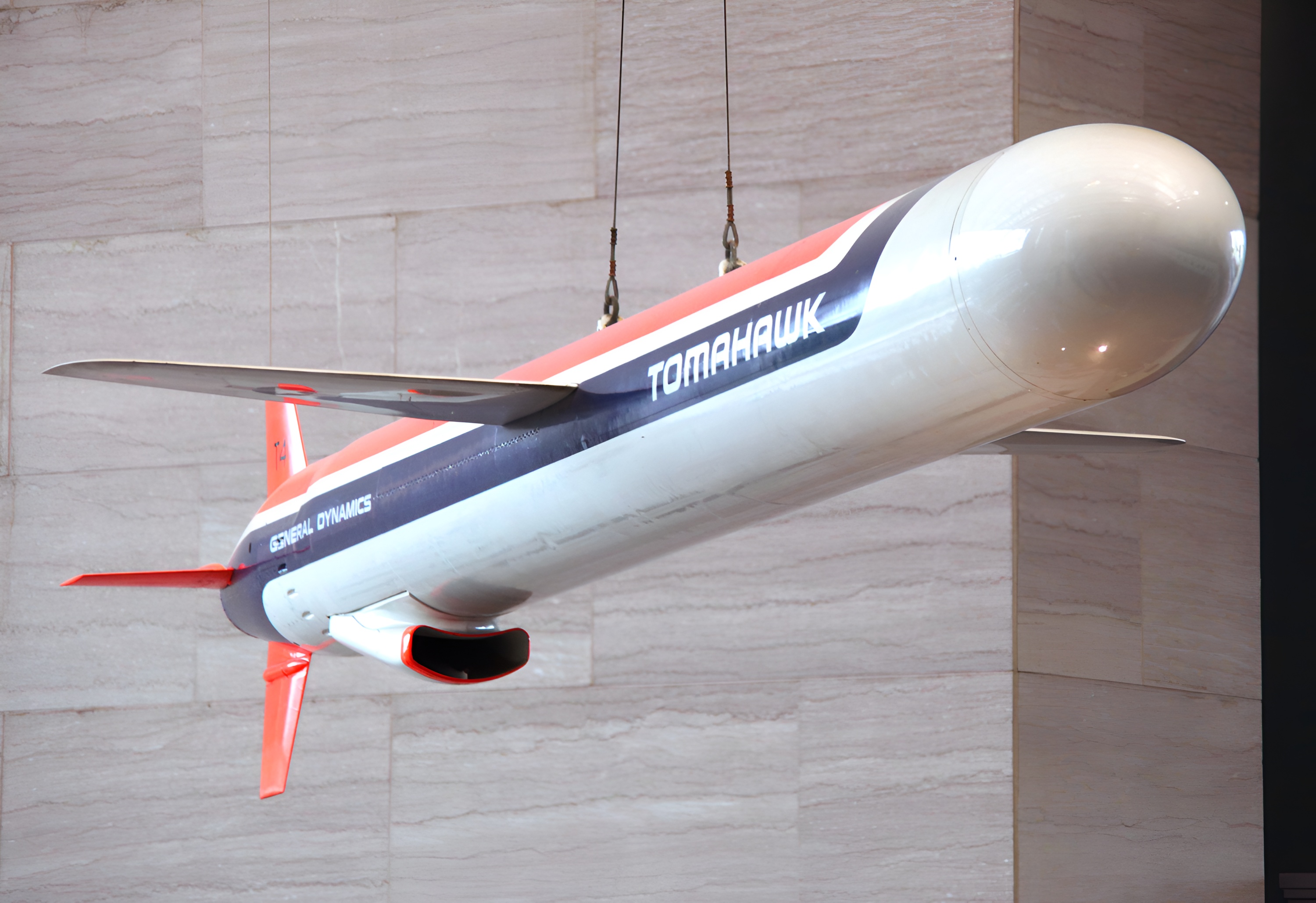
Nikon Wins Contract for Two-Metre 3D Printers to Scale Tomahawk Production
Nikon Advanced Manufacturing has won a U.S. defense contract to provide large metal 3D-printing systems for Tomahawk missile mid-bodies. The customized machines, each offering a two-metre build height, are intended to make prototypes and help expand production at Nikon AM’s technology center in Long Beach, California.

The award puts additive manufacturing into a defined part of the Tomahawk production effort rather than assigning Nikon an open-ended research project. According to published contract details, multiple machines based on Nikon SLM Solutions’ large-format NXG-E platform will be supplied through the Industrial Base Analysis and Sustainment program. They use laser beam powder-bed fusion, a process that builds metal components layer by layer.
What remains unclear is how much capacity the equipment will actually add. No contract value, delivery schedule, production target or quantified output increase has been disclosed. The precise number of machines also has not been published beyond the description of multiple systems. Those omissions prevent a direct assessment of the award’s cost, scale or effect on the wider Tomahawk supply chain.
Prototypes are not yet production output
The contract combines two different manufacturing stages: prototype fabrication and production scaling. A prototype can demonstrate that a component’s geometry is printable and give engineers physical hardware for measurement and testing. Repeated production requires considerably more: controlled machine settings, consistent material behavior, documented inspection methods and repeatable results across multiple builds.
That difference is especially important for a large structural section. A two-metre build envelope allows Nikon AM to work at a scale relevant to the missile mid-body, potentially reducing the need to divide a large geometry into smaller printed sections. The available information does not specify the exact part design, however, or whether the printed article emerges as a complete mid-body, a near-net-shape structure requiring substantial finishing, or one element within a larger assembly.
Nor does the contract announcement define the surrounding production flow. Metal additive manufacturing frequently sits between several conventional steps rather than replacing an entire factory line. Heat treatment, machining, surface finishing, dimensional inspection and nondestructive evaluation may all influence the time and equipment needed to turn a printed form into an accepted component. None of those responsibilities or process requirements has been disclosed for this program.
Qualification will determine practical significance
The central engineering measurement is not simply whether a large printer can produce the shape. It is whether the process can repeatedly deliver parts that meet the applicable requirements. The National Institute of Standards and Technology notes in its additive-manufacturing qualification work that internal pores, residual stresses, surface condition, anisotropic properties and post-processing can complicate the assessment of critical metal parts.
NIST’s work highlights the need for dimensional metrology, mechanical-property measurements and nondestructive testing capable of finding and characterizing internal defects. Nikon AM says its Long Beach operation brings engineering, production, laboratory and qualification resources together, but no qualification milestone or test result has been released for the Tomahawk application.
That leaves several thresholds between installation and sustained production. The machines must be delivered and commissioned, the manufacturing process must demonstrate repeatability, and the resulting components must pass the required inspections and qualification work. Production rate will also depend on build time, post-processing capacity, inspection throughput, material supply and machine availability not build height alone.
A capacity contract without a capacity number
Hamid Zarringhalam, Nikon Advanced Manufacturing’s CEO, said defense manufacturers increasingly need partners that can provide advanced technology alongside “reliable, repeatable production capabilities.” The contract gives Nikon AM an opportunity to demonstrate those capabilities on a recognizable defense program, but the disclosed information does not yet offer figures against which reliability or repeatability can be measured.
For public oversight, the missing benchmarks are consequential. Contract value would establish the government’s financial commitment; machine count and delivery dates would define the installed equipment; qualification status would show how close the process is to accepted production; and a target rate would reveal the intended capacity gain. Until those figures emerge, the confirmed change is narrower but still significant: multiple two-metre metal printers are being assigned to Tomahawk mid-body work in Long Beach, with the harder transition from prototypes to repeatable output still ahead.
| More aerospace and engineering stories, right in your MSN feed. Follow AMI on MSN |
By David Whitaker — Associate editor for AMI’s aerospace and drone systems desk, translating flight systems, aircraft programs, spaceflight, and UAV developments into accessible technical stories.




