


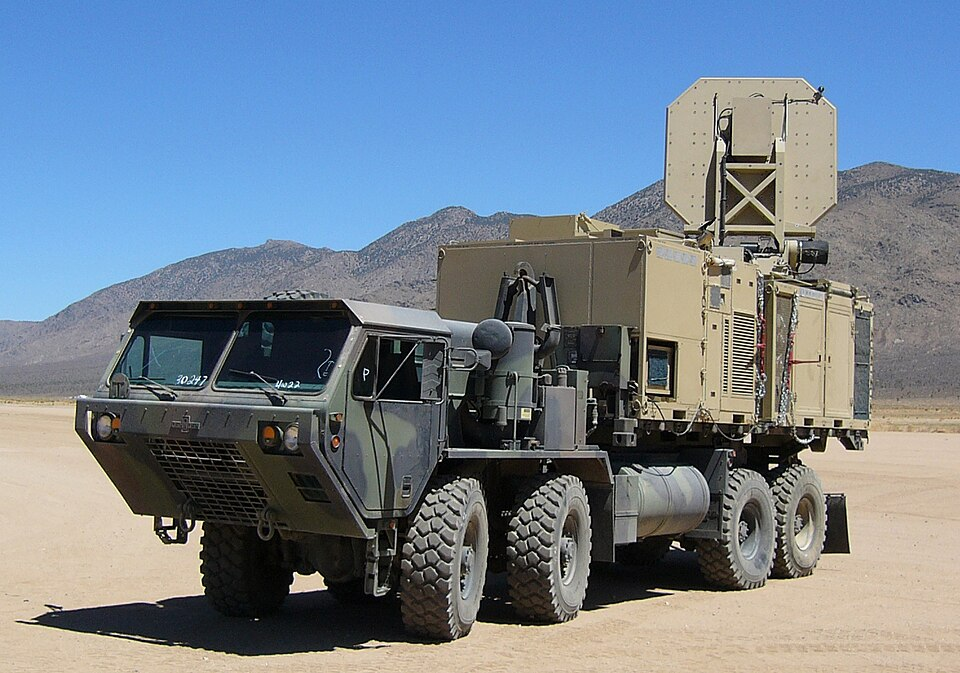
Skin-Heating Active Denial System Cleared for Seven-Month U.S. Border Test
A military system designed to produce an intense burning sensation has been cleared for a seven-month Department of Homeland Security test along the U.S.-Mexico border. Defense Secretary Pete Hegseth approved the loan of the Active Denial System, according to CNN, allowing DHS to evaluate the equipment and develop tactics for its possible use from distances of up to 1,000 meters.

The authorization permits testing, not operational deployment against migrants. DHS has not announced whether it will ultimately field the system, leaving unresolved the central safety and legal question: under what circumstances, if any, should civilian law enforcement use a military device that controls people by intentionally inflicting pain?
Heat concentrated near the skin’s surface
The Active Denial System sends an invisible beam of high-frequency, millimeter-wavelength electromagnetic energy toward a person. The Defense Department says the energy penetrates approximately 1/64 of an inch into the skin and rapidly heats the surface, activating temperature-sensitive nerve endings. The resulting pain is intended to trigger a reflexive movement away from the beam.
The beam uses non-ionizing energy and does not heat the body in the same way as a microwave oven. Its short wavelength concentrates energy near the skin’s surface rather than penetrating deeply. The intense sensation ends after a person moves outside the beam, although the Pentagon says tingling or tenderness can remain for 10 to 15 minutes.
That shallow penetration is central to the military’s nonlethal classification, but it does not remove the possibility of thermal injury. Exposure duration, repeated exposure and whether a person can promptly leave the beam all affect the safety case. At a range approaching one kilometer, operators also depend on sensors, optics, procedures and software to assess conditions that may be much clearer at close distance.
Burn incidents define the operating risk
At least two documented incidents produced second-degree burns. A 1999 laboratory accident caused a blister. In 2007, procedural errors during a training exercise led to an airman’s overexposure and burns; the airman recovered fully. Those cases do not show that burns are the usual result, but they demonstrate that the system’s nonlethal designation relies on keeping exposure within controlled limits.
The Pentagon says preset controls, checklists, software changes and operator training reduce injury risk. Its position is that a fatal exposure would have to continue many times longer than the exposure needed to make someone retreat. An earlier National Defense University paper on the system described range measurement, adjustable output and automatic exposure limits as elements of that safety architecture.
Those safeguards make systems integration and human factors as important as the energy source itself. A civilian trial must account for people who cannot move normally, do not understand a warning, are confined by terrain or a crowd, or receive multiple exposures. The beam is invisible, so affected people may not immediately understand what is happening or where they must move to escape it.
Military approval does not settle civilian use
The Active Denial System underwent military legal and treaty reviews addressing armed-conflict requirements. Civilian law enforcement operates under a different use-of-force framework, where necessity, proportionality, targeting and the treatment of uninvolved people depend heavily on the specific encounter. A Duke Law and Technology Review analysis previously identified unresolved excessive-force questions created by a system that physically compels a person to flee rather than restraining or incapacitating that person.
Physicians for Human Rights has also argued that long range can make it harder for an operator to evaluate conditions around the person being exposed. Its review of directed-energy crowd-control devices highlights burns, blisters and prolonged pain reported during volunteer testing, while calling for tighter controls on any law-enforcement application.
This is not the technology’s first consideration for border enforcement. Former DHS Secretary Kirstjen Nielsen rejected a proposal involving it in 2018, according to CNN. In July 2025, the Pentagon’s Joint Intermediate Force Capabilities Office supported considering active-denial technology for border security. Customs and Border Protection says it continually evaluates technology that could save lives while improving national-security effectiveness.
The seven-month test will therefore evaluate more than whether the beam can reach its intended range. Any decision to move beyond testing would require a defensible operating policy covering warnings, exposure limits, medical response, recordkeeping, accountability and protection of bystanders. For now, the system is authorized for evaluation; no border deployment has been announced.
| More aerospace and engineering stories, right in your MSN feed. Follow AMI on MSN |
By Thomas Caldwell — AMI’s senior editor for mechanical and mobility engineering, covering vehicle electronics, systems integration, electrification, chassis systems, propulsion, and safety policy.




