


Finland Licenses Onkalo Nuclear Repository, but Waste Burial Still Awaits Inspection
Finland has granted Posiva Oy an operating license for Onkalo, the world’s first licensed deep geological repository for spent nuclear fuel. The decision advances a 22-year, $1.16 billion project intended to isolate radioactive material for more than 100,000 years but it does not authorize Posiva to begin commercial waste burial immediately.
That final transition depends on the Radiation and Nuclear Safety Authority of Finland, known as STUK. The regulator must verify the remaining commissioning tests and complete its pre-operational inspection before disposal starts. Posiva has not provided a detailed startup date.
The license follows a favorable safety assessment that STUK issued on August 4, 2026. It permits Posiva to possess, process, store and dispose of spent fuel from Finland’s Olkiluoto and Loviisa nuclear power plants, subject to continued regulatory oversight. The operating license runs through 2070, and Posiva must submit updated safety assessments every 10 years.
A repository more than 400 meters below ground
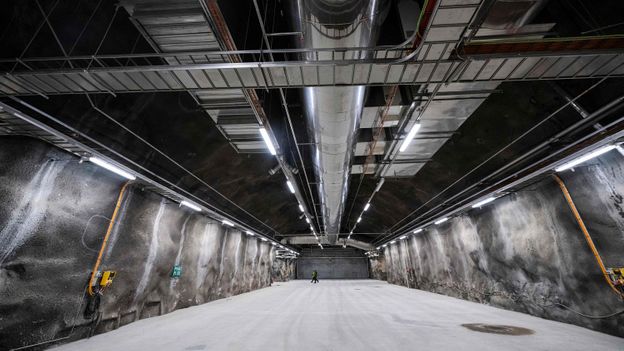
Onkalo’s defining feature is its physical depth and geological setting. At Eurajoki in southwestern Finland, tunnels extend approximately 430 meters, or about 1,400 feet, into crystalline bedrock described as 1.9 billion years old. The above-ground portion of the facility will prepare and encapsulate spent fuel before workers transfer the sealed packages underground.
The system does not depend on a single container remaining perfect for the entire isolation period. Spent fuel will be enclosed in corrosion-resistant copper canisters, placed into deposition holes in the bedrock and surrounded by swellable bentonite clay. The clay is intended to absorb moisture and restrict movement around each canister. Steel-reinforced concrete plugs will close sections of the tunnel, while the surrounding rock provides another barrier between the waste and the surface environment.
This nested design addresses an unusually long engineering horizon. Components, groundwater conditions and rock behavior must be assessed across periods that extend far beyond the service life of conventional industrial facilities and beyond recorded human civilization. Posiva says that after approximately 100,000 years, the waste’s radiation level is expected to decline to roughly that of the natural uranium ore from which the fuel originated.
Capacity also makes Onkalo a long-duration industrial operation rather than a single burial campaign. The licensed maximum is 6,500 tonnes of uranium waste, corresponding to approximately 3,300 disposal canisters. At full operation, workers are expected to place no more than 60 canisters underground annually. Final-disposal work could continue into the 2120s, when the remaining tunnels are expected to be backfilled and sealed and the repository transferred to the Finnish state.
Permanent disposal moves from policy to licensed infrastructure
Waste has been one of the central arguments against nuclear power for decades, in part because most spent fuel remains in interim storage rather than a permanent repository. Finland is now the first country to issue an operating license for a facility intended to bury that fuel permanently. Sweden and France are pursuing comparable deep geological projects, but neither displaces Onkalo’s first-mover status in licensing.
The repository is also part of a broader national system for assigning long-term responsibility. Finnish nuclear operators are required to fund waste management, and the country’s National Nuclear Waste Management Fund held €3 billion at the end of 2025 to cover remaining waste-management and plant-demolition costs. That financing structure is intended to preserve resources if the state eventually becomes responsible for the work.
Finland’s license therefore marks a material change: permanent geological disposal has moved from research, construction and testing into an authorized operating framework. Yet the practical boundary remains clear. Onkalo is licensed, its 400-meter-deep tunnels and multi-barrier system are in place, and its operating limits have been defined but the first commercial canister cannot be buried until STUK completes its inspection and approves the finished system for use.
| More aerospace and engineering stories, right in your MSN feed. Follow AMI on MSN |
By Thomas Caldwell — AMI’s senior editor for mechanical and mobility engineering, covering vehicle electronics, systems integration, electrification, chassis systems, propulsion, and safety policy.



