


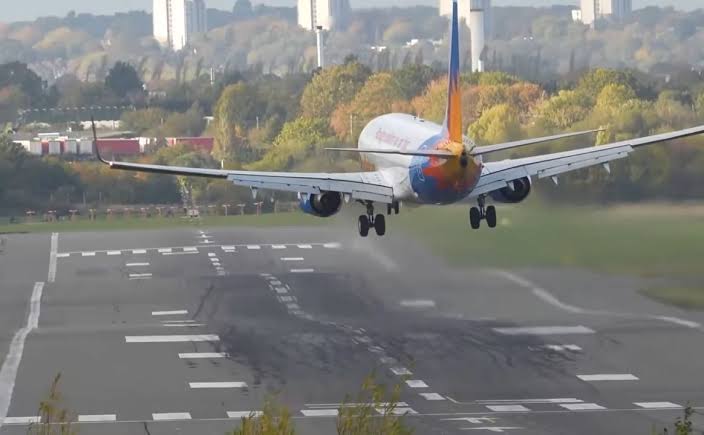
Jet2 Boeing 737-800 Skids Off Runway in Dramatic Birmingham Landing Video
Severe autumnal weather systems across the British Isles regularly challenge commercial aviation operations, forcing flight crews to execute demanding landings under restrictive crosswind limits. Low-cost air carriers like Jet2 rely heavily on the narrow-body ‘Boeing 737-800’ workhorse to sustain rigorous flight schedules between the European continent and major regional transport hubs such as Birmingham Airport. Even with modern flight deck avionics, the critical transition from aerodynamic deceleration to high-speed ground rollout remains vulnerable to sudden atmospheric wind shear.
Modern transport category aircraft depend on high-speed rudder deflection and automated flight controls to maintain lateral stability along the runway centerline during touchdown. However, as the aircraft rapidly sheds airspeed, aerodynamic control surfaces lose physical authority, shifting primary directional control to the nose-wheel steering mechanism and differential wheel braking systems. When intense crosswind gusts strike during this deceleration phase, sudden directional deviations can quickly challenge the flight crew’s ability to maintain safe runway alignment.
That precarious aerodynamic scenario materialized when a Jet2 ‘Boeing 737-800’ suffered a runway excursion while touching down at Birmingham Airport. Video footage circulating across social media platforms captured the airliner veering sharply toward the left shoulder during its rollout, sending its wheels momentarily onto the adjacent grass before returning to the paved surface. Eyewitnesses watching the landing from the airfield perimeter reported visible yaw instability as the pilots fought to arrest the lateral slide.
The commercial passenger flight, operating under flight number LS1310, had arrived following a routine departure from Venice Marco Polo Airport in Italy. Surface weather data indicated that the aircraft touched down in turbulent conditions featuring wind gusts reaching up to 29 knots driven by Storm Boelo. The expansive atmospheric disturbance generated severe delays and flight cancellations across the West Midlands, disrupting regional transport infrastructure throughout the weekend.
A Jet2 Boeing 737-800 veered off the runway while landing at Birmingham Airport. https://t.co/BEiTmDsrtc
— Breaking911 (@Breaking911) October 25, 2026
Following the landing incident, Jet2 addressed the public reports and confirmed that the brief runway excursion was caused by sudden meteorological instability. A spokesperson for the airline stated that the flight “temporarily moved off the runway after landing at Birmingham Airport earlier this afternoon, due to exceptional weather conditions caused by Storm Boelo”. The carrier added that the flight deck crew recovered directional control immediately and taxied to the passenger stand under the jet’s own engine power.
Ground control personnel at the airport briefly held departing traffic while emergency vehicles monitored the active airfield and inspected the runway edge for foreign object debris. Airport officials confirmed that all passengers and crew members safely disembarked through regular terminal facilities without any injuries. Technical teams subsequently conducted initial external inspections of the aircraft’s landing gear assemblies and twin ‘CFM56-7B’ turbofan engine nacelles to identify any turf impact damage.
Aviation safety specialists treat runway excursions as critical operational occurrences because high-speed transitions onto soft turf risk landing gear collapse or engine ingestion of foreign debris. Initial reviews of spotter livestream recordings show that the aircraft achieved a stable touchdown before encountering strong lateral force vectors that momentarily overwhelmed directional inputs. Regulatory bodies like the UK Air Accidents Investigation Branch routinely evaluate flight data telemetry and crosswind components to ensure that procedural envelope guidelines were properly maintained.
The incident underscores the narrow operational margins governing commercial transport operations when extreme coastal gale fronts move inland. While the rapid recovery by the flight crew prevented structural catastrophe, it highlights the persistent threat that localized weather spikes pose during final rollout. Moving forward, airport operators and civil aviation regulators will assess meteorological data logs from the event to refine crosswind thresholds and ground safety protocols.



