


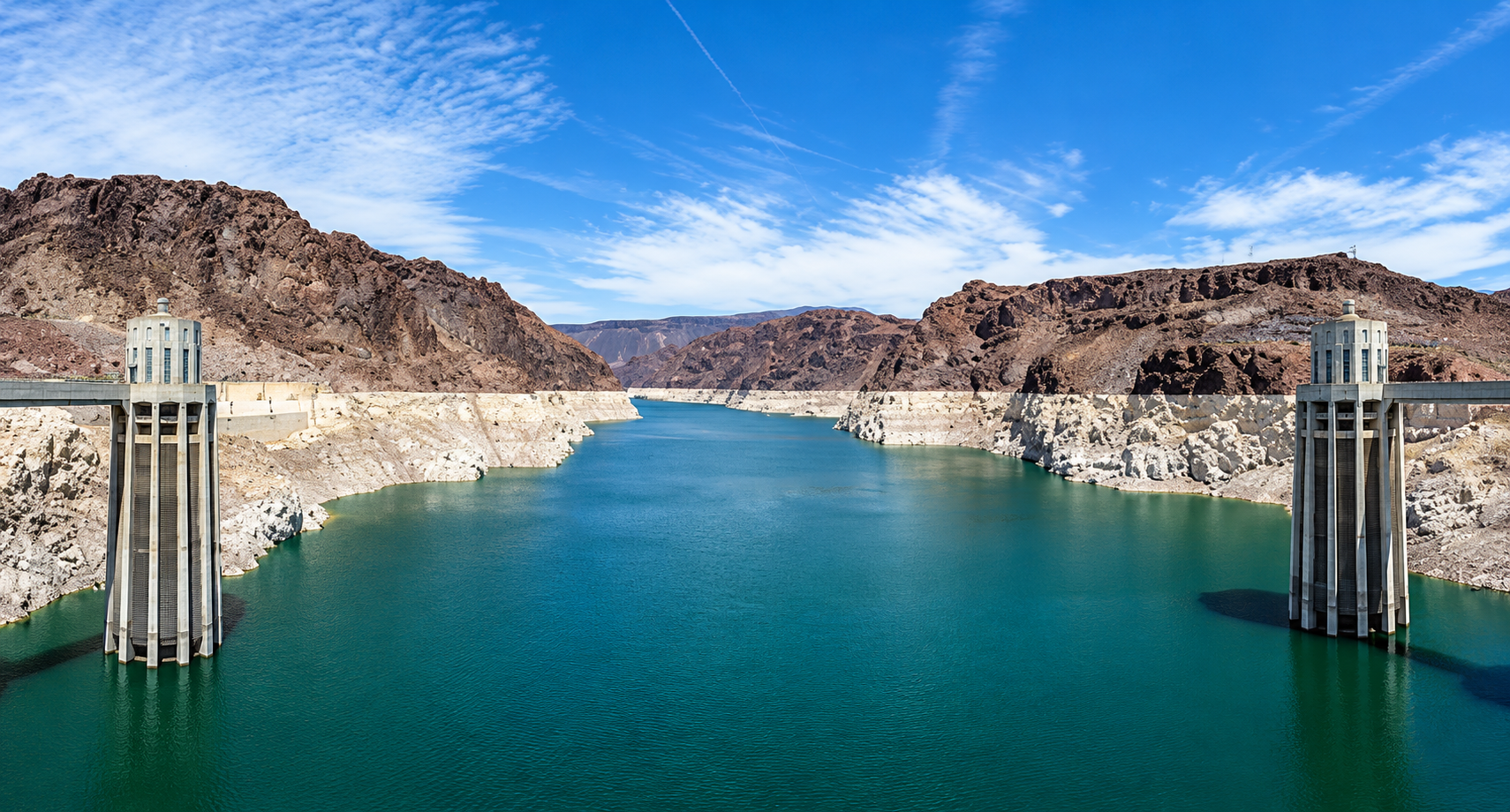
Lake Mead Dead Pool Would Cut 40% of Phoenix Supply Without Emptying Taps
If Lake Mead fell to “dead pool,” Phoenix would lose the Colorado River source that provides roughly 40% of its water. Yet the city’s taps would not immediately run dry. Local rivers, underground reserves, conservation, recycling and recently added transfer infrastructure give the established urban core several layers of protection.

The result would still be a severe capacity crisis. Replacing such a large supply would require billions of dollars in wells, pipelines and treatment facilities, while increasing pressure on finite groundwater. Residents could face higher water bills, and development around the metropolitan fringe could encounter tighter limits.
Why dead pool would break the Colorado connection
Dead pool is the elevation below which water can no longer pass through a dam by gravity. For Lake Mead, the stated threshold is 895 feet above sea level. At that point, water could no longer pass through Hoover Dam to replenish the lower Colorado River system feeding Lake Havasu.
That downstream connection is essential to central Arizona. Phoenix’s Colorado River water is pumped from Lake Havasu into the 336-mile Central Arizona Project canal. Without upstream replenishment, Lake Havasu could no longer sustain that diversion indefinitely, and the canal’s Colorado River supply would eventually be lost.
The physical threshold would not produce a sudden, unannounced cutoff. Arizona’s Central Arizona Project water has a relatively junior position during shortages, so its deliveries would be reduced well before Lake Mead reached dead pool. A Congressional Research Service overview of Colorado River management details how federal operating rules, water-right priorities and reservoir elevations govern those reductions. The federal operating plan taking effect in 2027 calls for deep cuts to Lower Basin deliveries, with Arizona carrying the largest share among the three states.
In practical terms, dead pool would be the final physical failure of a supply already diminished through years of administrative reductions. It would formalize the loss of the Colorado connection rather than erase 40% of Phoenix’s water overnight.
Phoenix has redundancy, but not a free replacement
About 58% of Phoenix’s current supply comes from the Salt and Verde rivers, whose reservoirs include Roosevelt Lake. These watersheds are separate from Lake Mead, making them the city’s most important independent supply. Approximately 2% currently comes from groundwater.
Phoenix has also banked roughly 700,000 acre-feet of water underground. That reserve can bridge shortages, although it is stored capacity rather than a permanently renewable replacement for Colorado River deliveries. Conservation and wastewater recycling can reduce demand and extend available supplies, but neither creates an immediate substitute equal to the full lost volume.
Distribution infrastructure is another part of the resilience strategy. A $300 million drought pipeline can move Salt and Verde river water into north Phoenix, an area historically more dependent on Colorado River deliveries. The project addresses a crucial systems-integration problem: having water elsewhere in the network is of limited value if treatment plants and pipelines cannot route it to the neighborhoods losing their normal source.
Even with that pipeline, replacing the Colorado supply would require more wells, treatment capacity and cross-city conveyance. Those investments would ultimately be reflected in public spending and customer rates.
Groundwater shifts the risk rather than eliminating it
Greater pumping could keep water flowing, but groundwater replenishes slowly and can be depleted when withdrawals exceed recharge. It also introduces a mechanical problem beneath the city: falling groundwater pressure can compact aquifer sediments, lowering the land surface and permanently reducing underground storage capacity.
The Arizona Geological Survey reports that subsidence and associated earth fissures affect more than 3,000 square miles in the state, including expanding areas around Phoenix and Tucson. Such ground movement can damage roads, pipes, canals and other infrastructure the same systems that would have to work harder during a surface-water shortage.
The effects would also be uneven. Phoenix’s established urban core has diversified supplies, underground storage and extensive infrastructure. Smaller cities and outer suburbs that depend more heavily on Colorado River water would have less redundancy. Farmers have already absorbed major Central Arizona Project reductions, including fallowed acreage in Pinal County, while Arizona has paused approval of some fringe subdivisions dependent on declining groundwater.
Lake Mead reaching dead pool would therefore leave Phoenix operating, but with less flexibility and a higher cost structure. The metropolitan area’s strongest defenses protect existing service; they do not guarantee the same pace of outward growth once a source supplying roughly two-fifths of the city’s water is gone.
| More aerospace and engineering stories, right in your MSN feed. Follow AMI on MSN |
By Thomas Caldwell — AMI’s senior editor for mechanical and mobility engineering, covering vehicle electronics, systems integration, electrification, chassis systems, propulsion, and safety policy.



