


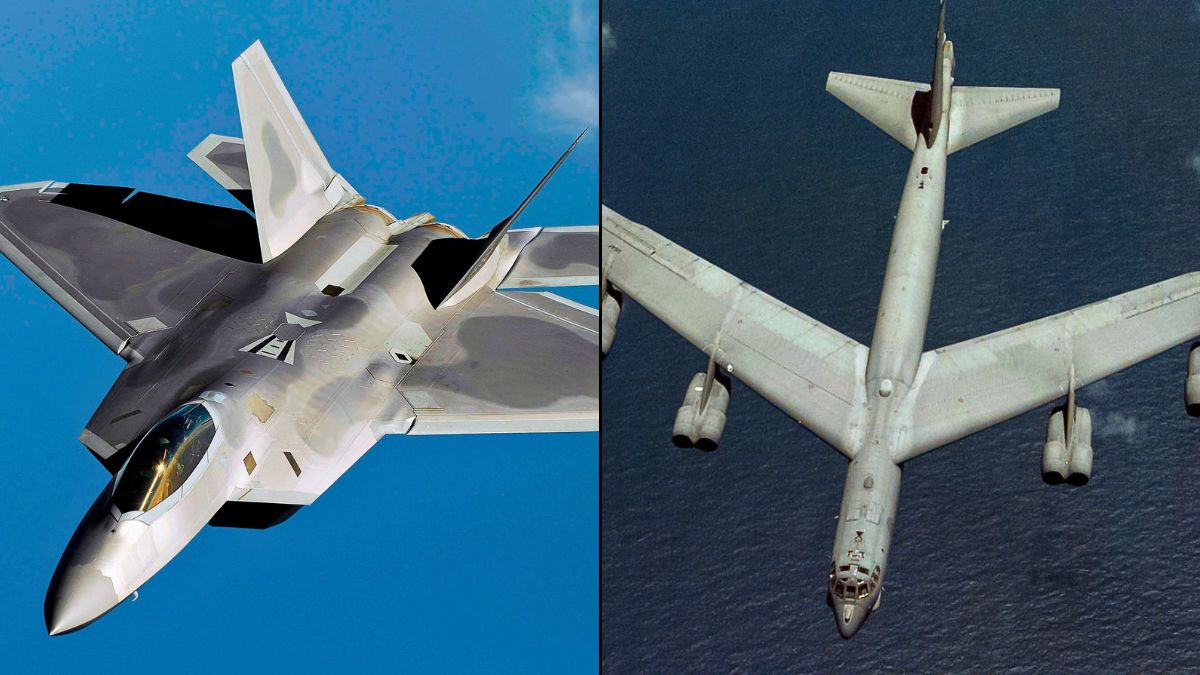
7 of the Most Powerful Military Planes Ruling the Modern Skies
Modern aerial warfare is defined by an uncompromising pursuit of speed, stealth, sensor dominance, and sheer firepower. From fifth-generation stealth fighters engineered to eliminate adversary threats beyond visual range to massive strategic bombers capable of delivering planet-altering payloads across oceans, military aviation represents the pinnacle of modern aerospace engineering.
These aerial platforms serve not only as decisive instruments of combat during wartime but also as primary tools of geopolitical deterrence on the global stage. Here is an in-depth look at seven of the most powerful and technologically sophisticated military aircraft actively in service today.
Lockheed Martin F-22 Raptor
The F-22 Raptor takes off like gravity simply gave up. 🔥 Pure thrust, insane power. One of the greatest fighter jets ever built. Even after all these years since its induction, no country has come close to matching the Raptor. https://t.co/8RVl172QtB
— Military Observer (@TheMilObserverr) October 23, 2026
Introduced into service with the United States Air Force in 2005, the Lockheed Martin F-22 Raptor remains widely regarded as the premier air-superiority fighter in the world. As the first operational fifth-generation fighter jet, the Raptor combines an extraordinarily small radar cross-section with twin Pratt & Whitney F119 afterburning turbofans that enable “supercruise”—the ability to sustain supersonic flight at speeds exceeding Mach 1.8 without activating fuel-guzzling afterburners. Its thrust-vectoring engine nozzles grant the aircraft unmatched maneuverability in both close-range dogfights and high-altitude engagements.
Beyond its aerodynamic agility, the F-22’s true lethality lies in its integrated avionics and low-observable configuration. Carrying its primary armaments—including AIM-120 AMRAAM and AIM-9 Sidewinder missiles—within internal weapons bays to maintain stealth, the aircraft utilizes an AN/APG-77 active electronically scanned array (AESA) radar combined with sophisticated sensor fusion. This architecture allows the pilot to detect, track, and engage multiple enemy targets long before an adversary is even aware of the Raptor’s presence.
Northrop Grumman B-2 Spirit
B-2 Spirit Disappears Into the Clouds… #B2Spirit #MilitaryAviation ©️lowflyingjets65 https://t.co/oc0gqhdiM2
— Cecilia (@cecilia_hl1584) October 26, 2026
The Northrop Grumman B-2 Spirit, commonly known as the Stealth Bomber, is one of the most fearsome strategic assets ever constructed. Featuring an unmistakable flying-wing airframe with no vertical tail fin, the B-2 was engineered during the Cold War to penetrate dense, sophisticated integrated air defense systems completely undetected. Its continuous-curvature design and composite radar-absorbent materials reduce its radar reflection to a fraction of a square meter, despite the aircraft having an imposing 172-foot wingspan.
Despite its elusive stealth profile, the B-2 delivers immense destructive capacity, capable of hauling up to 40,000 pounds of conventional or nuclear ordnance across intercontinental distances without refueling. It is the only operational stealth platform rated to carry the GBU-57 Massive Ordnance Penetrator (MOP), a 30,000-pound precision-guided bunker buster designed to obliterate deeply buried reinforced targets. Supported by mid-air refueling, the B-2 can strike any coordinates on the planet and return safely to its home base.
Lockheed Martin F-35 Lightning II
A stealth fighter built for the future, threading through valleys shaped over millions of years. These F-35B Lightning IIs are flying through the Mach Loop in Wales, a famous low-level training area where terrain, weather and precise aircraft control make every pass a spectacle. The F-35B combines stealth shaping with advanced sensor fusion and a short takeoff and vertical landing capability. Its lift fan and swivelling rear nozzle allow it to operate from shorter runways and suitable ships, but that capability comes with added mechanical complexity and weight. Down in the valley, though, the focus is different: maintaining the intended flight path while navigating changing terrain and conditions. The contrast between cutting-edge technology and the rugged Welsh landscape is part of what makes these passes so captivating. 🎥tespottersspouse
— Airforce Geek (@PrecisionLabs0) October 25, 2026
The Lockheed Martin F-35 Lightning II serves as the multirole backbone of modern allied air power, operating across three distinct variants: the conventional takeoff F-35A, the short-takeoff/vertical-landing F-35B, and the aircraft carrier-based F-35C. While possessing radar-evading stealth coatings and internal weapons carriage, the F-35’s defining advantage is its role as an airborne command-and-control node, capable of collecting, processing, and sharing battlefield data in real time across naval, ground, and air assets.
Powered by the Pratt & Whitney F135—the most powerful single engine ever installed in a production fighter—the F-35 utilizes an advanced sensor suite featuring the AN/APG-81 AESA radar and the 360-degree Distributed Aperture System (DAS). This system feeds high-fidelity situational imagery directly into the pilot’s helmet-mounted display, effectively allowing them to “look through” the aircraft’s skin. In modern networked warfare, the F-35 excels at suppressing enemy air defenses, conducting precision strikes, and managing complex battlespaces.
Boeing B-52H Stratofortress
🇺🇸 Three bombers. One formidable display of American airpower. The B-1B, B-2 Spirit and B-52 Stratofortress represent three generations of U.S. strategic bombing capability. https://t.co/UL9mUicitu
— Warwatch (@warwatchh) October 20, 2026
Few combat aircraft in history match the longevity and sheer payload capability of the Boeing B-52H Stratofortress. Entering operational service in the 1950s during the height of the Cold War, this eight-engine heavy strategic bomber has outlived multiple subsequent airframes thanks to continuous structural upgrades, advanced avionics, and modern navigation suites. With a colossal internal and external weapons capacity of approximately 70,000 pounds, the B-52 remains the most versatile long-range heavy strike platform in the U.S. military inventory.
Rather than relying on low-observable stealth or supersonic speeds, the B-52H functions as a high-altitude standoff missile carrier and heavy bomb truck. It is capable of launching an expansive array of long-range standoff munitions, including nuclear-tipped AGM-86 cruise missiles and conventional Joint Air-to-Surface Standoff Missiles (JASSM), far outside the range of hostile surface-to-air missile umbrellas. Scheduled to receive new Rolls-Royce engines and modern radar, the Stratofortress is projected to remain in active duty well into the 2050s, representing a century of continuous operational service.
Tupolev Tu-160
Russia has resumed serial production of the massive TU-160M strategic bomber. Its the heaviest and fastest bomber on earth, in a single payload it can launch 12 cruise missiles, including Nuclear armed weapons at stand off distances. https://t.co/LJC5wcZPvU
— Chay Bowes (@BowesChay) October 27, 2026
The Tupolev Tu-160 (designated by NATO as the “Blackjack” and known to Russian crews as the “White Swan”) holds the title of the largest and heaviest operational supersonic combat aircraft in aviation history. Originally developed in the late Soviet era, the Tu-160 features variable-sweep “swing wings” that extend straight for long-range cruising and sweep backward at high speeds to allow sprints exceeding Mach 2. It is powered by four massive Kuznetsov NK-32 afterburning turbofan engines, making it the fastest strategic bomber currently in active service.
The primary role of the Tu-160 is nuclear deterrence and long-range conventional standoff strike, carrying its armaments entirely inside two massive internal rotary launchers. Capable of carrying up to 88,000 pounds of ordnance, the bomber routinely deploys long-range cruise missiles such as the Kh-555 and the stealthy Kh-101/102, which can strike critical strategic targets thousands of kilometers away. With modern avionics upgrades and newly manufactured airframes entering the Russian military, the Tu-160 remains a cornerstone of airborne strategic deterrence.
Rockwell B-1B Lancer
The B-1 Lancer flyover at Circuit of the Americas before F1 yesterday was so awesome. https://t.co/JQZsaLTHNQ
— brandon wenerd (@brandonwenerd) October 26, 2026
Known affectionately among aviators as the “Bone” (a play on its designation, “B-One”), the Rockwell B-1B Lancer is a supersonic, variable-geometry strategic bomber engineered for low-altitude, high-speed penetration. Designed to blend blended-wing body aerodynamics with terrain-following radar, the B-1B can fly at transonic speeds just a few hundred feet off the ground, masking its presence within natural terrain contours to evade early-warning radar networks.
While denuclearized in the 1990s in accordance with international arms control treaties, the B-1B carries the largest internal conventional payload of any bomber in the U.S. fleet, holding up to 75,000 pounds across three internal weapon bays, with additional external hardpoints available. Its cavernous bays can be configured to deploy massive barrages of Joint Direct Attack Munitions (JDAMs) or up to 24 Long Range Anti-Ship Missiles (LRASMs), providing military planners with high-speed, heavy-volume conventional strike flexibility around the globe.
Boeing F-15EX Eagle II
When both afterburners ignite, the F-15J turns fuel into an enormous surge of thrust, driving the fighter into a steep climb. Japan’s F-15J Eagle uses two turbofan engines with afterburners to deliver the acceleration needed for rapid climbs and high-speed interception. The trade-off is much higher fuel consumption in exchange for a substantial boost in thrust. The white vapor forming around the aircraft adds another layer to the spectacle. As pressure drops around the wings during manoeuvres, moisture in the air can condense into visible clouds, briefly revealing the airflow around the jet. Built for air superiority, the F-15J combines raw engine power with an airframe designed to turn that thrust into exceptional climb performance.
— Airforce Geek (@PrecisionLabs0) October 26, 2026
While fifth-generation stealth aircraft command modern headlines, the Boeing F-15EX Eagle II demonstrates that upgraded fourth-generation designs still wield unmatched combat utility. Developed as a modernized evolution of the combat-proven F-15 airframe, the Eagle II incorporates fly-by-wire controls, a high-speed mission computer, and the advanced APG-82 AESA radar system. Capable of reaching speeds near Mach 2.5, it remains one of the fastest and most rugged tactical fighters ever constructed.
The F-15EX’s primary asset is its overwhelming payload capacity, which reaches up to 29,500 pounds of weapons across 23 external stations. It can carry up to 12 air-to-air missiles—nearly double the internal loadout of contemporary stealth jets—and is structurally certified to carry emerging, oversized hypersonic cruise missiles that cannot fit inside stealth weapons bays. Operating alongside stealth platforms as a heavily armed missile carrier, the F-15EX delivers sustained, high-volume firepower across heavily defended operational environments.



