Top Military Drones: The Unmanned Aircraft Reshaping Modern Warfare
Unmanned aerial vehicles have transformed contemporary military doctrine, evolving from specialized reconnaissance tools into multi-role assets central to strategic intelligence and precision combat. Today, armed forces across the globe depend on these platforms to gather intelligence, penetrate contested areas, and engage high-value targets while keeping aircrews out of harm’s way.
Recent conflicts in Eastern Europe, the Middle East, and the Caucasus have highlighted how uncrewed aerial systems can alter the tempo and outcome of military engagements. From high-altitude strategic surveillance to armed medium-altitude patrol, the following five military drones represent the most capable, technically mature, and operationally proven systems currently in service.
General Atomics MQ-9 Reaper
General Atomics MQ-9 Reaper #mq9reaper https://t.co/c7Qsrak5cr
— durvesh (@BLackgold_5) May 3, 2025
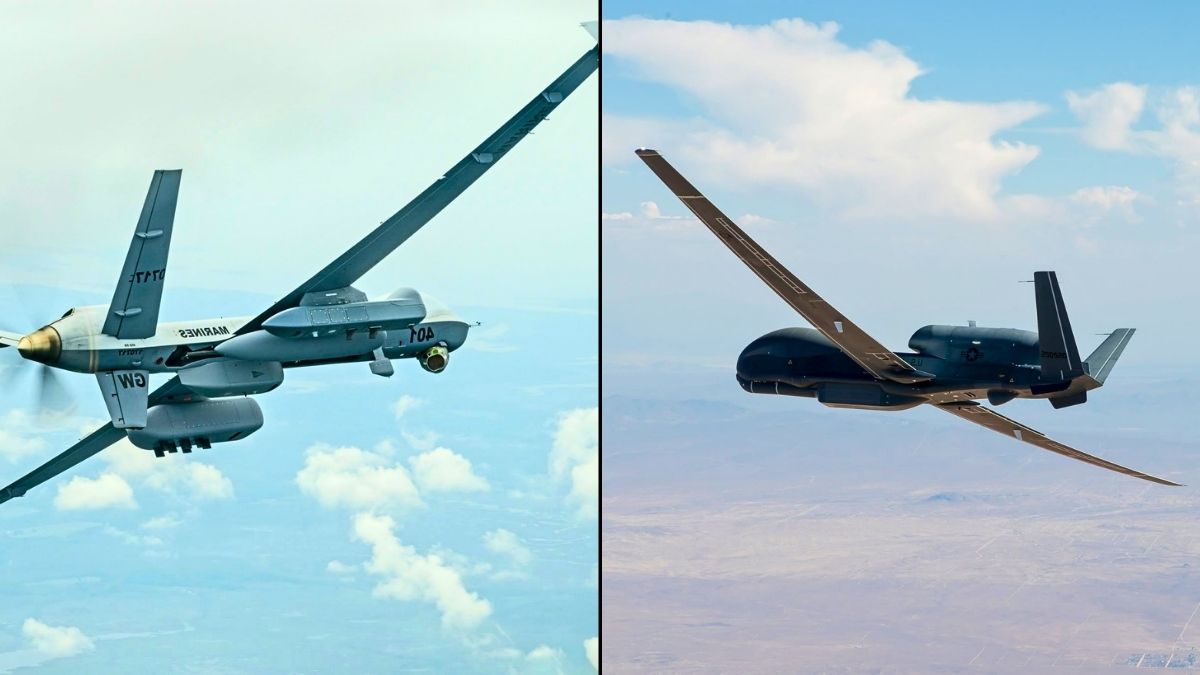
Developed by General Atomics Aeronautical Systems for the United States Air Force, the MQ-9 Reaper is a widely deployed medium-altitude, long-endurance (MALE) hunter-killer platform. Driven by a Honeywell TPE331-10 turboprop engine generating over 900 shaft horsepower, the MQ-9 operates at service ceilings up to 50,000 feet and can remain airborne for more than 27 hours in clean configurations. Its targeting architecture centers on the Raytheon Multi-Spectral Targeting System (MTS-B), which incorporates infrared sensors, daylight and low-light television cameras, and laser designators to deliver persistent target tracking to ground control stations worldwide.
The Reaper features seven external weapon stations capable of carrying up to 3,750 pounds of mixed ordnance and surveillance pods. Standard strike loads include laser-guided AGM-114 Hellfire air-to-surface missiles, GBU-12 Paveway II precision-guided bombs, and GPS-guided GBU-38 Joint Direct Attack Munitions (JDAM). In addition to the United States military, operators such as the United Kingdom’s Royal Air Force, the French Air and Space Force, and the Italian Air Force maintain MQ-9 fleets for joint combat, interdiction, and intelligence, surveillance, and reconnaissance (ISR) missions.
Baykar Bayraktar TB2
BayraktarTB2’den kontrol edilen PİRANA KİDA, hedefini başarıyla imha etti. https://t.co/ewMGkpdcp1
— X Basın (@XBasinX) October 26, 2026
Manufactured by the Turkish defense firm Baykar, the Bayraktar TB2 is a tactical MALE uncrewed aerial vehicle designed for persistent visual reconnaissance and precision ground-attack roles. The aircraft utilizes a blended wing-fuselage design with an inverted V-tail, powered by an internal combustion engine configured with a two-bladed pusher propeller. Operating at altitudes of up to 25,000 feet with an endurance exceeding 27 hours, the TB2 carries triple-redundant flight control systems and modular optical turrets equipped with infrared cameras and laser rangefinders.
The TB2 carries up to four laser-guided smart micro-munitions on its underwing pylons, primarily the Roketsan MAM-L and MAM-C lightweight guided bombs. These munitions utilize armor-piercing or high-explosive blast-fragmentation warheads engineered to eliminate armor, fortifications, and radar installations with low collateral damage. Having seen extensive operational use by Azerbaijan in the 2020 Nagorno-Karabakh conflict, as well as by armed forces in Ukraine, Libya, and Syria, the platform has gained wide adoption, leading to export contracts with more than 30 nations.
Northrop Grumman RQ-4 Global Hawk
RQ-4 Global Hawk: High-altitude UAV with advanced sensors for ISR, aiding military ops & disaster response. 🌍✈️ #military #UAV https://t.co/xygEwrGx4p
— Interesting Engineering (@IntEngineering) December 20, 2024
The Northrop Grumman RQ-4 Global Hawk is an unmanned, high-altitude, long-endurance (HALE) reconnaissance aircraft designed to replace or supplement traditional manned surveillance platforms. Powered by a Rolls-Royce AE 3007H turbofan engine, the Global Hawk operates at altitudes exceeding 60,000 feet and can stay airborne for more than 32 hours on a single sortie. Its glider-like composite airframe features a wingspan of over 130 feet, providing the lift and stability required to conduct wide-area strategic observation beyond the range of many tactical air defense systems.
The RQ-4 carries no offensive weaponry, dedicating its payload capacity entirely to the Integrated Sensor Suite (ISS). This sensor package includes a high-resolution Synthetic Aperture Radar (SAR) with Ground Moving Target Indicator (GMTI) capability, alongside long-range electro-optical and infrared cameras. The Global Hawk can survey up to 40,000 square miles of terrain in a single day through clouds, dust, and nighttime conditions, serving as a primary strategic ISR platform for the United States Air Force, NATO, and allied operators such as South Korea and Japan.
CAIG Wing Loong II
🇨🇮 🇨🇳 | The Ivorian Armed Forces have announced the induction of at least two Chinese made CAIG Wing Loong II MALE UCAVs. In June 2024, Côte d’Ivoire’s Ministry of Defence announced the signing of a contract with China’s CATIC for the acquisition of “aircraft”, without disclosing the types or quantities ordered.
— Jake (@Jakepor21) August 10, 2026
The Wing Loong II, developed by the Chengdu Aircraft Industry Group (CAIG) under the Aviation Industry Corporation of China (AVIC), is a dedicated MALE combat and reconnaissance platform. Measuring 36 feet in length with a 67-foot wingspan, the aircraft is propelled by a turboprop engine that provides a top speed of roughly 230 miles per hour and an operational ceiling of approximately 32,000 feet. The platform includes automated takeoff and landing capabilities, satellite datalinks for beyond-line-of-sight control, and an electro-optical payload for day-and-night targeting.
Designed to fulfill armed interdiction, counter-insurgency, and border protection roles, the Wing Loong II features six underwing weapon stations capable of carrying roughly 1,000 pounds of ordnance. It is qualified to launch an array of Chinese-produced guided munitions, including BA-7 air-to-ground missiles, YZ-212 laser-guided bombs, and FT-series precision glide weapons. The Wing Loong II has been acquired by several defense forces throughout the Middle East, North Africa, and South Asia, making it one of China’s most exported armed unmanned aircraft.
IAI Heron TP (Eitan)
The Indian Army recently leases 4 Heron TP UAVs from IAI Israel. Specifics: Endurance> 30 h Range: BLOS > 1000 km Altitude> 45,000 ft Payloads: M-19 HD Electro-Optical Payload (TV & IR Combi or Multi-Sensor TV/IR/LRF/LD), WIDE EYE Scan SAR COMINT – HF, VHF,UHF/DF) GSM ESM/ELINT https://t.co/SlBGJhThh0
— Defence Decode® (@DefenceDecode) February 17, 2021
The Heron TP, known within the Israeli Air Force as the Eitan, is a strategic multi-mission MALE UAV developed by Israel Aerospace Industries (IAI). Serving as the heaviest variant of the combat-proven Heron family, the aircraft spans 85 feet across its wings—comparable in width to a commercial airliner—and is driven by a Pratt & Whitney Canada PT6A turboprop engine producing 1,200 horsepower. The Eitan can operate at altitudes up to 45,000 feet with mission endurance exceeding 30 hours, incorporating automatic de-icing and advanced all-weather flight systems.
With a maximum takeoff weight of approximately 11,800 pounds, the Heron TP accommodates a payload of up to 2,200 pounds across its fuselage bays and wing hardpoints. The system can simultaneously carry maritime patrol radars, electronic support measures (ESM), communications intelligence (COMINT) packages, and optical sensors for standoff reconnaissance. In addition to primary service with the Israeli Air Force, leased and purchased variants of the Heron platform operate in militaries across Europe and Asia, including Germany and India, for both maritime and terrestrial monitoring tasks.