


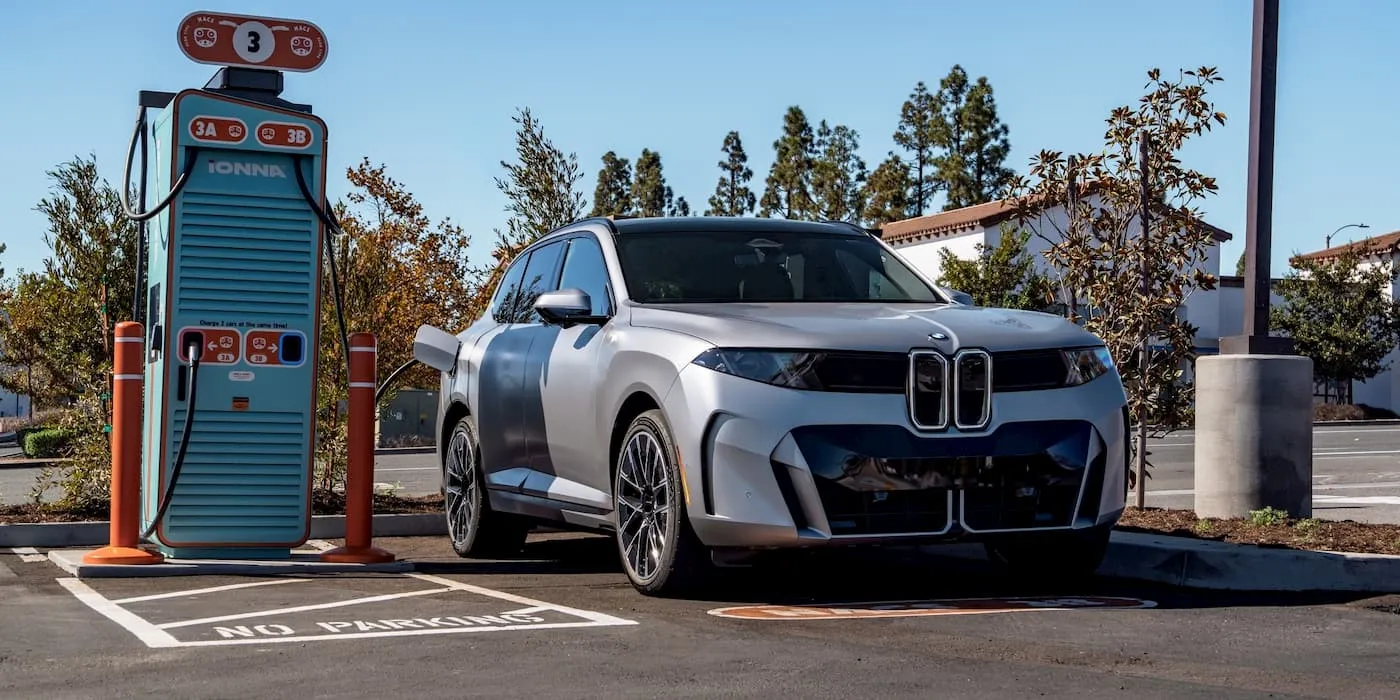
BMW iX5 Claims 528 Miles but Full Home Charge Takes 20-Plus Hours
The BMW iX5 presents an unusually sharp electric-vehicle tradeoff: BMW claims as much as 528 miles of range, yet completely replenishing its battery through a typical 7-kilowatt home wallbox takes more than 20 hours. For an electric SUV priced at about £85,000, the large energy reserve reduces the need to charge frequently but makes a full overnight refill impractical.
The reason is capacity. Every iX5 version assessed uses a 141-kilowatt-hour battery large enough that even 20 hours at a nominal 7 kilowatts only approaches the energy needed for a complete charge. Real charging also involves conversion losses, so the wallbox rating cannot simply be multiplied by time and treated as energy delivered to the battery.
BMW claims up to 512 miles for the base iX5 xDrive60, depending on its specification. The xDrive60 M Sport reaches the headline 528-mile figure, with its aerodynamic body and specialized wheels credited for the higher claimed efficiency. Those are standardized range claims rather than guarantees for every journey; speed, temperature, wheel choice and other operating conditions can change consumption.
Fast charging and home charging solve different problems
The same vehicle looks very different when connected to sufficiently powerful public infrastructure. Its 800-volt electrical architecture supports a claimed peak DC charging rate of 460 kilowatts, and the battery can reportedly reach 80 percent in as little as 23 minutes. That architecture allows high power to be transferred while controlling current and the associated resistive losses.
However, 460 kilowatts is a peak rather than a rate maintained throughout the session. The iX5 charging specifications compiled by EVKX put a typical 10-to-80-percent session at about 24 minutes and an average of 248 kilowatts. Battery temperature, charger output and the battery-management system’s charging curve all influence the result.
This creates two distinct charging experiences. High-power DC equipment is intended to add substantial driving range during a trip, while a home wallbox supplies energy gradually while the vehicle is parked. The iX5’s battery can accept power rapidly, but an ordinary domestic connection cannot provide anything close to its public-charging peak.
A more capable AC installation could narrow the gap. The iX5 supports AC charging at up to 22 kilowatts, with a compatible setup estimated to complete a charge in roughly six hours and 25 minutes. Whether a home can supply that rate depends on its electrical service and charging installation; a typical 7-kilowatt wallbox remains the more relevant baseline for many British households.
The practical answer is partial replenishment
Owners ordinarily will not arrive home with an empty battery or need to restore all 141 kilowatt-hours in one session. Charging little and often changes the calculation: replacing the energy used during the day can fit comfortably within an overnight period even when a zero-to-full charge cannot. The assessment estimates that favorable off-peak charging could provide more than 500 miles of range for under £10, although actual cost depends on the tariff and energy required.
The battery’s size can also produce a substantial bill when charging away from a favorable home tariff. Long claimed range does not automatically mean low energy cost; it means the vehicle can carry more purchased electricity before needing another connection.
Purchase and tax costs add another boundary to the engineering advantage. The iX5 is described as an £85,000 premium SUV, and every X5 and iX5 version exceeds £50,000, placing it in the top road-tax category for its first six years. For company-car users, the electric model falls into the lowest 4 percent benefit-in-kind band for the 2026/27 tax year.
The iX5 therefore uses battery capacity to shift charging from a frequent requirement into a scheduling decision. Its 528-mile claim and 23-minute rapid-charge figure show what the vehicle can offer under favorable conditions, while the 20-plus-hour home refill shows the limit imposed by ordinary household power. The battery may outlast a long driving day, but a typical wallbox cannot completely restore it during one night.
| More aerospace and engineering stories, right in your MSN feed. Follow AMI on MSN |
By Thomas Caldwell — AMI’s senior editor for mechanical and mobility engineering, covering vehicle electronics, systems integration, electrification, chassis systems, propulsion, and safety policy.



