


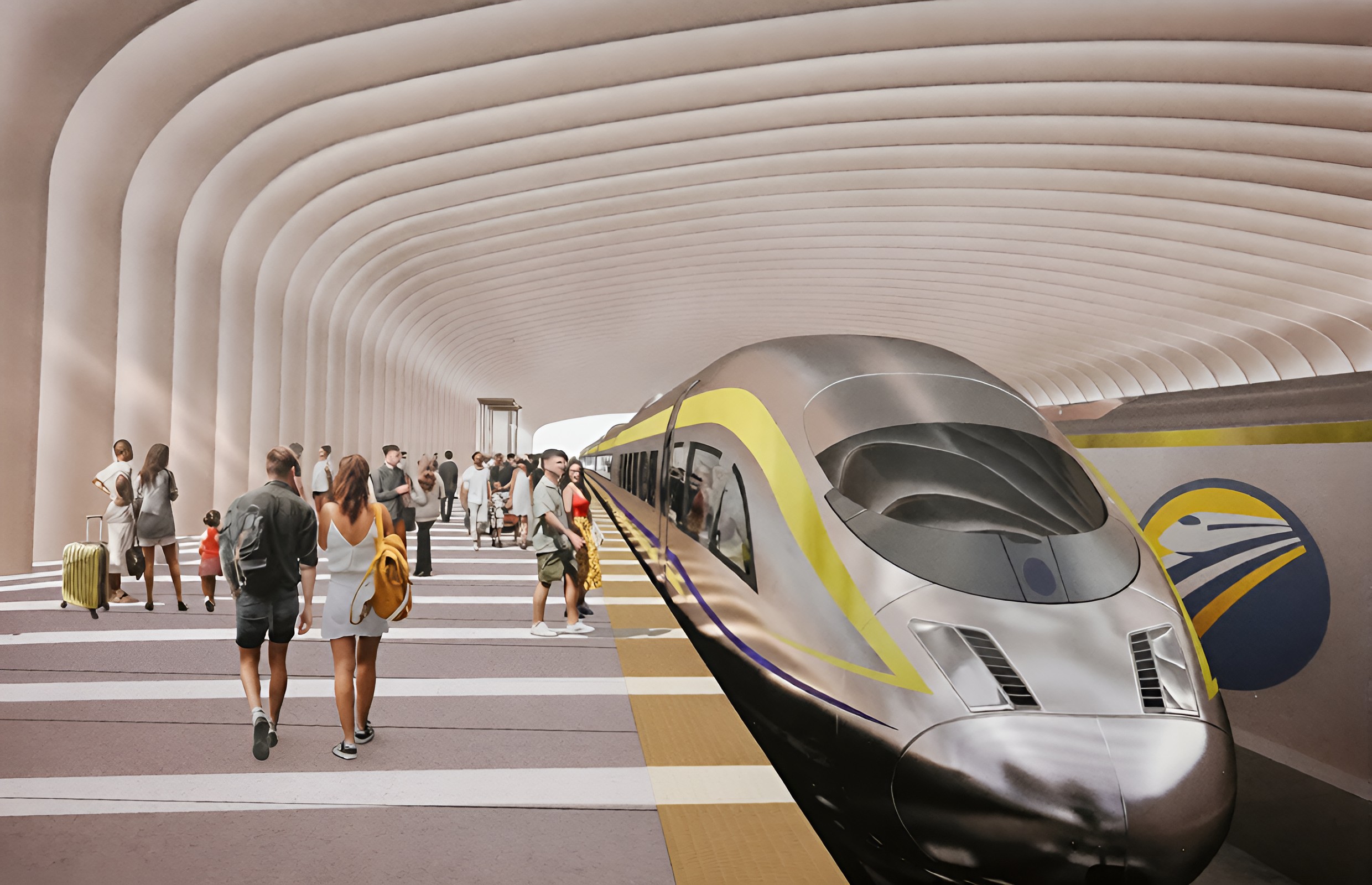
California’s $772 Million Siemens Plan Covers Three Trains and Decade of Maintenance
About $772.1 million is the scale of California’s planned initial Siemens high-speed-train package, but the figure covers considerably more than three trains. Documents prepared for the California High-Speed Rail Authority board’s October 28, 2026, meeting recommend approving a $281.7 million supply contract, a $284.1 million maintenance and full-service agreement for 2030-40, and a $206.3 million provision for testing, cost escalation, foreign exchange, taxes and other costs.
The award still requires the planned board approval. Delivery is envisaged from late 2029, followed by testing from spring 2030. Passenger operations on the 275-kilometer, or roughly 171-mile, initial section between Merced and Bakersfield are projected for 2033-34. That schedule puts several years between the procurement decision, arrival of the equipment and the point when paying passengers could use it.
What the initial commitment buys
The $281.7 million supply portion covers three seven-car American Pioneer 220 trainsets. Dividing the full $772.1 million package by three would therefore produce a misleading per-train figure: nearly two-thirds of the planned total sits outside the basic vehicle-supply contract.
The distinction is important for public-cost scrutiny. High-speed rolling stock cannot move directly from factory delivery into passenger service. The trains must be validated with the route’s power, signaling, track and operating environment, while crews, maintenance processes and emergency procedures also have to be prepared. The $206.3 million provision recognizes testing and financial uncertainties, although the listed amount also includes escalation, currency movements, taxes and other items rather than testing alone.
The maintenance agreement is similarly substantial. Siemens would receive monthly payments tied to train availability and reliability, aligning compensation with whether the small fleet is ready to operate. That structure transfers part of the long-term support responsibility to the manufacturer, but it also commits public funds through 2040 before passenger service is projected to begin. Five-year extensions could take maintenance coverage to 30 years.
For future passengers, three trains represent an initial fleet rather than the full potential service. Options would allow California to order as many as 19 additional trainsets at $62.1 million each. Those options are not included in the approximately $772.1 million initial package, and exercising them would create additional public commitments. Fleet size ultimately affects how much service can be scheduled and how much operational resilience exists when equipment is undergoing maintenance, but no service frequency is specified in the available plan.
A 220-mph platform adapted to California
Each aluminum-bodied train would be 202 meters long, seat at least 450 passengers and be rated for 220 mph. Its 8.2 megawatts of distributed traction power would spread propulsion equipment through the train rather than concentrate it in conventional locomotives. The design must accommodate long climbs, tunnels and elevations up to 1,400 meters, and two trainsets could operate together.
Batteries would provide limited emergency propulsion and keep air conditioning running after a loss of overhead electrical power. That is a resilience feature rather than a substitute for the railway’s normal power supply. The trains are also intended to meet federal Tier III crash and fire rules for high-speed passenger equipment, with a stated design life of 30 years and 20 million kilometers.
California plans to limit customization largely to exterior appearance, colors and selected materials. Using Siemens’ established Velaro Novo configuration can reduce the engineering work and configuration risk associated with a heavily customized fleet. The corresponding tradeoff is less freedom to redesign the basic platform around local preferences. Interiors would retain some flexibility for later changes, including possible family, bicycle and food-service areas.
Testing is a program milestone, not a formality
The gap between the anticipated late-2029 deliveries and spring-2030 testing provides time for commissioning, but train acceptance is only one part of opening a railway. Federal high-speed equipment rules treat the vehicle and its operating environment as an integrated system, requiring validation of braking, vehicle dynamics, electronic controls and interfaces with trackside systems before revenue service.
The trains would be built in Germany under federal domestic-sourcing relief. The Federal Railroad Administration’s final nonavailability waiver covered specified high-speed-rail products, including aluminum car shells, after domestic suppliers could not be identified. The agency said California estimated that more than 98% of total direct project spending would still go to domestically sourced products and labor, including all civil-infrastructure costs.
The immediate decision, then, is not an opening-day announcement. It is whether to authorize the first three trains and a support structure extending well beyond their expected arrival. Even if the board approves the package, the most consequential proof points remain ahead: delivery at the end of 2029, integrated testing from 2030 and a projected passenger-service opening in 2033-34.
| More aerospace and engineering stories, right in your MSN feed. Follow AMI on MSN |
By Thomas Caldwell — AMI’s senior editor for mechanical and mobility engineering, covering vehicle electronics, systems integration, electrification, chassis systems, propulsion, and safety policy.



