China Turns Sci-fi Into Reality With a Massive Deep Sea Floating Island
For more than a decade, the struggle for maritime dominance across the Western Pacific has driven major powers to project power far beyond their coastlines. Beijing has steadily advanced this doctrine by militarizing distant reefs across the South China Sea, deploying sophisticated underwater sensor nets, and investing in advanced blue-water combat groups. These sustained investments reflect a broader national strategy aimed at converting regional ocean access into permanent, fortified operational depth.
Yet fixed land-reclamation projects face distinct limitations, remaining vulnerable both to severe marine weather and persistent surveillance from rival naval forces. Consequently, naval planners and marine engineers have sought flexible offshore alternatives capable of remaining on station during rough conditions while retaining the mobility to shift locations at will.
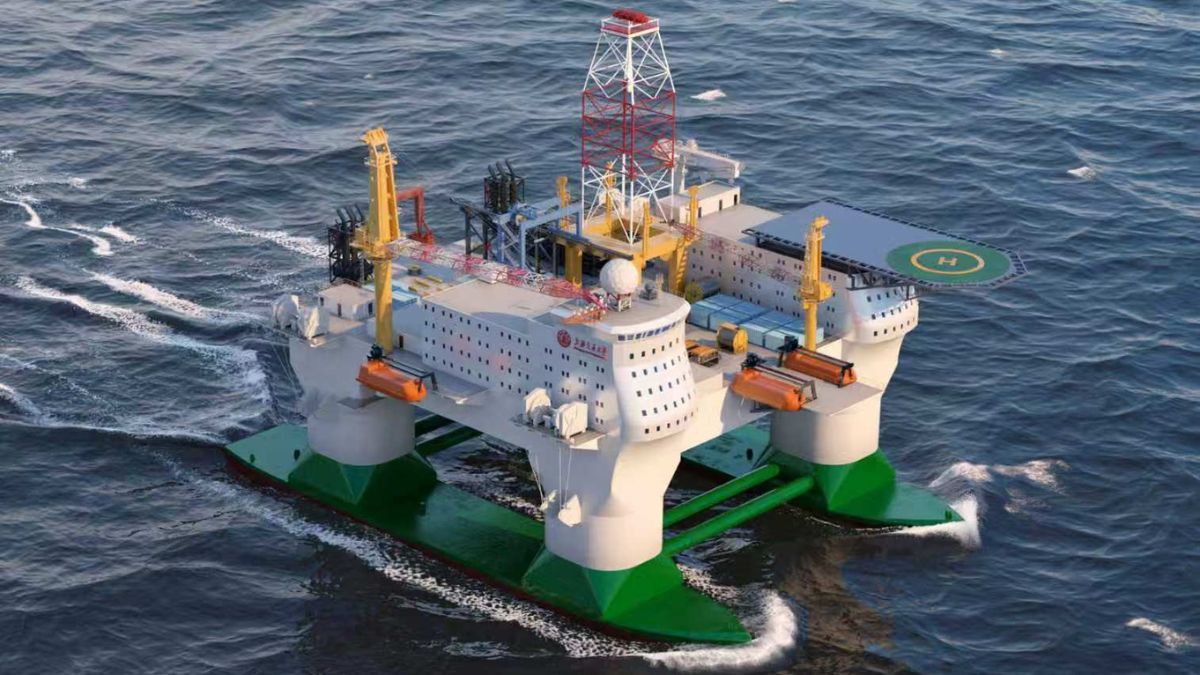
Now, Chinese state research institutions and shipbuilders have formalized plans to construct a mobile, deep-ocean artificial structure designated the ‘Deep-Sea All-Weather Resident Floating Research Facility’. Under a major contract reported by CGTN, Shanghai Jiao Tong University selected Shanghai Waigaoqiao Shipbuilding—a core subsidiary of China State Shipbuilding Corporation—to construct the floating platform for 2.76 billion yuan, or roughly $413 million.
The semi-submersible catamaran platform, dubbed the ‘Open-Sea Floating Island’, is engineered to function as an offshore base with a displacement comparable to a conventional aircraft carrier. The vessel will measure 453 feet in length and 279 feet across the beam, featuring a main deck structure that rises 148 feet above the water line, according to The Maritime Executive.
Displacing approximately 74,000 tons, the self-propelled installation is powered to cruise at 11 knots while maintaining operational stability in Sea State 7 swells measuring up to 30 feet high. Structural engineers designed the twin-hull base to survive Category 17 super typhoons packing sustained wind speeds over 165 mph, permitting a complement of 238 crew members and researchers to remain at sea for four months without replenishment.
To support deep-water interventions, the platform features a central moon pool aperture spacious enough to hoist submersibles and heavy seabed mining modules weighing up to 330 tons. This internal hoisting bay will allow operators to deploy autonomous underwater vehicles and heavy scientific rigs to abyssal depths reaching 32,800 feet. The platform will also incorporate six specialized shipborne laboratories dedicated to marine equipment testing, geophysical mapping, and atmospheric observation.
While Chinese state announcements characterize the project as a civilian platform for resource extraction and meteorological observation, defense analysts view the facility through a clear dual-use prism. Academic papers detailing the design reveal that core operational zones—including emergency generators, internal communication suites, and navigation centers—feature metamaterial sandwich panels specifically engineered to absorb blast shockwaves and overpressure.
By hardening vital internal systems against explosive concussions and structural shock, the platform mirrors survivability standards traditionally reserved for frontline naval combatants. Such capabilities suggest that the mobile island could function as a forward-deployed command post, acoustic surveillance nexus, or staging node for unmanned underwater vehicles in contested waters.
Under the newly finalized agreement, Shanghai Waigaoqiao Shipbuilding is scheduled to begin physical fabrication in 2028 ahead of a planned delivery target in June 2030. Once launched, this mobile floating base will give Beijing a resilient, persistent operational presence in remote sea areas where permanent land infrastructure cannot exist.