


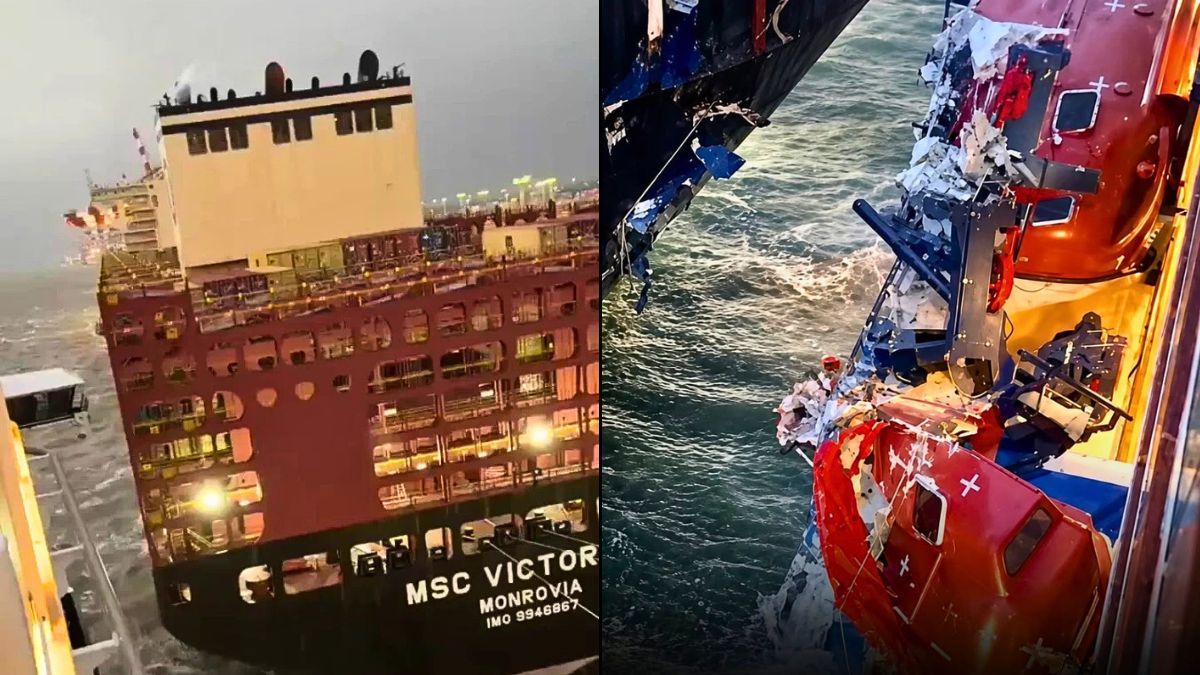
Harbor Video Captures Two Massive Ships Colliding, Tearing a 33-Foot Hull Gash
Harbor navigation along northern European coastlines demands extreme precision, particularly when deep-draft commercial vessels share tight turning basins during volatile autumn weather fronts. In major industrial ports like Bremerhaven, maintaining lateral separation is essential as thousands of cargo containers and passenger decks maneuver through restricted channels. The operational profile of the cruise ship ‘Mein Schiff 3’ relies heavily on synchronized tug support to clear the Columbus Quay without impeding nearby freight operations.
Large passenger liners possess high sail area, meaning severe gale-force wind gusts can easily overpower lateral thrusters during unmooring sequences. When heavy squalls track across the German bight, port authorities and harbor pilots frequently face narrow safety margins while coordinating multi-tug escorts. These operational dynamics make departure maneuvers particularly hazardous whenever sudden wind shears push displacement hulls toward adjacent commercial berths.
That delicate balance failed on Sunday evening when ‘Mein Schiff 3’ departed its berth at Bremerhaven amid severe weather conditions. As the 961-foot cruise ship attempted to maneuver outward into the Weser River channel, powerful wind gusts pushed the vessel off its intended track. Despite the active deployment of assisting harbor tugs, the passenger liner drifted sideways and collided with the stern of the docked container ship ‘MSC Victorine’.
The impact produced substantial structural damage along both hulls as the cruise liner scraped past the berthed freighter. As reported by Splash247, the collision tore a roughly 33-foot gash above the waterline of ‘MSC Victorine’, compromising deck structures and impacting adjacent cargo container stacks. Bremen port authorities confirmed that despite the severe gash, the container vessel suffered no water ingress into its lower hull compartments.
🚢 Two massive ships collide in Germany At the port of Bremerhaven, the cruise ship Mein Schiff 3 collided with docked container vessels while leaving the harbor. Strong winds reportedly pushed the massive liner toward the cargo ships. More than 3,300 people were on board. The collision damaged the cruise ship’s lifeboats and reportedly left a roughly 10-meter hole in the hull of one of the container vessels. Fortunately, no injuries were reported. However, the planned cruise to the Canary Islands had to be canceled. The vacation hadn’t even started, and the passengers had already had enough adventure for an entire cruise. 🎥 Original footage: YouTube — Alex / CruiseOfficerAlex
— NEXTA (@nexta_tv) October 26, 2026
Aboard ‘Mein Schiff 3’, the force of the collision crushed three lifeboats and heavily distorted their structural davit launch mechanisms along the starboard side. Eyewitness footage recorded from passenger decks captured shattered structural glass, damaged railings, and debris shearing away from the command bridge wing. Two assisting tugboats also sustained collateral damage while attempting to arrest the lateral drift of the 99,526-ton cruise liner.
More than 3,300 people were on board ‘Mein Schiff 3’ at the time of the collision, comprising 2,428 passengers and 922 crew members. Emergency protocols were initiated immediately across all decks, and medical personnel confirmed that no injuries occurred among the guests or crew. Assisting harbor tugs eventually secured the cruise liner and guided the vessel back to the safety of the Columbus Quay terminal for emergency technical assessment.
New footage shows the moment TUI Cruises’ Mein Schiff 3 collided with the docked container ship MSC Victorine in Bremerhaven, Germany. Strong winds pushed the cruise ship sideways despite tugboats trying to assist https://t.co/lELAkgnRbK
— Surajit (@surajit_ghosh2) October 26, 2026
Following a nighttime inspection by technical surveyors, operator TUI Cruises made the decision to cancel the vessel’s planned 20-day voyage to the Canary Islands and Morocco. The company confirmed that the destruction of essential life-saving appliances rendered the cruise ship legally unseaworthy until full shipyard repairs are completed. German maritime police, operating through the regional water protection unit, placed an immediate departure ban on all involved vessels and launched an official marine accident investigation.
The incident highlights the operational vulnerabilities of high-sided passenger vessels operating in proximity to commercial freight infrastructure during sudden weather shifts. With both ‘Mein Schiff 3’ and ‘MSC Victorine’ held for forensic evaluations, maritime investigators are examining whether tug allocation, pilot advisory timing, or engine throttle response factored into the drift. Until shipyard repair slots are confirmed, the accident serves as a stark reminder of harbor maneuvering risks in congested coastal shipping lanes.



