Fixed-Wing Electra EL2 Takes Off and Lands at Manhattan Heliport
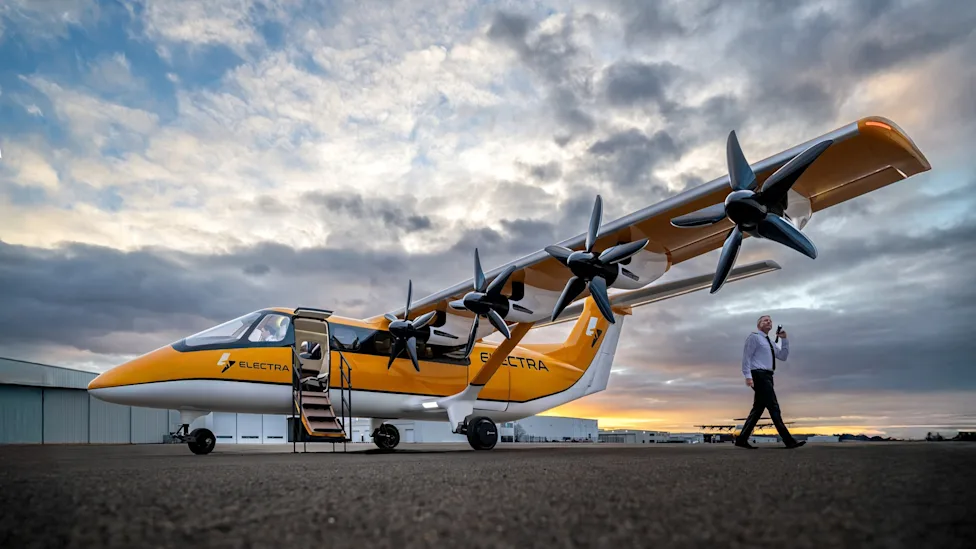
A fixed-wing aircraft has operated from a site normally associated with helicopters. Electra announced on October 26 that its two-seat, hybrid-electric EL2 demonstrator successfully took off and landed at Downtown Skyport in Lower Manhattan, advancing the company’s effort to operate aircraft from compact sites without conventional runways.
Electra described the flight as what it believes was the heliport’s first landing by a fixed-wing aircraft without vertical-takeoff capability. The completed demonstration establishes that the EL2 can use this particular constrained urban site, but it does not put Electra’s planned passenger aircraft into service. The nine-passenger EL9 remains under development and is progressing through the Federal Aviation Administration certification process.
How a fixed-wing aircraft uses such a short site
The EL2 does not hover. Instead, it combines distributed electric propulsion with blown lift to generate more lift at low speed. Multiple electrically driven propellers move air across the wing, increasing airflow where it contributes to lift even when the aircraft itself is traveling relatively slowly.
That arrangement addresses a basic constraint of conventional fixed-wing aircraft: wings generally need sufficient forward speed to produce the lift required for takeoff and landing. Increasing airflow over the wing allows Electra’s design to operate at lower speeds and use less ground distance. The company says the architecture permits takeoffs and landings in as little as 150 feet.
The 150-foot figure is Electra’s stated design capability, not a disclosed measurement of the Manhattan operation. Even so, the heliport flight provides a more consequential test than demonstrating short-field performance on a conventional airport runway. It places the aircraft in the type of compact operating environment central to Electra’s concept, where available pavement, surrounding development and established aviation activity impose tighter boundaries.
The Manhattan flight followed demonstrations in Charleston, South Carolina, and Atlantic City, New Jersey. Electra has also tested helicopter-style instrument procedures and unconventional landing areas at several Virginia airports. Those flights involved the FAA’s advanced-aircraft integration pilot program and other partners, giving regulators and participants operational data from environments beyond standard runway use.
A landing demonstration is one part of the system
Using existing heliports could reduce the need to find enough urban land for full-length runways, but aircraft performance is only one part of site suitability. FAA heliport design guidance covers matters including touchdown areas, approach and departure airspace, parking separation, markings, turbulence effects and protection zones. A fixed-wing aircraft using such a facility must fit within an operating environment originally structured around helicopters.
Urban aviation sites also have to manage obstacle clearance, emergency response, passenger movement, security, neighboring land uses and compatibility with other aircraft. Electrified operations can add power-delivery and charging requirements. Electra’s EL2 is hybrid-electric, while the broader task of adapting a constrained site depends on the aircraft, operating model and infrastructure selected.
These considerations help explain why a successful takeoff and landing cannot by itself establish that routine passenger service is ready. Commercial operations require a certificated aircraft, an approved operator and operating procedures, along with sites that can safely support repeated flights rather than a single demonstration. Local planning and community questions also remain relevant when aviation activity is introduced or expanded in a dense area.
The EL9 is the commercial objective
Electra is using the two-seat EL2 as a development platform for the planned nine-passenger EL9. The company envisions the larger aircraft connecting cities through smaller aviation facilities, including existing heliports and other compact areas, instead of depending exclusively on conventional airports.
CEO Marc Allen said the Manhattan operation demonstrated a capability intended to make travel faster and easier. Those transportation benefits remain an ambition for the future network, rather than a result established by the demonstration. Route economics, passenger processing, aircraft turnaround, site approvals and integration with existing air traffic will all influence whether short-field capability translates into a practical service.
Electra plans additional flight demonstrations while it works toward production and commercial operations. Neither has begun. The Manhattan flight nevertheless moved the concept into a demanding real-world setting: the EL2 arrived and departed as a fixed-wing aircraft from a compact downtown heliport, while the passenger-carrying EL9 still faces the longer work of certification and deployment.
| More aerospace and engineering stories, right in your MSN feed. Follow AMI on MSN |
By Thomas Caldwell — AMI’s senior editor for mechanical and mobility engineering, covering vehicle electronics, systems integration, electrification, chassis systems, propulsion, and safety policy.