Lufthansa Retires Fan-Favorite Airbus A340-600 as Twin-Engine Jets Take Over
A jet regarded as a commercial disappointment received an unusually affectionate sendoff from Lufthansa. Aviation enthusiasts gathered at Washington Dulles International Airport for the airline’s final Airbus A340-600 flight on October 18, bringing banners, homemade shirts and even a cake for the crew before the four-engine aircraft departed for Frankfurt.
The flight closed 23 years of A340-600 service at Lufthansa, which confirmed the aircraft’s retirement in an official fleet update. The final aircraft, the 17-year-old D-AIHW, carried 267 passengers and 15 crew members. Many passengers had purchased tickets specifically for the occasion.
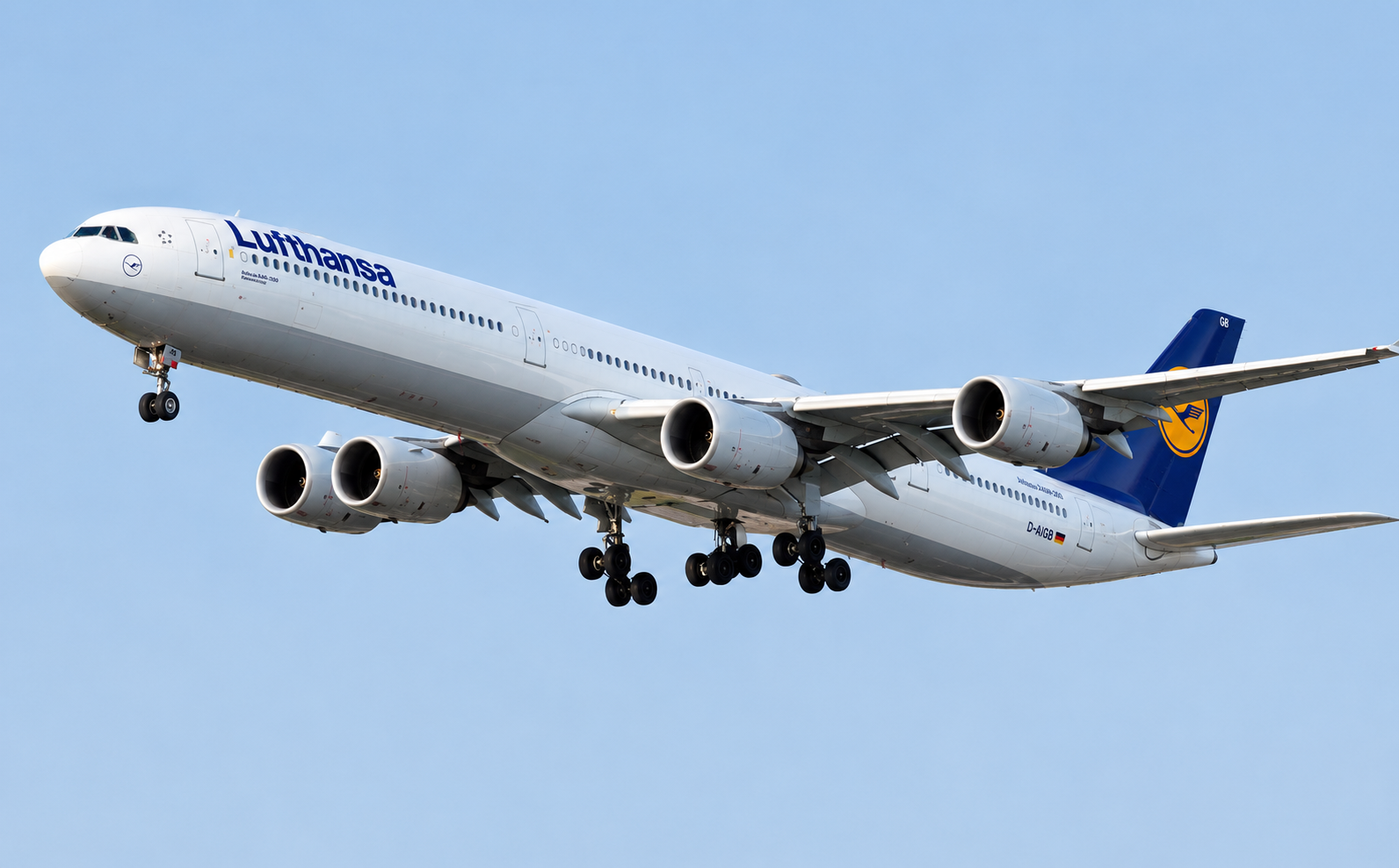
Among them were six friends wearing homemade “4 engines 4 long haul” shirts. The turnout captured the central contradiction of the A340-600: Its imposing proportions and unmistakable four-engine silhouette made it a favorite among aircraft enthusiasts, while those same physical and propulsion choices worked against it commercially.
A record-length body came with operating constraints
When the A340-600 entered service in August 2002, its 247-foot fuselage made it the world’s longest commercial passenger airplane. That record lasted eight years, until the Boeing 747-8 Intercontinental arrived with a fuselage five feet longer.
The Airbus was not merely long for visual effect. Its stretched body gave airlines substantial passenger capacity, and an unusual cabin arrangement could place lavatories below the main passenger deck in space normally used for cargo. That freed additional room for seats above.
But exceptional length also followed the aircraft onto the ground. The A340-600 needed external cameras to help pilots monitor its surroundings while maneuvering around airports. Operators and airports had to confirm that taxiways and runways could accommodate its dimensions. Late in Lufthansa service, the aircraft often carried its own tow bar because some destination airports might not have compatible equipment available.
Those details illustrate how a distinctive airframe can generate costs beyond fuel. Airport compatibility, ground equipment, towing arrangements and fleet-specific procedures all become part of the operating burden. An aircraft that needs uncommon support equipment also gives an airline fewer opportunities to simplify maintenance and planning.
Two engines changed the long-haul equation
Airbus developed the A340-600 as a large, long-range alternative to the Boeing 747-400. Its four Rolls-Royce Trent 500 engines fit an era when four-engine aircraft were established tools for long intercontinental routes. The market moved quickly, however, toward large twin-engine aircraft.
Boeing’s 777-300 and 777-300ER offered comparable seating capacity using two engines, and Boeing sold hundreds of the stretched 777 variants. The A340-600 fleet, by contrast, peaked globally at 95 aircraft in 2009, according to Cirium data cited in reporting on the retirement.
Four engines gave the A340-600 its visual identity, but they also meant four engines to fuel and support. As twin-engine designs became the preferred long-haul solution, the A340-600’s configuration became an economic liability rather than a defining advantage. China Eastern retired its last example in 2015, while Iberia and Virgin Atlantic followed in 2020 and South African Airways continued until 2021. Conviasa and Mahan Air still operate several A340-600s.
Lufthansa operated 24 of the aircraft over 23 years and carried more than 40 million passengers on the type. Its final four examples have been sent to storage in Düsseldorf and could potentially pass to a charter operator, so retirement from Lufthansa service may not be the end of every airframe’s flying career.
The airline plans to replace the A340-600 with Airbus A350-1000s and, later, Boeing 777-9s. Lufthansa says its incoming long-haul aircraft are quieter and, according to their manufacturers, use 30 percent less fuel than the older aircraft they replace. It also expects fewer aircraft types to reduce complexity in maintenance, training and fleet planning.
That transition explains both the farewell and the retirement. The A340-600 offered a 247-foot profile, four-engine presence and enough mechanical character to inspire banners, special shirts and a cake. Lufthansa’s future long-haul fleet will obtain comparable scale from two engines instead of four.
| More aerospace and engineering stories, right in your MSN feed. Follow AMI on MSN |
By David Whitaker — Associate editor for AMI’s aerospace and drone systems desk, translating flight systems, aircraft programs, spaceflight, and UAV developments into accessible technical stories.