


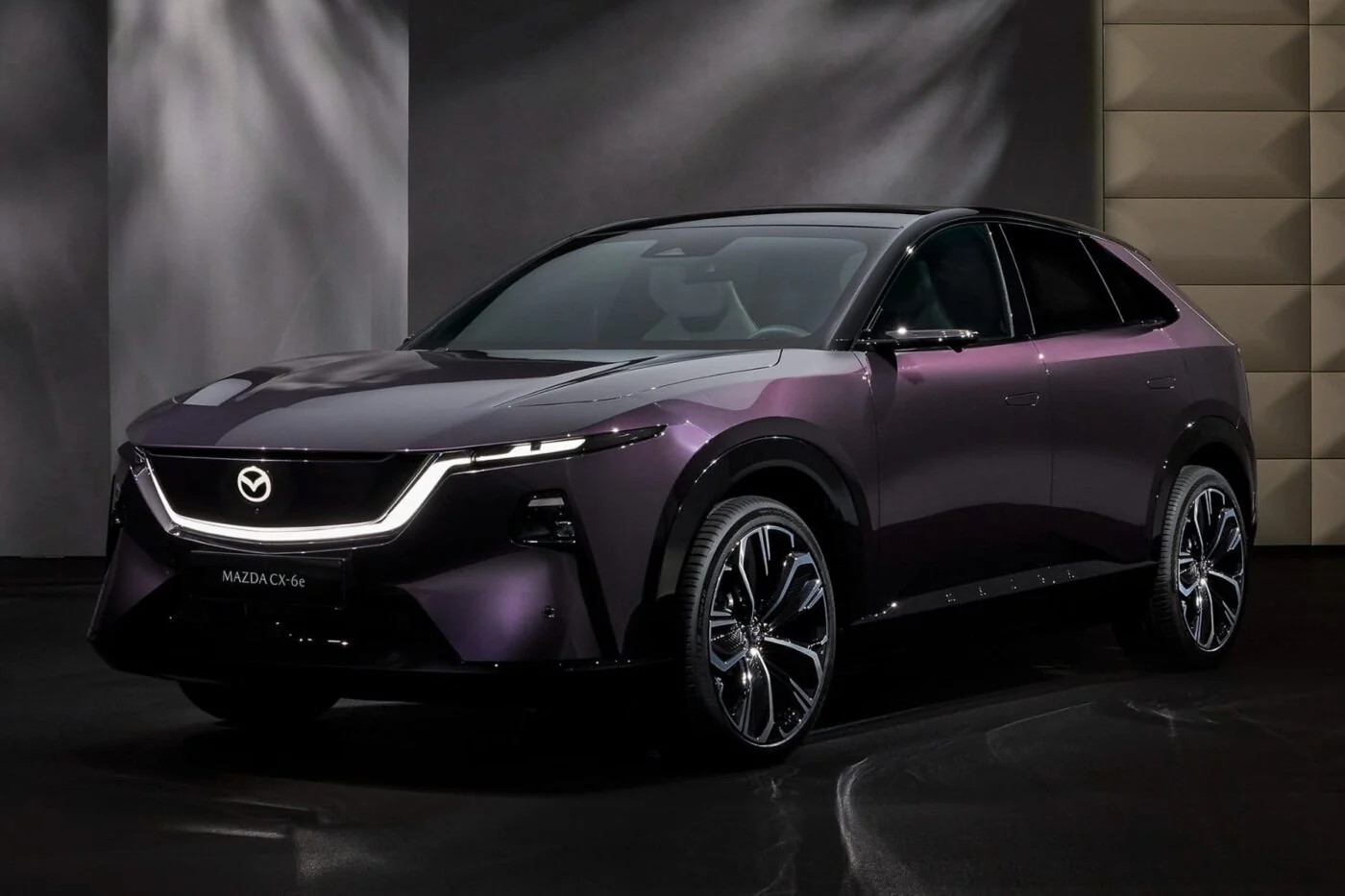
Mazda CX-6e Test Needed Three Stops and 93 Charging Minutes
The Mazda CX-6e made a strong case for itself on winding roads, with a controlled chassis, quiet cabin and premium interior. The tension emerged on the highway: a 444-mile test across Romania and Hungary required three charging stops totaling 93 minutes, including one unplanned stop before reaching Tata, Hungary.
The completed trip was almost evenly divided between national roads, at 51%, and highways, at 49%. Across the full route, the electric crossover averaged 19.9 kilowatt-hours per 100 kilometers, equivalent to about 3.14 miles per kilowatt-hour. Based on that consumption, the reviewer calculated a theoretical range of 240 miles 60 miles below the CX-6e’s 300-mile rating under Europe’s standardized test cycle.
This was one road test rather than a universal range result, but the route exposed a specific operating boundary. At a steady 81 mph, consumption rose to approximately 25 kilowatt-hours per 100 kilometers, or 2.49 miles per kilowatt-hour. The reviewer considered even 186 miles per charge optimistic for continuous highway driving at the speed limit.
Why highway speed changed the trip
The gap between the mixed-route average and the high-speed figure explains the additional stop more clearly than the official range number alone. The Worldwide Harmonised Light-Duty Vehicles Test Procedure provides a regulated, repeatable basis for comparing vehicles, but an individual journey can produce a different result as speed and operating conditions change.
Independent research has also found a strong relationship between vehicle speed, acceleration, battery power and electric-vehicle energy consumption. At sustained highway speed, the CX-6e could not benefit as frequently from lower-speed operation and regenerative deceleration. Its measured energy demand consequently reduced the distance available between charging sessions.
The vehicle uses a 78-kilowatt-hour lithium iron phosphate battery and a single rear motor producing 255 horsepower and 214 pound-feet of torque. Mazda advertises a peak direct-current charging rate of 195 kilowatts and says a 10% to 80% charge can take 24 minutes under ideal conditions. During the test, the car briefly exceeded its advertised peak power.
That charging result is encouraging, but peak power and total travel delay measure different things. The maximum rate is available only during part of a charging session, while a road trip is shaped by the battery’s charging curve, the starting and ending charge levels, charger availability and the number of stops required. In this case, three sessions still consumed a combined 93 minutes. Strong peak performance could not recover the time imposed by the added stop and repeated connections.
Refinement did not remove the control compromises
Away from the efficiency issue, the CX-6e displayed the qualities expected of a driver-focused crossover. Its rear-wheel-drive layout, firm but controlled suspension and quiet cabin impressed on Romania’s Transapuseana mountain road. The interior materials and overall presentation also supported the model’s roughly €50,000 European price more convincingly than the highway range did.
Regenerative braking introduced a separate human-factors concern. The test found that lifting off the accelerator could produce either strong deceleration or coasting, making the response difficult to anticipate when approaching a corner. Changing the regeneration setting also required touchscreen interaction rather than a direct physical control.
Predictable deceleration is important because drivers build timing and pedal inputs around a vehicle’s repeated response. A regeneration system can recover energy and reduce reliance on the friction brakes, but inconsistent behavior makes that benefit harder to use smoothly. Requiring a touchscreen adjustment adds another interface task when the driver may simply want a stable, repeatable setting.
The CX-6e therefore emerged as an appealing electric crossover with a narrower long-distance strength than its 300-mile rating might initially suggest. Its chassis and cabin performed well, and its charging hardware reached the advertised power level. Yet at sustained highway speed, higher consumption turned directly into an unplanned stop and helped make charging account for 93 minutes of a 444-mile cross-border journey.
| More aerospace and engineering stories, right in your MSN feed. Follow AMI on MSN |
By Thomas Caldwell — AMI’s senior editor for mechanical and mobility engineering, covering vehicle electronics, systems integration, electrification, chassis systems, propulsion, and safety policy.



