


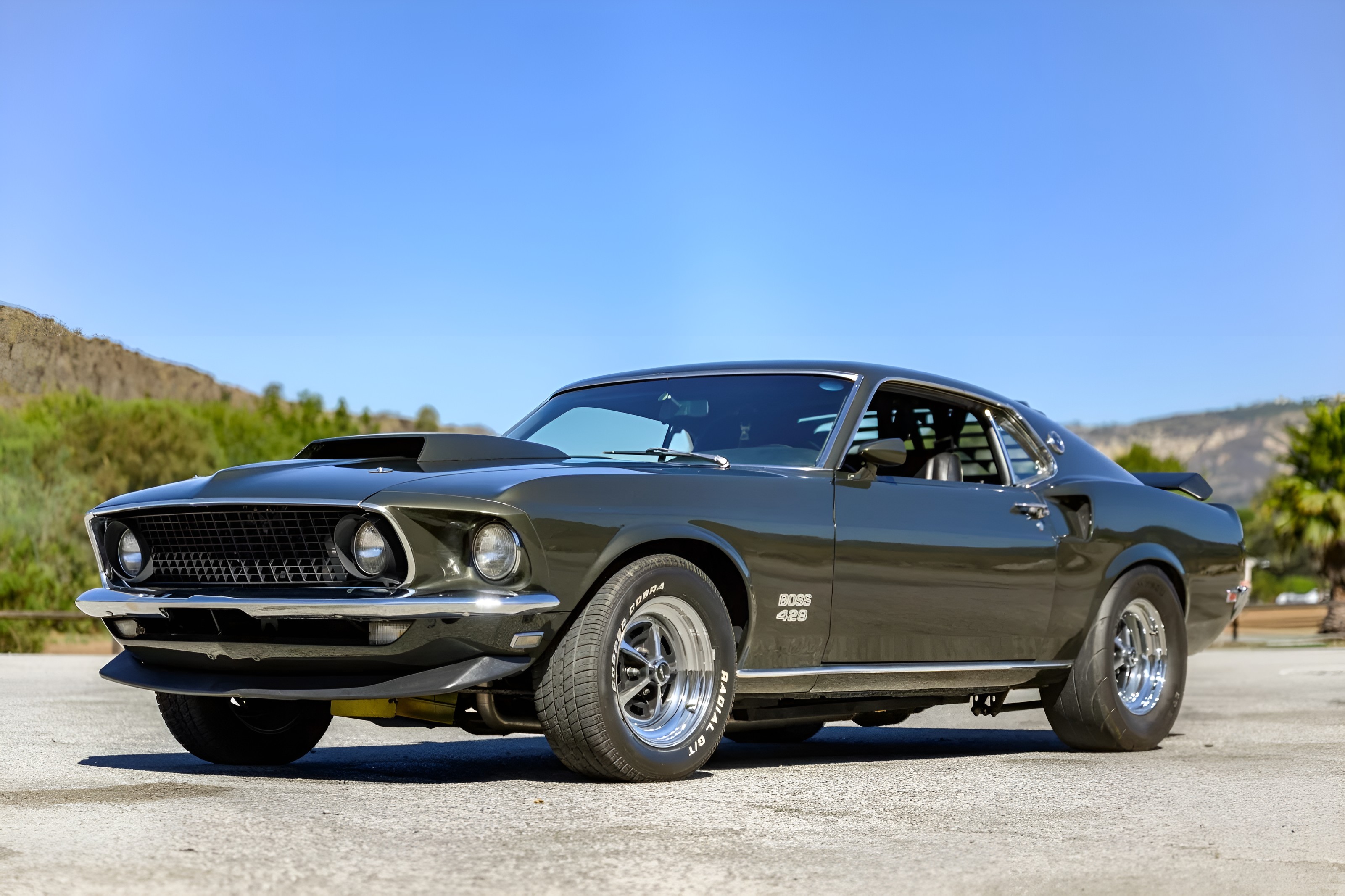
Modern Ford Mustang Boss 429 Rendering Hides a Costly 7.0-Liter Problem
The difficult part of creating a convincing modern Ford Mustang Boss 429 would not be the long hood, low roof or oversized scoop. It would be the number on the badge. An unofficial digital rendering imagines the 1969-70 muscle car rebuilt for 2028, but an authentic interpretation would require a 429-cubic-inch, or 7.0-liter, V8 engineered around modern emissions, durability and drivability expectations.
No such model has been announced by Ford, and the rendering does not depict a car known to be under construction. It is a useful engineering exercise because it exposes a conflict that exterior design alone cannot resolve: preserving the Boss 429 identity would make the powertrain significantly more complicated and expensive, while choosing an existing engine would make the car easier to build but less faithful to its name.
The 429 badge describes the engine
The original Boss 429 was not merely a Mustang appearance package. Ford created it to support homologation of its 429-cubic-inch racing engine for NASCAR competition against Chrysler’s Hemi-powered cars. Specialist Kar Kraft modified Mustangs in Brighton, Michigan, because fitting the large engine required substantial changes.
Those changes included revised shock towers and control-arm positioning, a thinner power-brake booster and a relocated battery. The street-going engine was officially rated at 375 horsepower and paired with a close-ratio four-speed manual transmission. As this Boss 429 history from Barrett-Jackson explains, the number identified the engine’s displacement rather than serving as decorative branding.
Ford built 857 examples for 1969 and another 499 for 1970, for a total of 1,356. With the model’s market benchmark placed around $395,000, depending on condition and history, cutting up a genuine car would be costly and likely objectionable to preservation-minded owners. A less valuable first-generation Mustang would therefore be the more practical foundation for a restomod.
An existing V8 solves the wrong problem
A modern 5.0-liter Ford Coyote V8 offers the most direct route to usable performance. The current Mustang GT demonstrates why: its 5.0-liter engine is already integrated with a six-speed manual or 10-speed automatic, contemporary controls and the supporting systems expected in a road car. For a builder, starting with a developed powertrain reduces the amount of bespoke calibration and validation required.
Yet a 5.0-liter engine leaves a basic identity problem. A car can reproduce the Boss 429’s body proportions, hood scoop and visual cues, but calling it a 429 without the corresponding displacement separates the badge from the feature that originally defined it.
A purpose-built naturally aspirated 7.0-liter V8 would close that gap, but displacement is only the starting point. The engine would need compatible emissions hardware and calibration, predictable cold and hot operation, acceptable low-speed behavior and durability across repeated thermal cycles. Its cooling, intake, exhaust and accessory systems would also have to fit within the vehicle as an integrated package.
That work extends beyond making an engine run or producing an impressive peak-power figure. Modern exhaust components interact with sensors, active valves, emissions controls and software. A credible roadgoing conversion must manage those relationships without sacrificing everyday starting, idle quality or serviceability. Low production volume would make the development expense harder to spread across multiple cars.
More power does not guarantee more authenticity
A supercharged smaller V8 could deliver greater output without requiring a unique 7.0-liter engine. It would also change the power delivery and move the project away from the original naturally aspirated formula. A hybrid system could add performance or efficiency, but it would bring a battery, electric hardware, control software and additional packaging demands into an already complex conversion.
None of those alternatives is inherently incapable of producing a fast Mustang. The question is what the Boss 429 name is supposed to preserve. If outright performance is the priority, an existing 5.0-liter engine, forced induction or electrification offers a more practical path. If mechanical continuity is the priority, the bespoke 7.0-liter V8 becomes the project’s defining requirement and its largest likely cost driver.
The rendered specification adds modern lighting, wide bodywork, lowered suspension, upgraded brakes and contemporary aerodynamic details. Those components could make the car look production-ready, while a six-speed manual and improved chassis hardware could make it more usable than the original. But the central choice remains unresolved: the closer a modern Boss 429 comes to recreating its defining oversized engine, the more expensive and difficult the entire vehicle becomes to engineer.
| More aerospace and engineering stories, right in your MSN feed. Follow AMI on MSN |
By Thomas Caldwell — AMI’s senior editor for mechanical and mobility engineering, covering vehicle electronics, systems integration, electrification, chassis systems, propulsion, and safety policy.



