


Navy Selects Radiant’s 1-Megawatt Reactor for Five-Year Off-Grid Power
The U.S. Navy has selected Radiant Industries to design, build and deliver a transportable 1-megawatt microreactor for Naval Weapons Station Crane in Indiana. The Navy announced the prototype selection on October 20, 2026, advancing a system intended to supply critical infrastructure with grid-independent power for up to five years between refueling.
The selection does not mean the Kaleidos reactor is installed or generating electricity at Crane. Radiant’s customer design is undergoing full-scale testing, while the Navy project still must pass design refinement, environmental review, regulatory coordination and site-preparation stages before deployment.
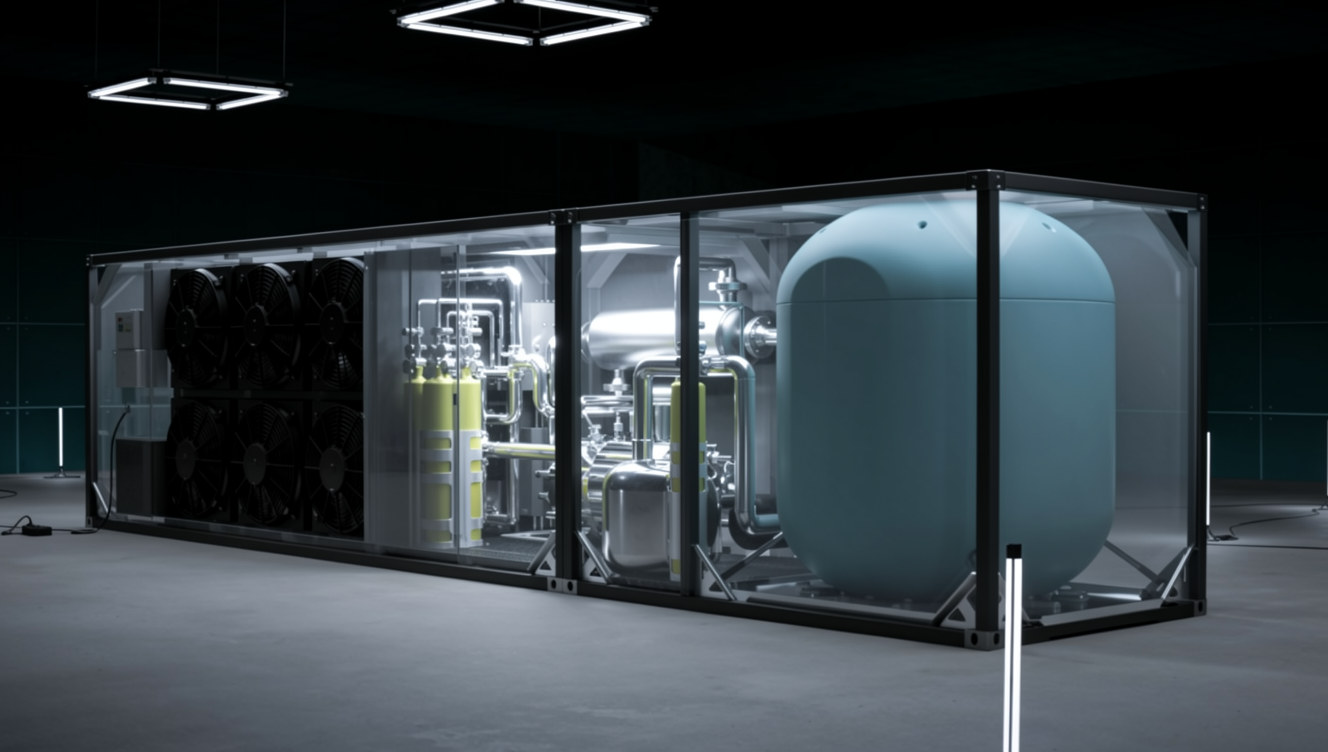
Kaleidos is a factory-built, high-temperature gas-cooled reactor designed to produce approximately 1 megawatt of electrical power. Radiant says the enclosed package can be transported by land, sea or air and operate continuously for as long as five years before refueling, with a stated overall service life of 20 years.
That combination defines the project’s appeal: a reactor compact enough to reach a military installation by truck, ship or aircraft, then serve as a primary off-grid power source for years rather than depending on frequent fuel deliveries. For Crane, the intended benefit is sustained electricity for mission-critical work when the surrounding grid is unavailable or constrained.
The physical installation concept is also designed to reduce the civil works normally associated with a power plant. According to Radiant, Kaleidos needs no cooling water, extensive excavation or major on-site construction. Factory assembly could shift more specialized work into a controlled manufacturing environment and reduce the amount of construction required at the receiving site.
That is the basis for the system’s plug-and-play proposition, but a transportable reactor is not literally a household-style appliance. The Crane installation will still need electrical connections, safety and security arrangements, regulatory approvals and site-specific infrastructure. Engineers must also integrate its output with the station’s distribution system and determine how the installation will manage changing demand, faults, maintenance periods and times when the reactor is unavailable.
The no-cooling-water claim refers to the reactor’s gas-cooled design. The complete power package must still transfer heat from the reactor, convert part of that thermal energy into electricity and reject the remaining heat within its approved operating limits. Full-system performance, rather than the reactor core alone, therefore determines whether the compact architecture delivers its promised installation advantages.
Radiant is testing Kaleidos at Idaho National Laboratory’s Demonstration of Microreactor Experiments facility, known as DOME. The company received exclusive access to the facility for one year. The program is described as a full-scale, full-power and long-duration test using the design and fuel intended for customer systems.
That test campaign is central to the Navy project because it can examine the interactions among the reactor, gas-cooling system, controls and power-conversion equipment under operating conditions. It is also where engineers can collect performance and reliability data before a customer installation is placed into service. A successful demonstration would support the design’s technical case, but it would not replace the site-specific reviews and approvals required at Crane.
The Crane project is being pursued through the Army’s Janus Program and was included in an August 2026 announcement under which the Army expects to build more than 20 microreactors at military installations. Radiant has also been selected for Army and Air Force microreactor efforts, making it the only nuclear company currently partnered with all three military departments on such programs.
The broader procurement objective is to move commercial reactor designs toward military use while retaining civil regulatory pathways. The Defense Innovation Unit’s advanced nuclear program calls for systems that are safe, secure, reliable and compliant, with enough decentralized generation to support critical installation loads. At Crane, experts from the Naval Nuclear Propulsion Program are expected to provide technical support as the project proceeds through prototype testing, regulatory coordination and deployment planning.
The next phases include final environmental reviews, localized site design and coordination with the appropriate federal, state and local authorities. No definitive commissioning date has been announced. Before Kaleidos can provide five years of off-grid power at Crane, its full-power test must establish that the same compact design and fuel intended for customers can perform as an integrated generating system under sustained operating conditions.
| More aerospace and engineering stories, right in your MSN feed. Follow AMI on MSN |
By Thomas Caldwell — AMI’s senior editor for mechanical and mobility engineering, covering vehicle electronics, systems integration, electrification, chassis systems, propulsion, and safety policy.



