


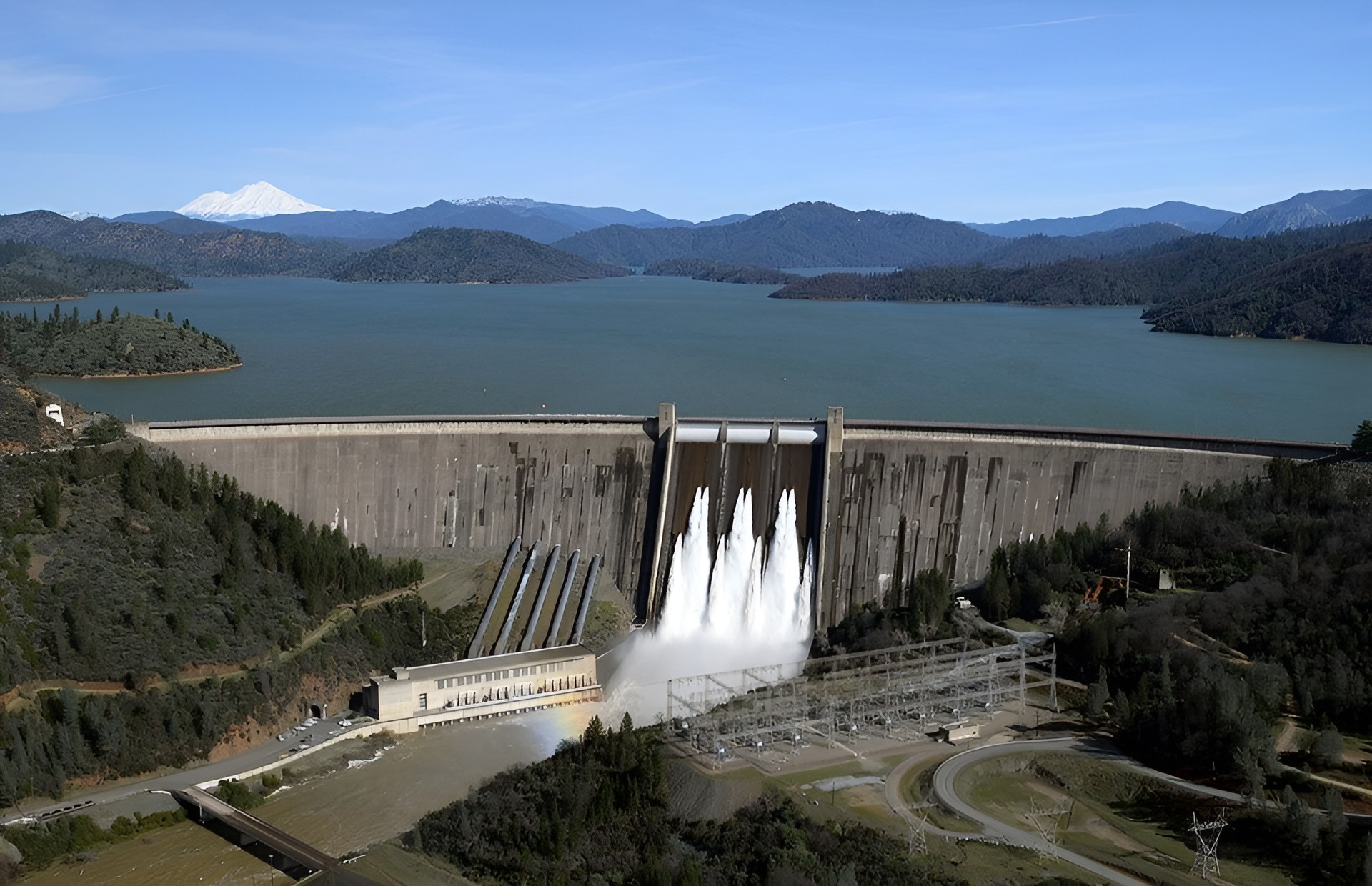
California State Auditor Finds 57 Deficient Dams, $28 Billion Repair Need
California faces an estimated $28 billion dam-repair requirement over five years, according to a California State Auditor review that found 57 of the state’s 1,222 operating dams in poor or unsatisfactory condition as of May 2026. Forty of those dams also carry high or extremely high downstream hazard classifications. If deficiencies caused the riskiest sites to fail, the auditor estimated that the combined exposure could reach 1.5 million people and more than $265 billion in property damage and economic disruption.

Those figures describe a large infrastructure-management problem, but they do not mean all 57 dams are close to failing. Condition and hazard are separate measures. A condition assessment addresses the physical state and performance of a dam; a hazard classification describes the consequences downstream if failure occurred.
Why 40 dams receive the highest attention
Under California’s definitions, a dam in poor condition has a recognized safety deficiency under operating conditions that could realistically occur, or uncertainties requiring further investigation. An unsatisfactory rating means a recognized deficiency requires immediate or emergency remedial action. Of the 57 deficient dams, 56 were rated poor and one unsatisfactory.
By contrast, a high-hazard classification means failure is expected to cause at least one loss of life. An extremely high classification applies when failure is expected to cause loss of life and inundate an area containing at least 1,000 people, or threaten specified infrastructure. It measures potential consequences, not the probability of failure.
This distinction is central to repair prioritization. A deficient dam above a densely populated area demands attention because physical condition and downstream exposure overlap. The auditor found the 40 dams combining poor or unsatisfactory condition with high or extremely high hazard ratings were concentrated partly around the Bay Area, Los Angeles and San Diego. One deficient dam could endanger more than 400,000 people and produce nearly $92 billion in economic damage, according to the audit’s modeling.
The repair bill exceeds the available funding system
The Department of Water Resources estimated that bringing currently deficient dams to satisfactory condition would cost $18.5 billion. It projected another $9.4 billion for dams likely to be identified as less than satisfactory during the following five years, producing the approximately $28 billion total.
California received $464 million in 2023 for dam safety and climate resilience, only a portion of which was planned for grants supporting owner repairs. The comparison shows why enforcement alone cannot close the gap. Most owners discussed in the audit are public agencies, and state law assigns owners responsibility for operation and maintenance without requiring them to maintain financial reserves or long-term funding plans for major rehabilitation.
That structure distributes costs unevenly. A public owner may have to choose among dam repairs, drinking-water systems, treatment facilities and other essential assets. Delaying dam work preserves money for immediate services, but it leaves downstream residents carrying more of the long-duration risk. Decommissioning is not a simple low-cost alternative because dams may provide water storage, flood control, power generation or recreation, while removal can require extensive engineering, environmental review and changes to surrounding infrastructure.
Authority expanded faster than enforcement capacity
California strengthened inspection and administrative-enforcement powers after the 2017 Oroville Dam crisis, which prompted the evacuation of about 188,000 residents. Regulations finalized in 2022 allow the Department of Water Resources to issue violation notices, impose reservoir restrictions and seek fines of up to $1,000 per day.
As of April 2026, engineers had referred owners of 44 dams for enforcement. Twenty cases were still awaiting action, including four involving deficiencies that had not been repaired. The department told auditors that staffing limits and the expected cost of defending administrative actions constrained its response. It had filled four of six authorized enforcement positions by the time of the review.
Reservoir restrictions can reduce risk while engineering and construction proceed; 49 dams were operating under active restrictions as of September 2025. They cannot substitute indefinitely for completed repairs. The state’s own process can require engineering studies, alternative selection, environmental permits, financing, detailed design, bidding and inspected construction. Water Resources said remediation can take as long as two decades from identification to completion.
Emergency planning presents a parallel integration problem. California had not approved emergency action plans for 245 dams, including 141 classified as high hazard and 58 as extremely high hazard. Sixty-two owners had never submitted plans, while others had not completed requested revisions. These plans connect dam monitoring and inundation maps with notification and evacuation responsibilities across local agencies; incomplete coordination weakens the response layer that remains necessary while repairs are pending.
The auditor recommended broader authority before a dam reaches imminent danger, financial-planning requirements for owners, fuller use of existing enforcement powers and enforceable deadlines for emergency plans. California’s emergency-management office agreed with the findings, while the Department of Water Resources disputed many recommendations and did not clearly commit to implementing them. The unresolved engineering constraint is therefore no longer identification: California has documented the deficient structures, but funding, enforceable schedules and completed emergency plans still determine how quickly that knowledge becomes reduced risk.
| More aerospace and engineering stories, right in your MSN feed. Follow AMI on MSN |
By Thomas Caldwell — AMI’s senior editor for mechanical and mobility engineering, covering vehicle electronics, systems integration, electrification, chassis systems, propulsion, and safety policy.




