


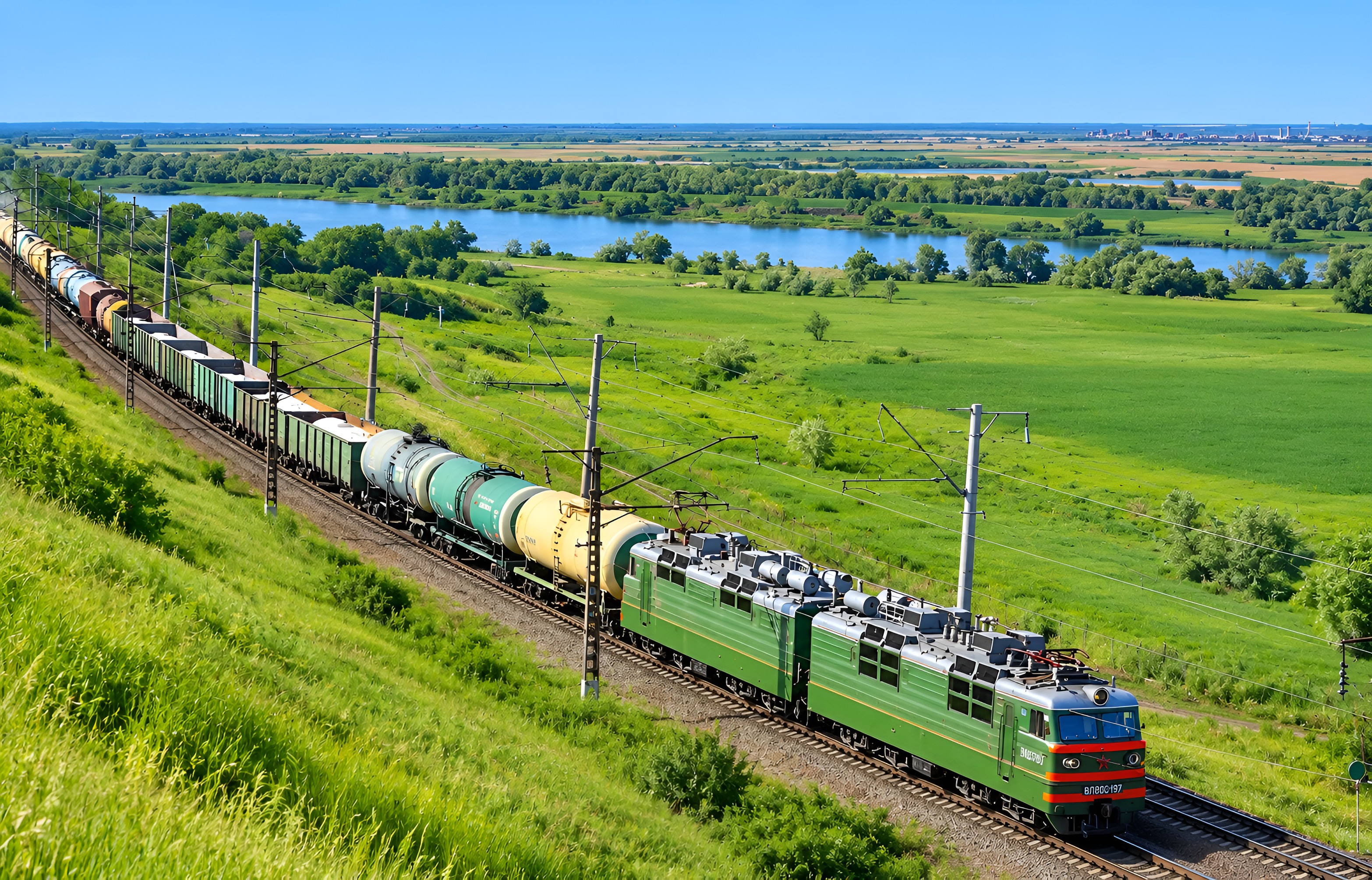
Diverted Cargo Overwhelms Russian Railways as Container Rates Jump 57.4%
Russia’s attempt to keep exports moving through alternative ports has transferred the bottleneck from its southern maritime terminals to an already heavily used rail network. Shipment applications are being rejected or cancelled, trains are standing idle and freight equipment is in short supply, while the Russian Sugar Producers Union, Soyuzsahar, cited a 57.4% increase in container rates from approximately $3,260 to $5,130 per container.

The congestion follows constraints on southern port capacity since Ukrainian strikes began disrupting maritime exports in August 2026. Those Black Sea and Sea of Azov ports previously handled about 90% of Russia’s seaborne grain exports. Redirecting even part of that traffic toward northwestern and eastern ports therefore requires far more than assigning cargo a new destination: trains, wagons, containers, terminal space and usable paths across the rail timetable must all be available together.
The immediate volume shift has been substantial. According to the Institute for Natural Monopoly Research, export shipments through Russia’s main northwestern border crossings reached 13 million tonnes in August, an 18.8% increase from a year earlier. Grain traffic rose sixfold, while ferrous-metals exports increased 91.6% and coal shipments climbed 56.7%. Shipment requests now exceed the capacity of rail lines serving northwestern ports.
That mismatch explains why additional demand can reduce overall efficiency rather than produce a proportional increase in freight movement. Alina Koryagina, a business development partner at consultancy Neo, said the rail network was already operating at capacity before the current disruption. Congestion is now slowing trains, increasing the time they wait for available paths and reducing the efficiency with which track is used. A delayed train also keeps its locomotive and wagons occupied longer, tightening equipment availability elsewhere in the network.
The mechanism is common to capacity-constrained transport systems. A 2026 multimodal transportation modeling paper examined how port disruptions propagate through rerouting, terminal queues and substitute transport modes. Its case study was based on Los Angeles rather than Russia, so its numerical findings do not transfer directly. Its broader systems result is relevant: rerouting delivers diminishing returns as alternative modes approach capacity, and congestion can spill from the original disruption into the corridors intended to provide resilience.
Russia’s current freight indicators fit that pattern. Kommersant reported that wagon and container costs have risen by at least 26%, alongside rejected applications, equipment shortages and idle trains. Businesses handling oil, metals and chemicals have also reported difficulty moving freight by rail. The pressure is therefore broader than a grain-logistics problem; multiple commodity flows are competing for finite train paths and port-feeder capacity.
Russian Railways said it has deployed the necessary resources to direct freight toward the country’s northwestern and easternmost regions and is maintaining contact with shippers. Resource deployment can help allocate crews and equipment, but it cannot immediately create additional track slots or terminal throughput. Giving one commodity priority can keep that traffic moving, yet it may also defer lower-priority freight when the corridor remains saturated.
Road transport offers limited economic relief for bulk cargo. Koryagina estimated that trucking currently costs 2.5 to three times as much as rail per tonne-kilometre. Trucks may provide flexibility for selected loads, but shifting large commodity volumes to road would purchase that flexibility at a substantially higher transport cost and would not replace rail’s bulk-haul efficiency.
The result is a network-level capacity problem rather than a simple routing problem. Alternative ports remain useful only to the extent that the rail corridors, terminals and equipment serving them have spare capacity. With shipment requests already exceeding available rail capacity, the attempted workaround is leaving some freight stranded while scarce container and wagon capacity becomes markedly more expensive.
| More aerospace and engineering stories, right in your MSN feed. Follow AMI on MSN |
By Thomas Caldwell — AMI’s senior editor for mechanical and mobility engineering, covering vehicle electronics, systems integration, electrification, chassis systems, propulsion, and safety policy.




