Florida Police Unveil Single-Seat Flying Patrol Craft on Campus
Across the United States, municipal law enforcement departments and campus public safety agencies have accelerated investments into emerging airborne technologies, evaluating whether single-seat flying patrol craft can provide an agile tactical edge over conventional cruisers. These exploratory initiatives represent an ambitious bid to bridge the capability gap between costly police helicopter divisions and small uncrewed aerial systems. By integrating advanced air mobility directly into baseline patrols, proponents envision a future where first responders can bypass ground traffic and traverse obstructed geography within minutes.
Tactical quadcopters and automated surveillance cameras have already become standard equipment for crash reconstruction, tactical reconnaissance, and wide-area search operations nationwide. However, transitioning from remote ground stations to placing a sworn officer inside a lightweight electric vertical takeoff and landing airframe introduces complex hurdles. Departments exploring these experimental personal flight platforms must contend with strict regulatory airspace controls, hazardous payload limits, and unforgiving power constraints that often restrict practical service life.
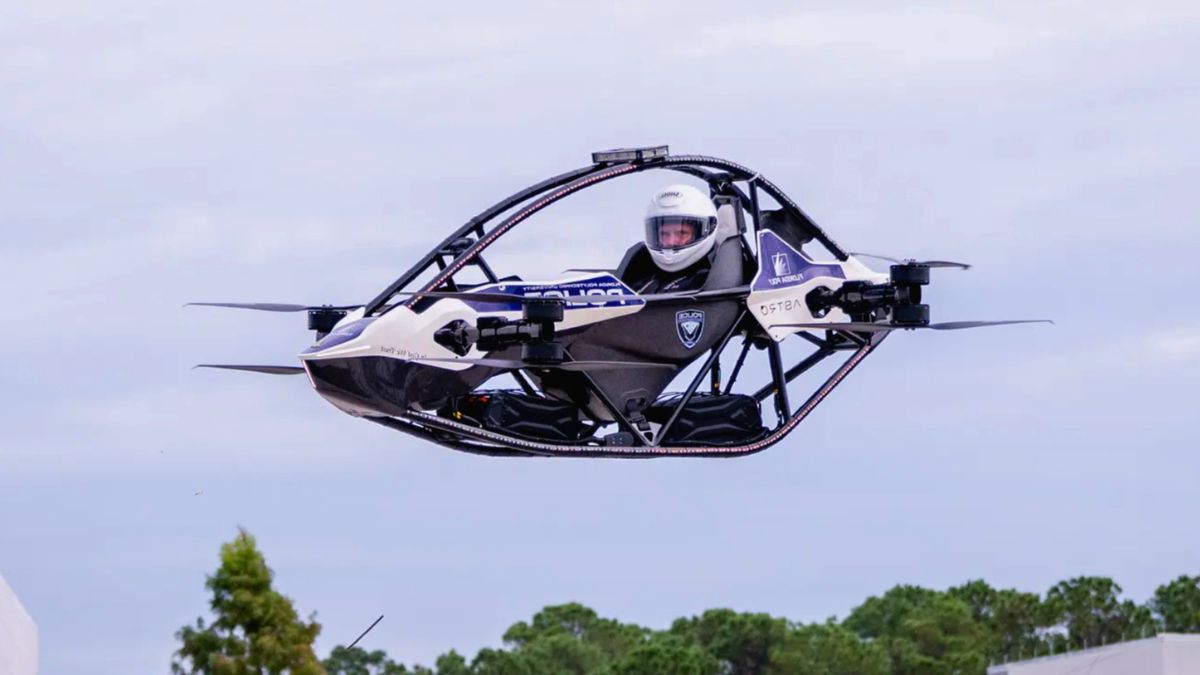
That ambitious leap from conceptual aviation to practical policing materialized in Lakeland, Florida, where the Florida Polytechnic University Police Department recently unveiled ‘Astro’, a piloted electric patrol craft. The department announced that it has formally integrated the customized single-seat multicopter into its campus fleet, establishing the polytechnic force as the first law enforcement agency in the nation to operationalize a manned electric flyer.
The compact flying patrol vehicle is a heavily modified iteration of the ‘Jetson ONE’, an ultralight personal electric vertical takeoff and landing aircraft engineered by California-based mobility firm Jetson. According to reporting from FOX 13 Tampa Bay, the university spent nearly $150,000 on the procurement, skipping past a three-year commercial customer backlog after the manufacturer agreed to fast-track delivery to support the school’s public safety experiment.
Visually customized with official campus police livery and a miniature emergency strobe light bar, the aircraft relies on an aluminum space frame propelled by eight electric motors turning four coaxial rotor pairs. Without its battery system or a pilot seated in the open cockpit, the airframe weighs just 154 pounds and achieves an electronically governed top speed of roughly 63 mph. For pilot survivability, the craft integrates automated ground-sensing landing algorithms alongside a rapidly deploying ballistic emergency parachute.
Despite its futuristic aesthetic, the aircraft’s frontline utility is heavily dictated by existing battery energy storage, providing an operational flight window of merely 20 minutes before requiring a full recharge. As reported by Vice, that brief operational endurance means any dynamic campus deployment or suspect tracking scenario must wrap up almost immediately after launch. On a campus where public crime logs recorded just 13 liquor law referrals for the entire previous year, critics have questioned whether the 20-minute flight envelope warrants a six-figure investment.
Department leadership has pushed back against skepticism, framing the acquisition as a long-term investment into next-generation tactical aerial mobility. Florida Polytechnic University Police Chief Aaron Murray told public broadcaster WUSF that “advanced air mobility is a technology on the rise, and we can either choose to be proactive or reactive as it develops”. Murray indicated that ‘Astro’ will assist with post-hurricane damage assessments, regional mutual aid requests, and wilderness searches, though operational missions cannot launch until the Federal Aviation Administration grants final regulatory authorization.
Beyond its police role, the aircraft will function as an active testbed for the university’s newly launched aerospace engineering program, giving students telemetry data to develop virtual reality simulators and conduct airframe research. Whether other public safety agencies follow Florida Poly’s aerial experiment remains uncertain, as police commanders wait to see if battery technology can transform lightweight personal flyers from high-tech campus novelties into durable, persistent patrol assets.