Air Force Plans $1.057 Billion F-47 Test Campus at Nellis
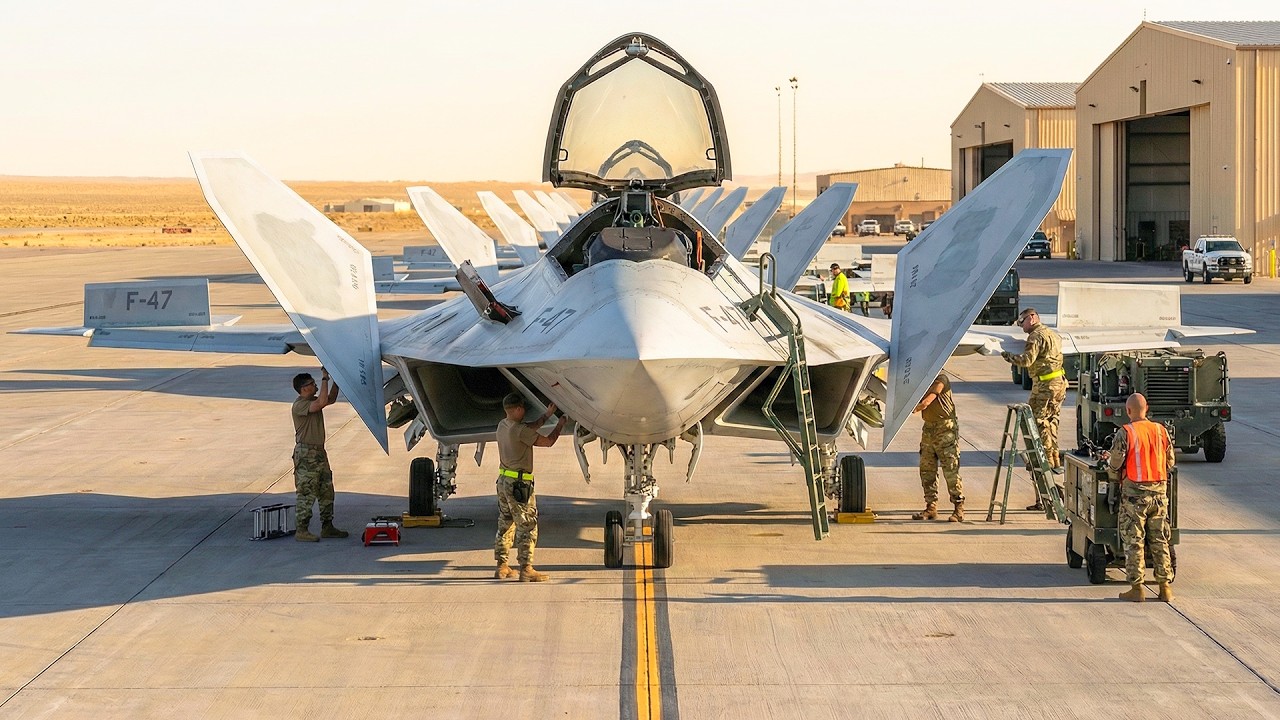
The U.S. Air Force plans to spend $1.057 billion on a test and maintenance campus for Boeing’s F-47 fighter at Nellis Air Force Base in Nevada. The first facilities are targeted for completion by March 2031, giving aviation enthusiasts an early, concrete look at where the aircraft would undergo operational testing and how extensive its ground-support system could become.
The proposal, detailed in an October 23 draft solicitation, puts a striking public price on infrastructure years before the fighter is expected to enter operational service in the 2030s. Critics of Pentagon spending will see a big bill arriving before the jet begins flying. For the program itself, however, the schedule reflects a basic constraint: hangars, laboratories, simulators, maintenance spaces and aircraft parking must be ready before an operational test fleet can work at useful tempo.
A campus built around testing and maintenance
The first phase would place four major elements on the eastern side of Nellis. Plans call for a 116,745-square-foot operations and maintenance hangar, a 39,200-square-foot reprogramming laboratory and a 40,903-square-foot simulator facility. The largest footprint would be a 1.154 million-square-foot aircraft apron equipped with sunshades.
Those structures reveal more about the proposed campus than the classified details of the aircraft. The hangar provides the central space for aircraft operations and maintenance. The laboratory would support the work of updating and managing the fighter’s programmable systems, while the simulator building would let crews train and evaluate procedures without requiring every event to consume aircraft time. The expansive apron indicates that the project is being planned as a working test complex rather than a single hangar for occasional visits.
A later phase, planned through 2032, would add a fuel-cell hangar, a low-observable corrosion-control hangar, a weapons-load training hangar, a consolidated maintenance facility, a maintenance training facility and a dining facility. Together, the phases cover both flying activity and the less visible work required to sustain it: specialist maintenance, personnel training, system support and routine servicing.
The schedule is aggressive, but not final
The Air Force intends to use a progressive design-build approach, allowing the most important parts of the site to advance first instead of waiting for the entire campus design to be completed. It hopes to award an other transaction agreement to between one and four vendors by February 2027. Design and preconstruction would continue through November 2027, followed by rapid construction scheduled to run until March 2031.
That sequence is still a plan rather than a completed construction award. It also places substantial infrastructure work on the program’s critical path. If the aircraft is to begin operations in the 2030s, facilities for testing, simulation and maintenance cannot be treated as an afterthought once jets arrive. Building them in parallel with aircraft development can reduce that mismatch, although the draft status means scope and timing can still change.
Nellis is a logical operational-test location based on its existing mission. The Nevada base already supports combined developmental and operational testing of Boeing’s F-15EX. An environmental review is also moving ahead: the Department of the Interior awarded Versar Inc. a $1.9 million contract in August 2026 to prepare an environmental impact statement for the Next Generation Air Dominance program, and the contract notice was subsequently updated to identify Nellis.
Nellis does not settle permanent basing
The campus proposal confirms where the Air Force plans to conduct F-47 operational testing, but it does not identify the permanent homes of future combat squadrons. That boundary is important because a test base needs specialized evaluation infrastructure, while operational basing decisions also involve force distribution, existing units, construction requirements and longer-term fleet plans.
An Air Force report to Congress lists the future transition missions of the 90th and 525th Fighter Squadrons at Joint Base Elmendorf-Richardson, Alaska, as “to be determined.” Both currently belong to the F-22 force that the F-47 is expected to replace, but the report does not confirm that either squadron will receive the new aircraft. Other identified F-22 units at Joint Base Langley-Eustis in Virginia and Joint Base Pearl Harbor-Hickam in Hawaii are planned to retain their current mission during the report’s planning period.
The Nellis proposal therefore answers one major question while leaving another open. The Air Force now has a defined location and a billion-dollar infrastructure concept for testing and maintaining Boeing’s next fighter. Where the operational F-47 squadrons will ultimately be stationed remains undecided.
| More aerospace and engineering stories, right in your MSN feed. Follow AMI on MSN |
By David Whitaker — Associate editor for AMI’s aerospace and drone systems desk, translating flight systems, aircraft programs, spaceflight, and UAV developments into accessible technical stories.