Ukrainian Pilot Shares Nighttime Drone Hunt Footage
Across the contested skies over Ukraine, the air campaign has transformed into a high-tempo operational struggle against long-range uncrewed strike platforms. Russian forces continue to saturate defensive corridors with waves of loitering munitions, deploying deep-penetration systems designed to probe gaps in radar coverage and exhaust surface-to-air missile stockpiles. In response, Ukrainian pilots flying quick-reaction sorties have stepped forward to intercept Russian ‘Geran-4’ drone waves before they can strike energy infrastructure and urban centers.
The relentless tempo of these nighttime saturation raids has strained ground-based air defenses, which cannot cover every vulnerable sector across hundreds of miles of territory. While mobile machine gun crews and point-defense surface batteries handle low-altitude incursions near major population centers, intercepting fast-moving threats across remote expanses requires airborne speed. Fighter squadrons must operate in total darkness at low altitudes, navigating electronic countermeasures and hazardous low-level flight profiles to locate slow or low-signature uncrewed targets.
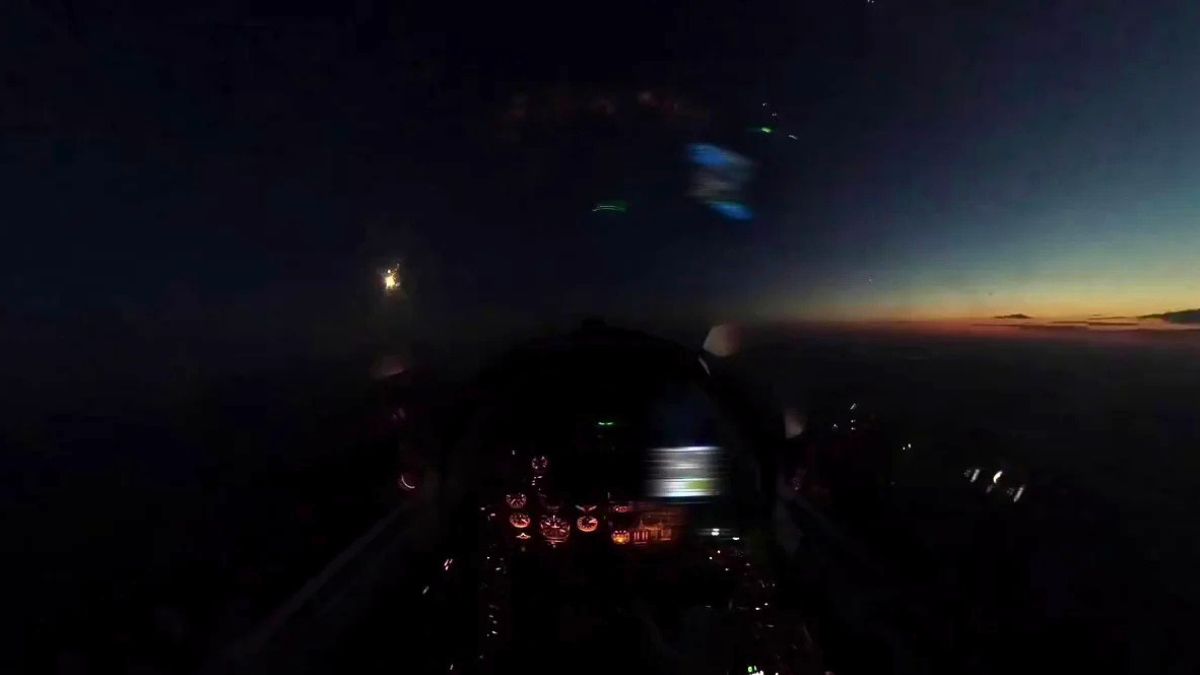
Newly released cockpit footage captures this intense aerial hunt during a recent nocturnal defense sortie conducted over Ukrainian territory. An aviator serving with the tactical aviation brigade of Air Command West, known by the call sign ‘Denfix’, detected an incoming Russian ‘Geran-4’ kamikaze drone and immediately initiated an intercept course. After establishing a tracking lock on the hostile platform, the pilot launched a guided air-to-air missile, scoring a direct hit that eliminated the threat in midair.
The video recording filmed from inside the cockpit shows the moment of release, as the missile motor ignites and bathes the canopy in a brilliant amber glare. Seconds later, a bright fireball detonates against the darkness as the interceptor strikes the hostile drone, confirming an immediate kinetic kill. Ukrainian military officials commended the execution of the mission, highlighting the sortie as another successful neutralization in their layered defense network.
Ukrainian pilot shows footage of a nighttime hunt for a Russian drone During one of Russia’s nighttime attacks, a Ukrainian Armed Forces pilot with the call sign Denfix spotted a Russian Geran-4 kamikaze drone and began pursuing it. After locking onto the target, the pilot fired a missile and destroyed the drone.
— NEXTA (@nexta_tv) October 27, 2026
The pilot known as ‘Denfix’ has emerged as a key aerial defender within the Sevastopol Tactical Aviation Brigade, having eliminated more than 20 cruise missiles and attack drones over the course of his service. Operating a modernized ‘MiG-29’ fighter jet, the aviator has routinely balanced high-stress nighttime intercept sorties with daytime precision-strike missions along the front. Recounting the delicate mechanics of aerial tracking, reported by Defence Blog, the pilot noted that “shooting down a slow attack drone with a high-speed fighter missile isn’t as easy as it seems.”
Airborne intercepts have become significantly more demanding as Moscow iterates upon its loitering munition designs, fielding improved platforms such as the ‘Geran-4’ alongside older piston-engine ‘Shahed-136’ variants. These upgraded drones feature faster flight envelopes, lower acoustic signatures, and altered navigation profiles designed to bypass ground acoustic arrays and mobile gun teams. To counter these shifts, tactical aviation units rely on onboard radars and short-range heat-seeking missiles, such as the ‘R-73’, to close the distance rapidly.
Relying on manned tactical fighters to counter cheap loitering weapons underscores the asymmetric cost curves that continue to define the air domain. Modernized airframes provide rapid vectoring and high-altitude sensor look-down capability, as analyzed by The War Zone regarding the tactical role and mechanical strain on legacy jets in counter-drone roles. As drone incursions continue to probe defensive coverage every night, the aviators flying low-level interception missions will remain vital in preserving ground infrastructure from destruction.