


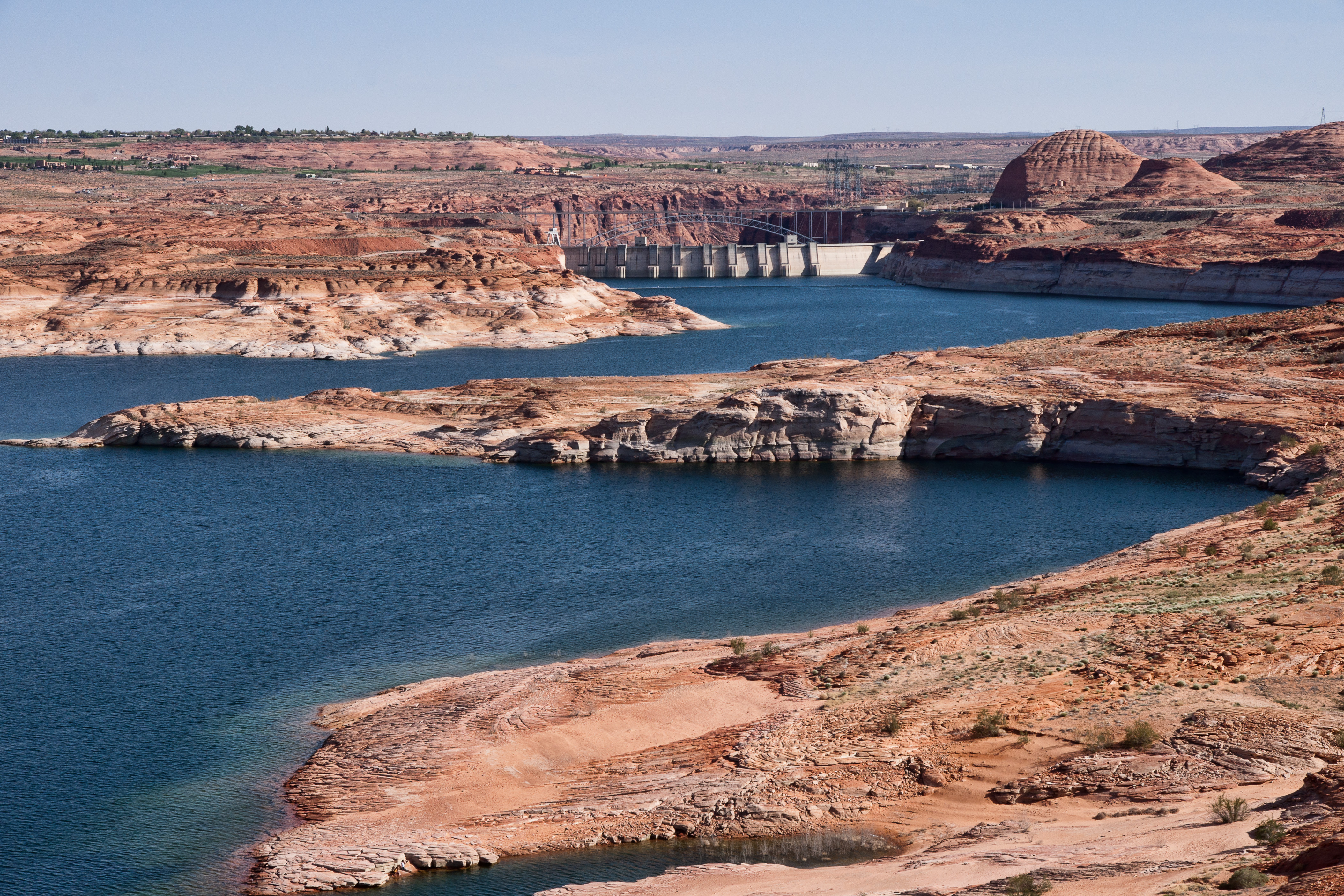
Lake Powell Rises Nearly 11 Feet, but Power Risk Remains
Lake Powell’s sudden October rise created a useful operating cushion for Glen Canyon Dam, but it did not erase the reservoir’s larger decline. Heavy rain added nearly 11 feet and about 173 billion gallons after the lake reached a reported record low on Sept. 15. Even after that gain, Powell remains 12 feet down in 2026, with its average level for the year the lowest on record.

The contrast is important for the dam’s two linked functions: storing Colorado River water and generating electricity as that water passes through turbines. More water above the intakes gives operators additional room to continue producing hydropower. Yet Lake Powell remains at serious long-term risk of dead pool, the lower condition at which water can no longer flow through the dam.
A rare October inflow surge
The new water came from rainfall in northern Arizona and southern Utah, rather than releases from reservoirs upstream. From Oct. 20 through Oct. 22, unregulated inflow into Lake Powell increased four-and-a-half times and reached 65,000 cubic feet per second. That was the second-highest October daily inflow recorded since Glen Canyon Dam began impounding the reservoir in 1963.
October gains are unusual because Lake Powell normally rises with mountain runoff between May and July, then declines through the rest of the year. A nearly 11-foot increase outside that normal seasonal pattern is therefore operationally significant, even though it is not large enough to reverse the annual loss.
Lake Mead also responded to the rain. After reaching a reported record low the previous week, the downstream reservoir rose 11 inches to an elevation of 1,038 feet, adding roughly 19 billion gallons. Powell’s increase was much larger in both elevation and volume, making it the more consequential change for Glen Canyon Dam’s immediate power margin.
Why elevation controls power generation
Glen Canyon’s eight generating units have a combined capacity of 1,320 megawatts. The Bureau of Reclamation says the powerplant produces around five billion kilowatt-hours annually, with electricity distributed across Wyoming, Utah, Colorado, New Mexico, Arizona, Nevada and Nebraska.
The dam also provides short-duration grid support. Reclamation can adjust generation to help balance electricity supply and demand, including maintaining reserve capacity for infrequent system emergencies. That flexibility makes the water elevation behind the dam more than a storage statistic: it sets the hydraulic margin available to operate the generating system.
The principal power threshold is the minimum power pool, around elevation 3,490 feet. Below that level, hydropower generation is expected to stop. Dead pool is a separate and more severe condition in which reservoir water can no longer pass through the dam at all. The October rise moves Powell farther from both outcomes, but it does not remove either from long-range planning.
For perspective, Reclamation reported an end-of-September elevation of 3,518.08 feet and storage of 5.16 million acre-feet, about 182 feet below full pool. Earlier in 2026, the agency projected annual unregulated inflow at only 3.50 million acre-feet, or 36% of average. That weak annual hydrology explains how an exceptional three-day rain event can provide meaningful relief while leaving the year as a whole deeply depleted.
A cushion, not a recovery
Lake Powell’s history also cautions against treating one sharp rise as a trend. Across 27 years, its average annual elevation change has been close to zero, but individual years have ranged from a 48-foot increase to a 38-foot decline. Large short-term movements are part of the system’s variability; the direction over multiple seasons depends on inflow, releases and stored water carried over from prior years.
The nearly 11-foot gain therefore buys operating space rather than restoring the reservoir. It improves the immediate margin for moving water through Glen Canyon Dam’s turbines and sustaining a major source of Western hydropower, but Powell still finishes the period 12 feet lower than where it began 2026. The next sustained runoff cycle not one exceptional October storm will determine whether that new cushion grows or is consumed.
| More aerospace and engineering stories, right in your MSN feed. Follow AMI on MSN |
By Thomas Caldwell — AMI’s senior editor for mechanical and mobility engineering, covering vehicle electronics, systems integration, electrification, chassis systems, propulsion, and safety policy.




