


SpaceX Plans First Catch of Both Starship Stages on Flight 15
SpaceX plans to catch both stages of Starship for the first time on Flight 15, but the more difficult half of that demonstration cannot begin unless the upper stage first completes its orbital profile and returns over the company’s South Texas launch site. The targeted window opens no earlier than Nov. 8, according to CEO Elon Musk.
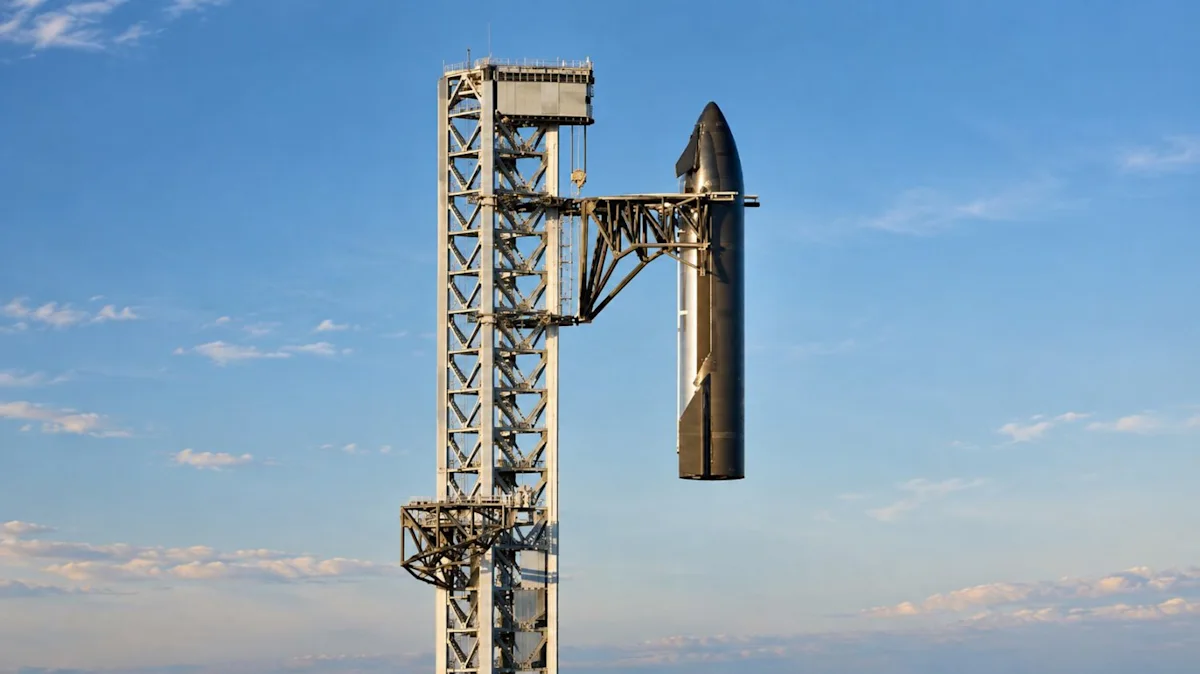
The plan calls for separate launch towers at Starbase to recover the Super Heavy booster and the Starship upper stage, known as Ship. Mechanical arms on each tower would close around the descending vehicles, eliminating the landing legs that a conventional vertical landing would require. SpaceX has caught Super Heavy three times. It has never attempted the same operation with Ship.
That difference is substantial. Super Heavy separates earlier in flight and returns from a lower-energy trajectory. Ship travels higher and farther, reaches orbital altitude and comes back at much greater speed. It must survive atmospheric reentry, manage its energy and position itself precisely enough to approach a fixed tower rather than a broad ocean landing zone.
SpaceX’s disclosed recovery sequence has Ship approaching in a horizontal, belly-first attitude, which allows its body and aerodynamic surfaces to manage speed during descent. Near the tower, the spacecraft would conduct a braking burn, rotate upright and descend between the mechanical arms. The booster would return to the second tower in a separate recovery operation.
The tower is only the final component in a much longer chain. Ship must complete the planned climb, remain healthy in orbit, execute its de-orbit maneuver and follow a return corridor to Starbase. Guidance, propulsion, thermal protection and aerodynamic control all have to support the flight before the catch hardware becomes relevant.
Flight 14 demonstrated that dependency. One Raptor engine shut down prematurely during ascent, although mission control completed the climb with the remaining engines. The mission ended after roughly three hours and two circuits of Earth rather than its planned 10 hours and six circuits.
That shortened flight still produced controlled disposal outcomes. Super Heavy splashed down in the Gulf of Mexico, while Ship conducted a de-orbit burn and made a vertical splashdown in the Pacific north of Hawaii. Neither stage was recovered. The upgraded Raptor 3 engines have reportedly encountered malfunctions on all three Starship flights in which they have operated, putting propulsion reliability directly ahead of the proposed tower catch on Flight 15.
A return to Starbase also carries a regulatory dimension beyond the vehicle itself. Commercial launch and reentry operations require Federal Aviation Administration authorization, and the agency’s Starship review page describes environmental work covering updated return-to-launch-site profiles, airspace closures and contingency landing areas. Those alternatives are intended to provide safe options if tower use or vehicle conditions prevent a Starbase recovery.
The recovery method reflects Starship’s scale. A 2026 conceptual study comparing upper-stage recovery systems found that parachutes become structurally and operationally impractical for super-heavy vehicles, while a winged runway return would demand large aerodynamic surfaces and specialized ground infrastructure. Vertical recovery avoids those particular constraints, but it transfers the burden to propulsion, thermal protection, control authority and terminal guidance.
Using a tower instead of onboard landing gear also shifts hardware from the spacecraft to the ground. That can reduce mass carried through every phase of flight, but the vehicle must return to a narrow capture area with the correct attitude and descent conditions. A splashdown offers considerably more geographic margin than a tower catch.
Musk said success is not guaranteed but assessed Flight 15 as more likely than not to complete the attempt. SpaceX has additional flights planned through the end of 2026 and expects to accelerate testing in 2027. Before the tower arms can demonstrate full-stack recovery, however, Ship must deliver the orbital endurance that Flight 14 did not and then bring that faster-returning upper stage back to Texas.
| More aerospace and engineering stories, right in your MSN feed. Follow AMI on MSN |
By David Whitaker — Associate editor for AMI’s aerospace and drone systems desk, translating flight systems, aircraft programs, spaceflight, and UAV developments into accessible technical stories.



