


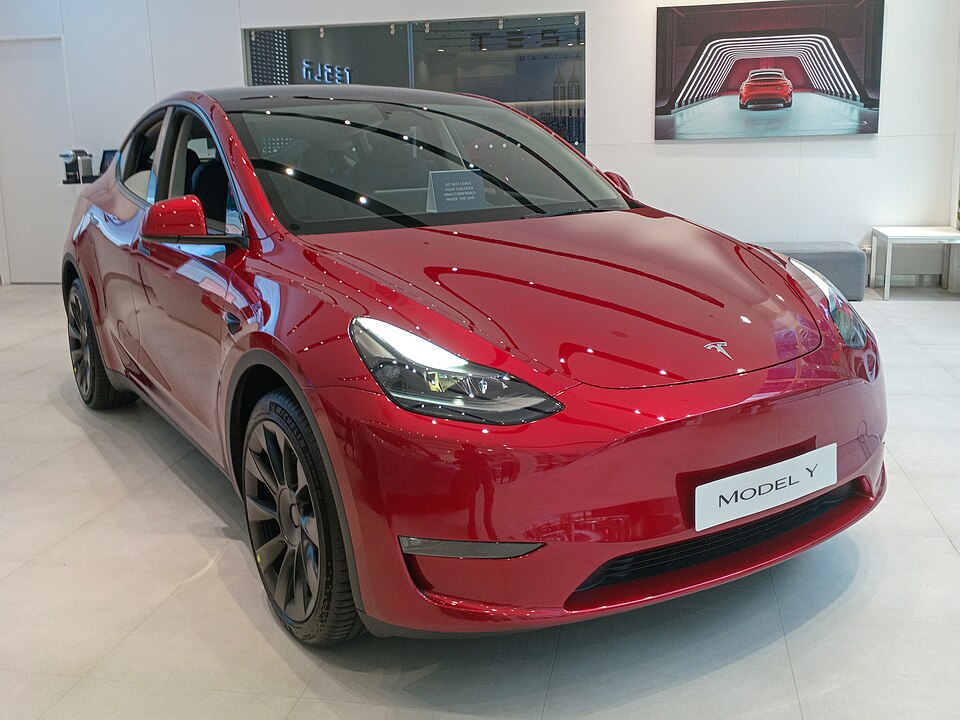
Tesla Model Y’s Rs 19,990 Offer Still Requires Rs 39,990 Monthly Payments
Tesla’s advertised Rs 19,990 monthly cost for the Model Y in India is not the amount a buyer pays the lender. The promotion requires a scheduled monthly instalment of Rs 39,990, subject to financing approval, plus an upfront down payment of Rs 6 lakh. Tesla reaches the lower figure by subtracting an estimated Rs 20,000 in monthly fuel and maintenance savings.

The difference turns an apparently simple monthly-price offer into a comparison between two separate measures. One is a contractual cash payment under a seven-year step-up financing plan at an stated annual interest rate of 8.5%. The other is an estimated effective ownership cost that depends on how much the customer drives, what vehicle is being replaced and where the Model Y is charged.
Tesla announced the offer for its three-day Switch and Save Carnival, held October 23 to 25 at experience centres in Noida, Delhi, Gurugram, Chennai, Hyderabad, Bengaluru and Mumbai. Event purchases included a complimentary Wall Connector, while exchange valuations and financing through partner banks were available.
How Tesla derives the lower number
Tesla’s calculation estimates Model Y electricity consumption at 14.3 kilowatt-hours per 100 kilometres and applies an electricity tariff of Rs 7 per kilowatt-hour. On those inputs, electricity costs about Rs 100 per 100 kilometres, or roughly Rs 1 per kilometre. The calculation also assigns Model Y maintenance costs of Rs 2 per kilometre.
The comparison petrol or diesel vehicle is assumed to return 8 kilometres per litre. However, the published calculation does not identify that vehicle, state the fuel price used or disclose the monthly distance behind the Rs 20,000 savings estimate. Those missing inputs are consequential because avoided fuel spending generally rises with distance: a high-mileage driver can recover more operating-cost savings than an owner who makes relatively few trips.
Charging conditions can move the result as well. The Rs 7 electricity assumption may be relevant to some home-charging arrangements, but the announcement does not provide public-charging prices or explain how charging behavior is treated. A household relying heavily on public infrastructure could therefore face a different energy cost from one able to charge routinely at home.
The complimentary Wall Connector does not by itself settle that issue. Installation conditions, apartment or housing-society permissions, parking access and any required electrical upgrades were not specified. These practical integration costs can determine whether a customer can consistently obtain the charging price assumed in the calculation.
The loan disclosure matters more than the savings label
Buyers must maintain enough monthly cash flow for the financier’s scheduled Rs 39,990 debit regardless of whether their operating savings ultimately reach Rs 20,000. The promotion also does not publish the precise step-up repayment schedule, total repayment amount, processing charges, insurance expense or registration costs. Because a step-up structure can change payments during the loan term, the opening instalment alone does not describe the entire seven-year obligation.
For covered retail term loans, Reserve Bank of India rules require regulated lenders to provide borrowers with a Key Facts Statement. It must include the annual percentage rate, associated charges and an amortisation schedule. The annual percentage rate is particularly useful because it incorporates interest and other charges associated with the credit facility, giving a broader measure than the stated interest rate alone.
That loan document is where a prospective borrower can assess the actual repayment sequence and overall credit cost. It also separates fixed contractual obligations from projected savings that may change with fuel prices, electricity tariffs, mileage, maintenance experience and charging access.
Tesla’s Rs 19,990 figure may align more closely with the economics of a high-mileage household replacing an inefficient combustion vehicle and charging affordably at home. It will be less representative when annual mileage is low, the outgoing vehicle uses less fuel than Tesla’s assumed comparison, or the owner depends on costlier public charging. In every case, the immediate household budget must still accommodate Rs 39,990 a month and Rs 6 lakh upfront the savings arrive only if the owner’s real operating pattern produces them.
| More aerospace and engineering stories, right in your MSN feed. Follow AMI on MSN |
By Thomas Caldwell — AMI’s senior editor for mechanical and mobility engineering, covering vehicle electronics, systems integration, electrification, chassis systems, propulsion, and safety policy.




