


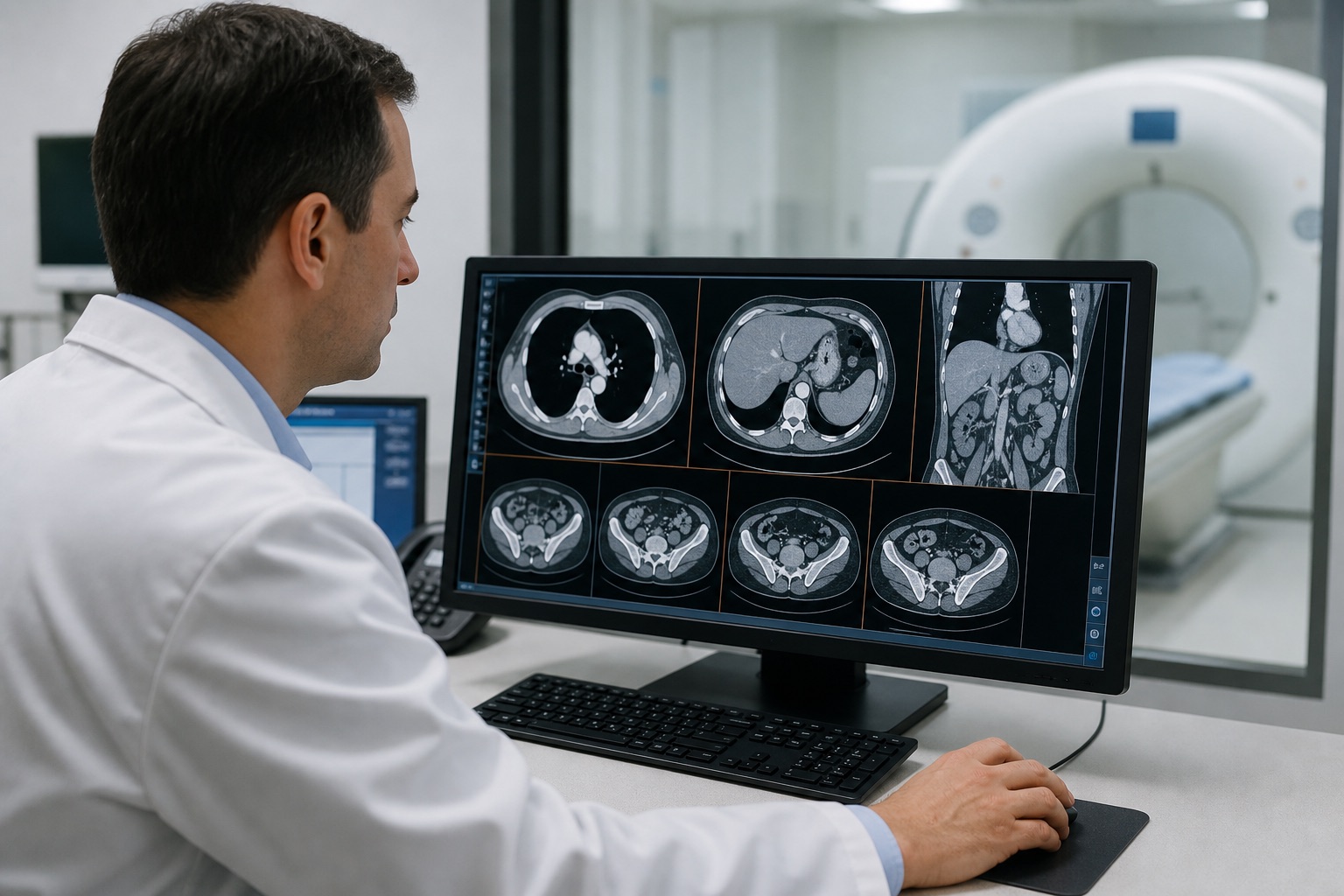
REDMOD AI Finds Pancreatic Cancer Signs 475 Days Before Diagnosis
An artificial-intelligence system identified CT signatures associated with pancreatic cancer an average of 475 days before patients received a clinical diagnosis. Called REDMOD, the model achieved 73% sensitivity on earlier scans that radiologists had read as showing no evidence of cancer, compared with 39% sensitivity for experienced radiologists.
The comparison is notable because it involved subtle signs in images obtained before the disease was clinically recognized not conventional analysis of already apparent tumors. Pancreatic cancer is usually detected after it has advanced, when treatment options are more limited. Earlier recognition could therefore benefit a broad range of patients and families, although REDMOD still needs prospective and more diverse testing before it can be considered for routine care.
Software found patterns that human readers had missed
REDMOD stands for Radiomics-based Early Detection MODel. It analyzes fine texture patterns in pancreatic tissue on abdominal computed-tomography scans. The software also identifies and outlines the pancreas automatically, removing the need for specialists to trace the organ manually and reducing one source of variation in the analytical process.
Researchers evaluated earlier scans from 219 patients who were subsequently diagnosed with pancreatic ductal adenocarcinoma, the most common type of pancreatic cancer. Experienced radiologists had initially found no evidence of the disease in those images. The scans were acquired from three months to roughly three years before diagnosis: 87 patients had been scanned three to 12 months beforehand, 76 were scanned 12 to 24 months beforehand, and 56 were scanned more than two years beforehand.
The study also included 1,243 comparison patients who remained free of pancreatic cancer for as long as three years. That group was matched by age, sex and scan date. The average age was 69 among patients who later developed cancer and 64 in the comparison group.
The performance difference widened among the earliest images. On scans obtained more than two years before diagnosis, REDMOD detected associated signatures in 68% of cases, while radiologists detected 23%. That result suggests the model was extracting image texture information that was difficult to recognize through conventional visual interpretation.
Sensitivity is only part of a clinical system
A useful early-detection system must find genuine cases without sending an unmanageable number of cancer-free patients into additional imaging, invasive procedures or prolonged uncertainty. In a separate group of 539 patients from several hospitals, REDMOD correctly classified just over 81% of cancer-free scans. It correctly classified 87.5% of 80 cancer-free patients in the NIH-PCT dataset.
The software also produced matching results in 90% to 92% of cases when patients had scans taken several months apart. That degree of repeatability is important because inconsistent classifications could undermine surveillance decisions. Even so, repeatability does not by itself establish that a flagged patient has cancer or determine what follow-up procedure should occur.
The potential clinical role is also narrower than population-wide screening. Pancreatic ductal adenocarcinoma is relatively uncommon, and broad screening is constrained by the need for a highly sensitive and specific method that is also practical and minimally invasive. Current pancreatic-cancer surveillance efforts instead concentrate on people with elevated risk, using imaging and other clinical information to look for disease before symptoms develop.
The next test must happen in real clinical workflows
This was a retrospective evaluation: researchers already knew which patients eventually developed cancer and examined their earlier scans. Prospective testing would assess REDMOD as new patients move through care, including how clinicians interpret its output, what follow-up testing it triggers and whether the process finds disease early enough to improve treatment decisions.
The researchers identified people with unexplained weight loss or recently diagnosed diabetes as possible high-risk groups for such testing. Those populations could provide a more focused setting than screening the general public, but the model would still need clinically acceptable performance across varying scanners, hospitals and patient characteristics.
Population coverage remains another limitation. The study did not include enough ethnic diversity to establish that REDMOD performs consistently across different groups. A system intended to influence consequential diagnostic decisions needs validation on patients who reflect the population in which it will operate.
REDMOD’s current achievement is therefore specific but substantial: it found cancer-associated warning signs an average of more than a year before diagnosis and was nearly twice as sensitive as experienced radiologists on the earlier scans. Its next milestone is to show that this advantage persists prospectively, across more diverse patients, without imposing an unacceptable burden of false alarms and follow-up procedures.
| More aerospace and engineering stories, right in your MSN feed. Follow AMI on MSN |
By Thomas Caldwell — AMI’s senior editor for mechanical and mobility engineering, covering vehicle electronics, systems integration, electrification, chassis systems, propulsion, and safety policy.



